Cuts by face shape
Curtain Bangs: Face Shapes, Fine Hair, and How to Ask for Them
Curtain bangs are a center-parted fringe cut shortest in the middle, usually around cheekbone level, and graduated longer toward the temples so the pieces sweep outward like open curtains. They suit most face shapes because the shortest point is adjustable, but they spend hair density and cost a few styling minutes most mornings. Fine hair, a strong front cowlick, or a zero-styling routine calls for a modified version or a different fringe.
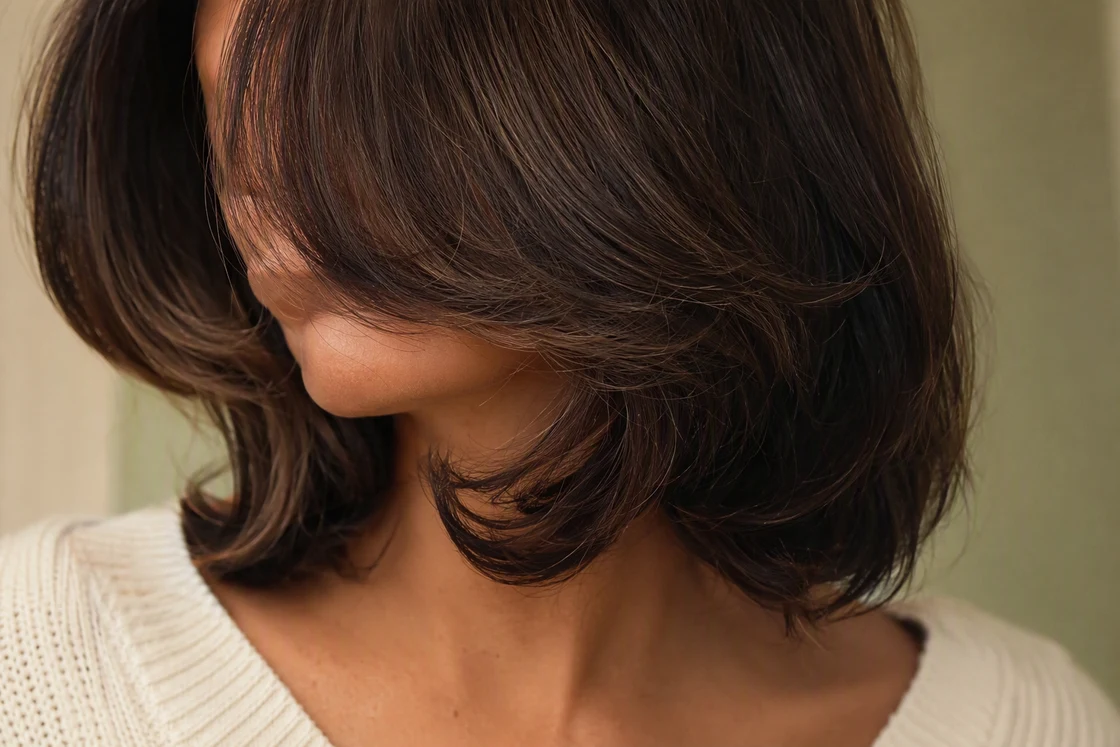
Curtain bangs spiked during the 2020 to 2021 grow-your-hair-at-home era, peaked as a trend, and then did something trend fringes rarely do: they stayed. Five years on they remain one of the highest-volume fringe searches in the US, because underneath the name is the most forgiving bang architecture that exists, adjustable to almost any face, and the only one with a built-in exit plan. This guide explains the mechanism, maps the face-shape conventions honestly, runs the density math for fine hair, and gives you the exact script to hand your stylist.
What exactly are curtain bangs?
Strip the name away and curtain bangs are a graduated, center-parted fringe. Three decisions define them, and every variation you have screenshotted is just a different setting of these three dials.
The part. The fringe splits at or near the center of the forehead, and each half sweeps outward toward the temple, which is where the curtain image comes from: two panels drawn open around the face [1][2].
The graduation. The shortest pieces sit at the center, and the length increases continuously toward the sides. The classic setting puts the shortest point around cheekbone level with the longest pieces blending into the hair at chin level or below, cut at roughly a 45 degree elevation so the ends stack into that short-to-long slope rather than a straight line [1].
The section. The hair that becomes the fringe is taken from a shallow triangle at the front hairline, usually no more than an inch deep. Deeper triangle, denser and more dramatic fringe; shallower triangle, softer and wispier. This dial matters more than any other for fine hair, and we will come back to it.
The style is old. It runs through 1950s and 1960s French cinema, Brigitte Bardot most famously, resurfaced with 1970s feathered cuts, and returned as a named trend in the late 2010s [3]. The 2021 spike had a practical engine: a fringe that parts in the middle and sweeps sideways is the one bang you can push out of your face during grow-out, which made it the lowest-risk experiment of the stay-at-home years. It also pairs naturally with the layered cuts that dominated the same period; the wing layers of the butterfly haircut are essentially curtain bangs continued down the face.
Do curtain bangs suit every face shape?
The honest frame first: face-shape matching is stylist convention, inherited from cosmetology training, not validated science. No controlled study shows that matching a fringe to a face shape changes how faces are rated. What the conventions reliably encode is geometry: where a cut places lines, angles, and volume on the face. Curtain bangs place diagonal lines from the center part down past the cheekbones, and an adjustable shortest point. That adjustability is why the convention answers “almost everyone” for this particular fringe [2], and why the interesting question is not whether but at what length.
| Face shape | Conventional setting | The mechanics behind it |
|---|---|---|
| Round | Shortest point at cheekbone or below | The pieces draw diagonals past the widest part of the face. Avoid ending the fringe exactly at the widest point of the cheek, which repeats that width. |
| Square | Longer, softer sweep past the jaw | Curved pieces passing the jaw corner lay soft diagonals over it. A fringe ending at jaw level underlines the corner instead. |
| Oval | Free choice, decide by hair type | Length and width are already balanced, so pick the setting your density and styling budget can afford rather than optimizing geometry. |
| Oblong or long | Shortest point higher, near the brow | A longer face benefits from the fringe adding horizontal interest higher up. Deep cheek-length curtains add more vertical line. |
| Heart | Shortest point at cheekbone, sweep to chin | The taper fills out the lower third. Pieces ending at cheekbone height repeat the widest line of the face. |
The three most-searched cases have full guides of their own: hairstyles for round faces covers the diagonal-line logic this fringe exploits, hairstyles for square faces explains why ends should pass the jaw rather than stop on it, and hairstyles for oval faces explains why “everything suits you” is true but unhelpful and what to optimize instead. Treat the table as a map of what each setting does, not a permission system. Every row is a starting point a good stylist will adjust after looking at your hairline, not your category.
Curtain, wispy, or full blunt: which fringe are you actually asking for?
“Bangs” covers three structurally different things, and salon disappointment usually starts with asking for one while picturing another. Curtain describes a shape, wispy describes a density, and blunt describes both at their maximum [1][3]. Here is the comparison that sorts them.
| Curtain bangs | Wispy bangs | Full blunt bangs | |
|---|---|---|---|
| Shape | Center part, shortest in the middle, graduated toward the temples | Any part or none; soft scattered pieces across the forehead | Straight-across dense panel, brow level |
| Skin show-through | Center of forehead only | Throughout, deliberately airy | None; opaque panel |
| Density required | Medium; adjustable via section depth | Low; the format is built for less hair | High; thin hair reads as gaps |
| Daily styling | 5 to 10 min round brush, or a velcro roller set | 1 to 2 min, fingers and a light product | 5 to 15 min; every kink shows in a straight line |
| Trim cadence | 6 to 8 weeks; grow-out is part of the design | 4 to 8 weeks, forgiving | 2 to 4 weeks to hold the line off the lashes |
| Grow-out | Graceful; sweeps into face-framing layers | Graceful; fades into layers | Awkward; months of pinning and headbands |
| Cowlick tolerance | Good if the cowlick is central, poor if off-center | Best of the three | Worst of the three |
Two practical notes. First, the categories combine: a wispy curtain bang, the curtain shape cut from a shallow section at low density, is a real and common request, and the correct one for fine hair. Second, the maintenance gap is the real decision for most people. A blunt fringe is a standing appointment every three weeks and a nemesis relationship with humidity. A curtain fringe survives a skipped trim, a windy day, and a growth spurt, which is precisely why it outlived its trend cycle [1].
Can fine hair afford curtain bangs?
This is where most curtain-bang coverage goes soft, so let us run the actual math. A fringe is not free hair. Every strand in it is transferred from the front section of your scalp, and the hair behind the fringe has to keep covering the territory it left.
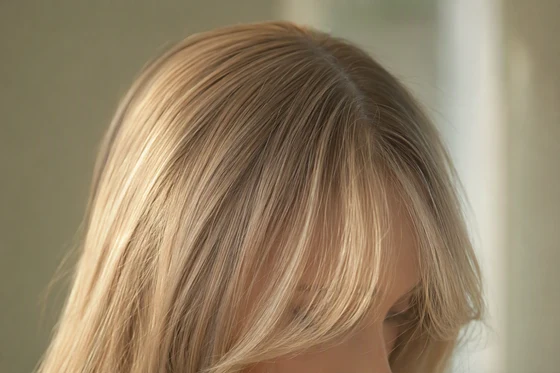
Measured scalp density varies enormously between individuals: phototrichogram studies put typical values in the low hundreds of hairs per square centimeter, with averages well over 200 in some populations and closer to 150 in others, before any thinning is factored in [5][6]. That spread is research-backed, and it means the same one-inch triangle section yields a lush fringe on one head and a see-through one on another. Density also declines with age and with conditions like female-pattern hair loss that concentrate exactly where a fringe is harvested, at the front and crown.
So the honest sorting question is not “do I want bangs” but “can my hairline pay for them.” Three tiers:
Medium to high density. The standard spec works as pictured. Take the full triangle, enjoy the movement.
Fine but not thinning. Ask for the wispy curtain version: a shallow section under an inch deep, longer shortest point at cheekbone level or below, ends point-cut so the fringe reads as intentionally airy [2]. You keep the sweep and the frame while spending perhaps half the hair. Resist the urge to deepen the section for more fullness; that fullness is borrowed from the layers behind it, and fine hair notices the loan.
Low density or visible thinning at the hairline. Skip the fringe. A sparse curtain bang draws the eye to exactly the region with the least coverage, and the density it consumes is density the rest of the style needs. This is not a styling failure, it is arithmetic, and there are better moves for the same goal: our guide to hairstyles for thin hair covers the full decision logic, including the face-framing layer shapes that deliver most of what a fringe delivers without the spend.
Why check your cowlick before you commit?
A cowlick is a patch of hair that grows in its own fixed direction, usually a whorl or a stubborn forward or sideways push at the hairline. Growth-pattern direction is largely set by biology, not habit: scalp whorl rotation has been studied as a genetically influenced trait, most visibly in a Genetics paper linking whorl direction and handedness in a common developmental mechanism [4]. Whether that specific model holds is mixed evidence, with later studies disputing the handedness link and pointing to additional factors, but the practical part is uncontested: the direction your front hairline grows is not something styling will permanently retrain.
For a fringe, that direction is destiny. Cut hair falls where its root points it, and a fringe is the one part of a haircut with nowhere to hide.
Curtain bangs are the most cowlick-tolerant of the classic fringes, with one big caveat about position. A cowlick at the center front can actually help: this fringe wants to split in the middle, and a stylist can set the part directly in the cowlick’s natural break so the growth pattern does the styling for you. A strong cowlick sitting off-center is the genuine problem. It will shove one curtain panel sideways or lift it off the forehead, and you will be renegotiating with it every single morning.
Run this two-minute check before you book. Push your hair straight forward onto your forehead while it is wet and watch what it does as it starts to dry. If it splits near the center, you are a natural candidate and should tell your stylist to part the fringe where it split. If it splits well off to one side, ask for a side-swept curtain variation with the part placed in that split, or for longer face-framing pieces instead of a true fringe. If a section at the front stands up or spirals no matter what, point it out in the consultation: an experienced stylist can sometimes cut length and weight around a cowlick to calm it, and will tell you honestly when they cannot.
How do you style curtain bangs, and what does it cost every morning?
The inspiration photos show one specific finish: fringe swept back and away from the center part with a rounded bend at the ends. That finish is produced, not grown, so budget for it honestly.

The reference method: round brush, 5 to 10 minutes. On damp hair, blow-dry the fringe forward first to kill any parting memory, then wrap each half around a medium round brush and dry it back and away from the center, finishing with a blast of cool air to set the bend [1][2]. On straight and wavy hair this is the whole job, and with practice it is closer to five minutes than ten.
The passive method: one velcro roller, 15 to 20 minutes of not-your-time. Rough-dry the fringe, roll the whole thing up and back in a single large velcro roller, and go do something else: makeup, coffee, inbox. Body heat and evaporation set the shape. Total hands-on time is under two minutes, which makes this the best effort-to-result ratio in fringe styling.
Air-dry variants. If your hair has natural wave or curl, part the fringe where it wants to split, twist each half loosely away from your face while damp, and leave it alone. The result is softer and less lifted than the blowout, a bent sweep rather than a bouncing one, and on textured hair it is the correct target: diffuse or air-dry and let the fringe stack as curl, since brushing curl straight only to bend it again costs time and frizz. Curly hair has one non-negotiable at the salon, not the mirror: the fringe must be cut or checked dry, because shrinkage can lift a wet-cut cheekbone length to mid-forehead.
Between washes, curtain bangs are cheap to reset. The fringe picks up oil from your forehead faster than the rest of your hair, and the fix is washing or wetting just the fringe at the sink, thirty seconds, then styling as above. Dry shampoo at the fringe roots buys another day.
How do curtain bangs grow out?
Every fringe is a contract, and the exit clause is where curtain bangs beat everything else. Ask anyone who has grown out blunt bangs: months of a horizontal shelf that cannot be tucked, pinned back through every photo. Curtain bangs skip that stage entirely, because the shape they grow into is the shape they already are.
The mechanics: the pieces are angled from a short center point toward the temples, so growth just slides the whole slope downward. Cheekbone-length pieces reach the chin in roughly three to four months at typical growth rates of about half an inch a month, at which point the fringe has become face-framing layers without a single awkward week [1]. Longer settings get there even faster. This is the trade coverage’s consistent observation and it matches the geometry: the outer pieces are already blended into the lengths, so there is no line to erase [1][2].
Managing the grow-out well takes two things. First, one or two shaping trims along the way, not to shorten the fringe but to keep its ends blended into your layers as it descends; a $10 to $25 bang trim, free at many salons between full cuts, does it. Second, styling continuity: keep round-brushing or rolling the growing pieces back and they read as intentional face-framing at every length. This exit plan is also the reason curtain bangs are the correct first fringe. If you love them, you maintain a 6 to 8 week trim cycle. If you do not, you simply stop, and four months later the experiment has erased itself.
How do you ask your stylist for curtain bangs?
“Curtain bangs” alone is not a spec; stylists interpret the term differently, and the same words have produced brow-length wisps and jaw-length panels [1]. Give the shape a number at each dial. Screenshot the script that matches you.
The standard spec, medium or thick hair:
“Curtain bangs, parted at the center. Shortest point at my cheekbones, longest pieces blending into my hair at chin level. Triangle section about an inch deep behind my hairline. Point-cut the ends so they are soft, not a hard line, and please err on the long side, we can always take more.”
The fine-hair version:
“Wispy curtain bangs. Keep the section shallow, well under an inch, so the fringe stays airy and I keep density in my lengths. Shortest point at cheekbone level or a touch below, blended into face-framing pieces at the chin. Soft point-cut ends, and cut conservatively.”
The cautious first-timer version:
“Curtain bangs on a trial setting: shortest point at mouth level, blending to chin, shallow section. If I love them I will come back and take the center up to my cheekbones.”
The curly version:
“Curtain bangs cut dry, in my natural texture, with every length judged as a dry length. Shortest point where it visually hits my cheekbone after shrinkage, and cut longer than it needs to be on the first pass.”
Two consultation notes. Bring the cowlick check result from above and say where your hairline splits, because part placement should follow growth, not fashion. And expect honest pricing: adding a fringe during a regular cut is usually free to $15, a standalone first-time bang appointment runs about $20 to $45 depending on market, and the ongoing cost is the trim cadence, 6 to 8 weeks if you keep them sharp, longer if you are letting the grow-out run.
The bottom line
Curtain bangs earned their staying power mechanically: a center-parted, graduated fringe with an adjustable shortest point fits almost any face geometry, tolerates central cowlicks, and grows out into face-framing layers instead of an awkward shelf. The conventions about face shape are conventions, useful as a map of where the lines land, and the real gatekeepers are practical: enough hairline density to fund the section, a cowlick that splits somewhere workable, and five honest minutes of round-brush or roller time most mornings. Fine hair should take the wispy, shallow-section version or skip the fringe in favor of face-framing layers. If you commit, commit with numbers, cheekbone to chin, shallow triangle, soft ends, cut long, because the difference between the fringe you screenshotted and the one you get is almost always a missing measurement.
Frequently asked questions
Do curtain bangs suit everyone?
Nearly, and that is a mechanical fact rather than flattery. Because the shortest point of the fringe is a free variable, from cheekbone to chin, the cut can be tuned to almost any face: shorter center pieces for longer faces, longer sweeping pieces for rounder ones. The real disqualifiers are not face shapes. They are very low hair density, a strong cowlick sitting off-center at the front hairline, and an honest unwillingness to spend five minutes on styling most mornings.
Do curtain bangs work on a round face?
Yes, and they are one of the most commonly recommended fringes for round faces in stylist convention. The mechanics: the pieces run diagonally from the center part down past the cheekbones, placing angled lines over the widest part of the face instead of a horizontal line across the forehead. Ask for the shortest point at cheekbone level or below. A fringe that ends right at the widest point of the cheek repeats that width rather than cutting across it.
Are curtain bangs good for thin or fine hair?
Only in a moderated form. A fringe is paid for with hair moved from behind the hairline, and hair that starts at low density may not afford a full triangular section. The workable version is a shallow section, less than an inch deep, cut into longer wispy pieces starting at cheekbone level, so the forehead shows through and the fringe reads as deliberately airy rather than sparse. If your hairline is visibly thinning, skip the fringe and put your density elsewhere.
What is the difference between curtain bangs and wispy bangs?
Curtain bangs describe a shape: center-parted, shortest in the middle, graduated longer toward the temples, sweeping sideways. Wispy bangs describe a density: thin, airy pieces across the forehead that let skin show through, with no required part or sweep. The two overlap, and a wispy curtain bang, meaning the curtain shape cut at reduced density, is the standard adaptation for fine hair. A full blunt bang is the opposite of both: a dense, straight-across panel that needs the most hair and the most maintenance.
How do I ask my stylist for curtain bangs?
Name the shape and give numbers: 'Curtain bangs, parted at the center, with the shortest pieces hitting my cheekbone and the longest blending into my layers at chin level. Keep the section shallow, about an inch behind my hairline, point-cut the ends soft, and err on the long side.' If your hair is curly, add that you want them cut dry. If your hair is fine, ask for a shallower section and wispy density.
How long do curtain bangs take to style every day?
Five to ten minutes on straight and wavy hair for the reference finish: rough-dry the fringe forward, then round-brush it back and away from the center part, or set it in one large velcro roller for 15 to 20 minutes while you do something else. Air-dry versions exist and cost less time, but they produce a flatter, more undone sweep. Budget zero minutes only if your hair has enough natural bend to fill the shape on its own.
How do you grow out curtain bangs?
Mostly by waiting, which is the honest answer and the reason this fringe is a low-regret choice. Because the pieces are already angled toward the temples, growth moves them smoothly from cheekbone to chin to face-framing layers with no horizontal line to push aside. At roughly half an inch of growth a month, the fringe reaches chin level in about three to four months. One or two shaping trims along the way keep the ends blended into your layers.
Can I trim curtain bangs myself between appointments?
Dusting the ends, yes, with sharp scissors, on dry styled hair, cutting vertically into the ends rather than straight across, and removing less than you think you should. Recreating the graduation, no. The shape depends on the angle of the original cut, and a horizontal home trim converts curtain bangs into uneven blunt bangs in one snip. Many salons offer bang trims for free or $10 to $25 between full cuts, which is cheap insurance.
Do curtain bangs work if I have a cowlick?
It depends on where the cowlick sits. A cowlick at the center of the front hairline can actually cooperate, because curtain bangs part in the middle anyway; a good stylist will place the part in the cowlick's natural split. A strong cowlick sitting off-center is the real problem: it will push the fringe to one side and fight the symmetry daily. Test before you cut: push wet hair forward onto your forehead and watch where it insists on splitting.
- Hairdressers Journal International. Types of Fringes: The Styles Your Clients Are Asking For. HJI. 2026.
- John Frieda. The Ultimate Guide to Curtain Bangs. JohnFrieda.com.
- Bangs (hair). Wikipedia. Accessed 2026.
- Klar AJ. Human handedness and scalp hair-whorl direction develop from a common genetic mechanism. Genetics. 2003;165(1):269-76.
- D'Amico D, Vaccaro M, Guarneri F, Borgia F, Cannavo S, Guarneri B. Phototrichogram using videomicroscopy: a useful technique in the evaluation of scalp hair. European Journal of Dermatology. 2001;11(1):17-20.
- Alsharif SH, AlGhamdi KM. Evaluation of Scalp Hair Density and Diameter in the Arab Population: Clinical Office-Based Phototrichogram Analysis. Clinical, Cosmetic and Investigational Dermatology. 2022.