Cuts by hair type
Hairstyles for Fine and Thin Hair: Cuts That Build Real Volume
Fine hair means each strand is narrow; thin hair means fewer strands per square centimetre, and the right cut depends on which one you have. Cuts with a blunt, minimally layered perimeter build the most apparent volume, because they stack every end into one dense line while removing the hanging weight that pulls roots flat. Long, heavily layered cuts do the opposite: they spread limited hair across a larger silhouette.
Most advice for thin hair fails at the first step: it never asks whether your hair is actually thin. Fine hair and thin hair are two different measurements, they respond to different cuts, and a style that rescues one can visibly worsen the other. This guide starts with that diagnosis, then works through the cut families by length, with the mechanics of why each one builds or destroys apparent volume, and finishes with what styling products can and cannot do, stated honestly.
Is your hair fine, thin, or both?
Fine describes the strand. Thin describes the crowd.
Fine hair means each individual fiber has a narrow diameter. Scalp hair diameters run from under 60 microns for genuinely fine strands to over 80 for coarse ones, and the diameter you grow is mostly set by genetics: a large in vivo study across 24 ethnic groups found Asian hair grows the thickest fibers, African hair the most elliptical, and Caucasian hair spans a wide fine-to-medium range [3]. Fine hair can be extremely abundant. Plenty of people with fine strands have high density and enormous total hair mass; their problem is limpness under weight, not coverage.
Thin hair means low density: fewer strands growing per square centimetre of scalp. Density is the number that most strongly drives how much hair other people perceive you to have [2], and it declines with age in a way diameter does not fully explain. The largest study on this, measuring over 1,400 Caucasian women, found strand diameter rises until roughly the early-to-mid 40s and then falls, while density is already at its peak in the 20s and declines steadily from there [1]. The same study proposed a combined metric, “hair amount,” precisely because neither number alone predicts what the mirror shows. All of this is research-backed, and it is the reason “volumizing” advice that ignores the distinction so often disappoints.
The quick self-test: roll a single dry strand between your fingertips. If you can barely feel it, your strands are fine. Then look at your part under bright light and compare it with photos from ten years ago: a widening part, a shrinking ponytail circumference, or visible scalp at the crown are density signals. Fine plus dense wants weight removed and lift created. Thin, at any strand diameter, wants every remaining strand kept and concentrated. Both at once, the hardest case, wants short, blunt and simple. If your part is widening quickly or you are shedding in clumps, that is a dermatologist conversation before it is a haircut conversation; progressive density loss has medical workups and treatments that no stylist can substitute for [2].
What actually makes hair look fuller?
Three mechanical levers, and every good cut for fine or thin hair pulls at least one of them.
Cut the cantilever. A strand of hair is a beam anchored at one end, loaded by its own weight. The longer the strand, the more load it transfers back to the root, and the flatter it lies against the scalp. Shorten the strand and the load drops, so the same follicle, producing the same fiber, sits with visible lift. This is why the identical head of hair looks fuller at the jaw than at the bra strap.
Stack the perimeter. When every strand is cut to the same length, all the ends arrive at one edge together, forming a single dense line. That line is the thickest-looking part of any cut, and a blunt perimeter puts your entire density budget into it. Every layer you add withdraws strands from that edge and scatters them higher up the silhouette.
Shrink the silhouette. Apparent density is strands divided by the area they cover. Concentrate the same hair into a smaller, tighter shape and coverage reads fuller; stretch it over a long, layered outline and it reads sparse. This is arithmetic, not styling talent.
Keep those three levers in mind and the rest of this page is just applications.
What are the best short haircuts for fine hair?
Short is the strongest length for low density, because it pulls all three levers at once: minimal hanging weight, a compact silhouette, and a perimeter close enough to the scalp that the ends never get a chance to go wispy.
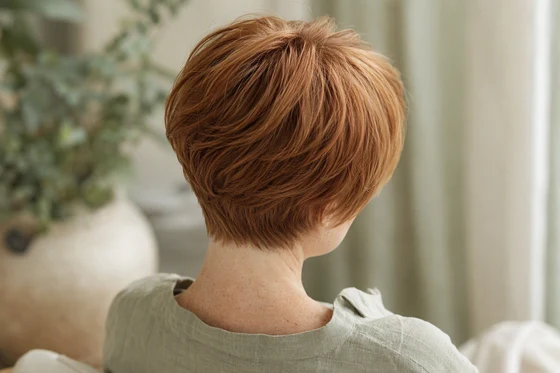
The soft long pixie leaves 3 to 5 inches through the top with gently graduated sides. The top length gives strands something to lie against, so coverage builds in overlapping shingles, while the short back and sides remove most of the total weight. It is the workhorse for fine hair with modest density. Avoid heavy texturizing here: every point-cut piece is hair removed from a budget that is already tight. Styling runs 5 to 8 minutes, a rough-dry with a golf-ball of root-lift mousse.
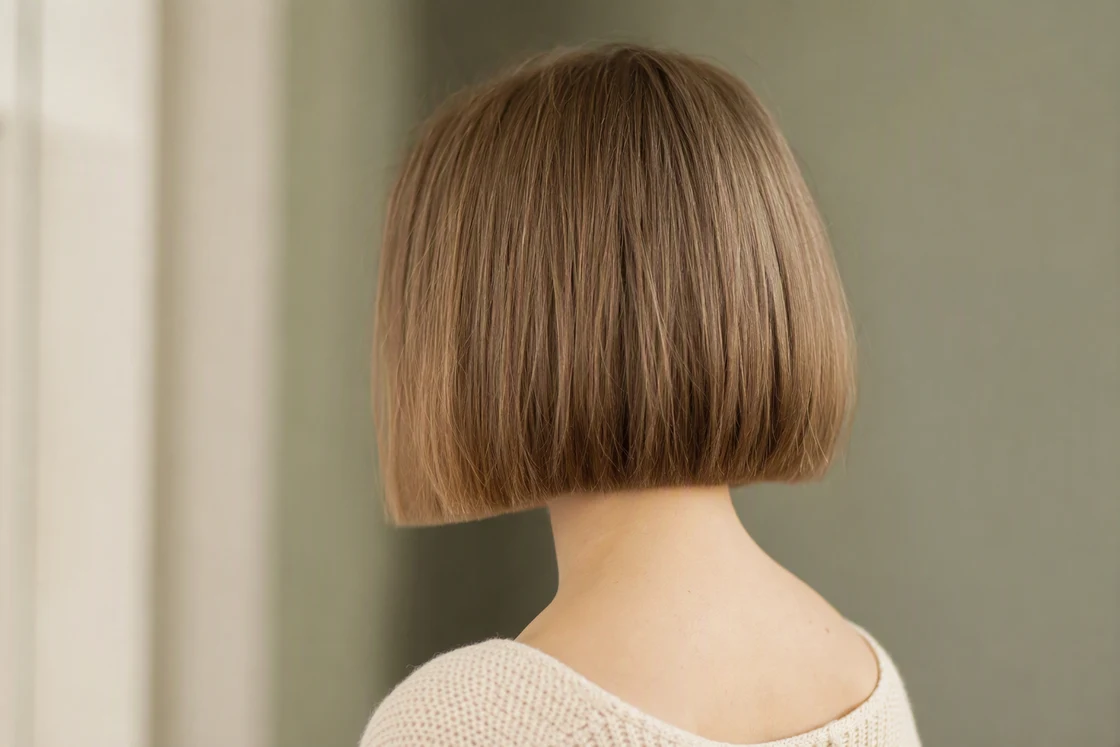
The cropped or French bob, jaw to chin length, is the entry point if a pixie feels too committal. The blunt line is the entire mechanism: it stacks your ends into one edge, which is why stylist convention treats the blunt bob as the default prescription for fine hair, a convention that happens to agree with the physics. Cost honesty: a sharp French bob wants smoothness, which means 10 to 15 minutes with a round brush on most textures, and a trim every 6 to 8 weeks at roughly $45 to $90 US per visit to keep the line sharp.
If you are over 50 and weighing short options in more depth, our dedicated guide to short hairstyles for women over 50 compares the pixie, crop bob and shag by density and styling time.
Why is the bob the default answer for thin hair?
Because it is the longest cut that still keeps the perimeter dense. Between the jaw and the collarbone, a one-length bob holds enough hair at the bottom edge to read as a solid line, while staying short enough that hanging weight has not yet flattened the crown. It is the compromise point on the length-versus-density curve, which is why nearly every stylist reaches for it when a client says “fine” or “thin.”
Within the family, the choices that matter for low density:
- Blunt, one-length bob: maximum perimeter stacking. The best single option for genuinely thin hair. Ask for scissors-only; razoring tapers each end and defeats the purpose.
- A-line or angled bob: slightly longer at the front. The angle keeps the front pieces substantial around the face while the shorter back sits fuller. A good pick if you want the front length to tuck.
- Stacked bob: short graduated layers through the back. This one is for fine-but-dense hair wanting crown lift; on low density the stacking can expose the nape. Say which problem you have.
Chin, jaw or collarbone, with or without fringe, and how each version behaves on different textures is a full article of its own: see our comparison of bob lengths and shapes for the family tree. On the fringe question specifically, be aware that a full blunt fringe is purchased with density: the hair that fills it is borrowed from up to a few inches behind the front hairline. On thin hair that loan can leave the crown sparser. A wispy curtain fringe costs less hair but also delivers less presence; on truly low density, skipping the fringe keeps your budget where it counts.
Can mid-length and long hair work on fine or thin hair?
Mid-length can, with discipline. Long is possible, but you should take it on with open eyes about what it costs.
The collarbone cut, one length. At collarbone, hanging weight is real but not yet punishing, and a blunt edge still stacks convincingly. Keep layering to almost nothing: at most a whisper of face-framing that starts below the chin. This is the longest cut this page can recommend for thin hair without caveats.
Long, soft layers on fine-but-dense hair only. If your strands are fine but your density is good, a mid-length cut with a small number of long, subtle layers can add swing without emptying the perimeter, because you have strands to spare. The currently popular butterfly haircut, with its short face-framing tiers over longer lengths, sits in this category: it is engineered for medium-to-high density and it spends hair freely. On genuine thinness it reads stringy within a week of the salon blow-dry. Read the linked guide before you bring that photo in.
Past the collarbone on thin hair. Every inch past the collarbone adds root-flattening weight and stretches a fixed number of strands over more silhouette, and the ends, the oldest and most weathered part of each fiber, thin out first [4]. If length is non-negotiable, the least-bad configuration is one blunt length, no layers, trimmed on schedule so the perimeter never goes translucent, worn with root lift at the crown to fight the weight you have chosen to keep. That is a legitimate choice, it just is not a volume strategy.
Do layers make thin hair look thinner?
Usually, yes, and this is the single most common mistake in the chair. The question deserves a mechanical answer rather than a fashion one.
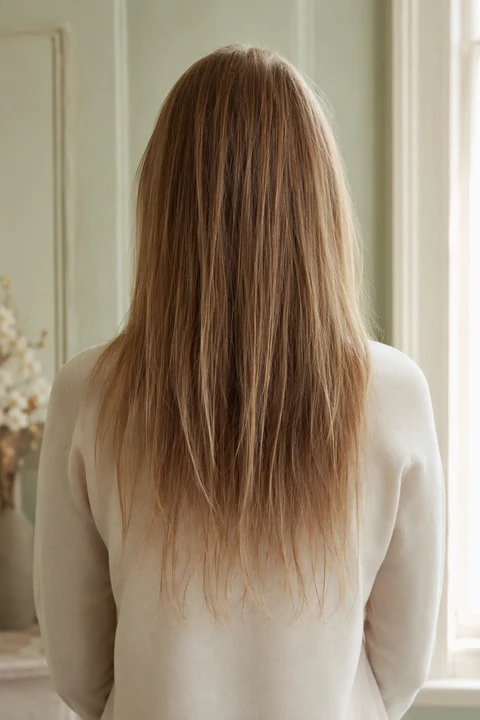
A layer is a withdrawal from the perimeter. Every strand cut shorter is a strand that no longer reaches the bottom edge, so the dense line that makes a cut read thick gets sparser with each pass of the scissors. On high density this is fine, there are strands to spare, and the withdrawal buys movement. On low density the perimeter goes see-through, the layers themselves are too thinly populated to hold a shape, and the whole cut collapses into wisps. Long, heavy layering on thin hair spreads the least hair over the most silhouette: the worst possible configuration.
The narrow exception: short, internal layers confined to the crown on hair that is fine but dense. There, layering removes weight from exactly the spot that needs lift, and density is high enough that the perimeter survives the withdrawal. This is a scalpel, not a default.
The same logic condemns the other subtractive habits. Thinning shears and over-texturizing remove bulk fine hair does not have; on thin hair they create the frizz halo of short broken-looking pieces that never rejoin the perimeter. Razor cutting tapers every end to a point, which is the exact opposite of a stacked edge. If a stylist reaches for thinning shears on hair you have described as fine or thin, that is your cue to speak up. The blanket rule “never thin fine hair” is stylist convention rather than trial-tested science, but it follows directly from arithmetic the studies do support [1][2].
Which cut family fits your situation?
| Cut family | Best for | Apparent-density payoff | Daily styling | Trim cadence |
|---|---|---|---|---|
| Soft long pixie | Fine, low-to-medium density | High: minimal weight, shingled coverage | 5-8 min | 4-6 weeks |
| Blunt French/crop bob | Fine or thin, straight to wavy | Highest: full perimeter stack | 10-15 min | 6-8 weeks |
| A-line bob | Thin, wants front length | High | 10-15 min | 6-8 weeks |
| Stacked bob | Fine but dense, flat crown | Medium-high | 10-15 min | 5-7 weeks |
| Collarbone cut, one length | Fine or thin, wants length | Medium | 10-20 min | 8-10 weeks |
| Long soft layers / butterfly | Fine but dense only | Low on thin hair, medium on dense | 15-25 min | 8-12 weeks |
| Long one-length past collarbone | Length as priority | Low | 15-30 min | 10-12 weeks |
Payoff and minutes are estimates for typical hair; strong natural wave shifts every row toward easier, and very straight, slippery fiber shifts it toward the blow-dryer.
What changes for fine and thin hair over 50?
The data says: quite a lot, and predictably. Density has been declining since the 20s, strand diameter joins the decline from the mid 40s [1], and around menopause, falling estrogen alongside steady androgen exposure shortens the growth phase in many women, so strands shed at shorter maximum lengths and the ponytail slims from both ends of the equation [5]. The fiber itself also weathers: decades of washing, heat and UV roughen the cuticle, and graying often changes texture along the way [4]. This is research-backed and it is normal biology, not a personal failing.
The practical consequence is that the advice on this page applies with more force, not different direction. The blunt-perimeter rule matters more because there are fewer strands to stack. The layering warning matters more because the density budget is smaller. Length costs more because each strand is finer and bends more easily under the same load. Most women who loved long layers at 35 get a better return from a collarbone cut at 55 and a jaw-length blunt bob at 65, not because of any rule about age, but because the inputs to the same equation have changed.
For the full length-by-length treatment, including color and texture decisions, start with our complete guide to hairstyles for women over 50. And if your goal is the broader question of which cuts read as fresher rather than heavier, haircuts that make you look younger covers the proportion and perimeter logic in detail.
What can styling do that the cut cannot?
A cut sets the ceiling; styling decides how close you get to it each morning. In rough order of payoff per minute:
Root direction, nearly free. Hair dries in the position it holds while the last water leaves. Rough-dry your roots while pushing them against their growth direction, or flip your part to the other side, and the roots cross over their neighbors instead of lying flat in their trained groove. Cost: zero dollars, two minutes. This is the highest-return habit on this list.
Root-lift mousse or spray, then heat. Polymer products coat the fiber and stiffen it slightly, helping roots hold the lifted position you dried them into. $8 to $20 US, adds two or three minutes. Velcro rollers at the crown while you do your makeup do the same job without more heat.
Dry shampoo between washes. Sebum is a weight and an optical smoother: it glues neighboring strands into thicker-looking but fewer-looking bundles and flattens the root. Powder absorbs it and adds friction between strands, so they stand apart. On fine hair this often buys more visible volume than any wet-styling product.
Density powders and fibers. Tinted keratin fibers or powder cling to existing strands and shade the scalp so contrast drops and coverage reads fuller. They are the cosmetic with the most dramatic before-and-after for visible-scalp areas like a widening part, $20 to $30 US a canister, and they last until the next wash. Two honest caveats: they need existing hair to cling to, so they fade in ability exactly where loss is most advanced, and they transfer onto pillowcases and pale collars if over-applied.
“Thickening” leave-ons, labelled honestly. The best evidence for a cosmetic diameter change comes from a controlled study of a leave-on combining caffeine, niacinamide, panthenol, dimethicone and an acrylate polymer, which thickened existing terminal fibers by 2 to 5 microns, roughly a 10 percent gain in cross-sectional area, and improved their resistance to breakage [6]. That is a real, measured effect, and it is also modest, temporary and industry-funded, with little independent replication; for the category as a whole the evidence is mixed evidence. Volumizing shampoos mostly work by removing conditioning residue rather than adding anything. None of these products changes what your follicles produce. For actual regrowth chemistry, the conversation is minoxidil and a dermatologist, not a shampoo aisle [2].
What should you say in the chair?
Screenshots welcome. The words below tell the stylist what a photo cannot: which problem you have and what you refuse to trade away.
- Diagnosis first: “Before we pick a cut, can you look at my density at the part and crown and tell me whether my hair is fine, low-density, or both? I want the cut chosen for that, not for a photo.”
- Blunt bob for thin hair: “A one-length bob at [jaw / chin / collarbone], blunt perimeter, scissors only. No layers, no razor, no thinning shears anywhere. The strongest possible bottom line is the whole point.”
- Soft pixie for fine hair: “A longer pixie, four to five inches on top, soft graduation at the sides. Please keep the top full rather than texturized; I need every strand for coverage.”
- Mid-length with discipline: “One length at the collarbone with the smallest amount of face-framing that starts below my chin. If a layer would thin the bottom edge, skip it.”
- The refusal script: “Please do not use thinning shears or a razor on my hair, even for the ends. If the cut needs weight removed, tell me first and show me where.”
Then add your two budgets out loud: minutes per morning and weeks between trims. A cut that assumes fifteen minutes of round-brushing you will never do is the wrong cut, however good it looked leaving the salon.
The bottom line
Work out whether your hair is fine, thin, or both before you change anything, because the two problems pull the scissors in different directions. Then favor cuts that stack your ends into one dense perimeter and shed hanging weight: a blunt bob is the reliable center of the target, a soft pixie the stronger move at low density, a disciplined collarbone cut the longest safe option. Be skeptical of long, heavy layering and of any tool that tapers or thins your ends, and treat volumizing products as useful styling aids with modest, temporary, partially proven effects. Your follicles set the raw numbers; the cut decides how much of them the mirror gets to see.
Frequently asked questions
What is the difference between fine hair and thin hair?
Fine hair describes the diameter of each individual strand: the fiber itself is narrow. Thin hair describes density: fewer strands growing per square centimetre of scalp. You can have fine, dense hair, coarse, sparse hair, or both problems at once, and the best cut differs for each. Diagnose which you have before choosing a style, because advice for one can backfire on the other.
Do layers make thin hair look thinner?
Long, heavy layers usually do, because each layer removes hair from the bottom edge and spreads a limited number of strands across a taller silhouette, so the ends go wispy. Short internal layers on fine but reasonably dense hair can do the opposite by adding lift at the crown. The rule of thumb: the lower your density, the fewer and shorter your layers should be.
Does cutting hair shorter make it look thicker?
Within limits, yes. A strand of hair is a weight hanging from its root, so removing length removes the load that pulls the root flat, and the same strands sit with more lift. A shorter perimeter also concentrates your ends into a smaller, denser edge. The effect is real but mechanical: no cut adds strands, it only redistributes the ones you have.
Should fine hair be cut blunt or layered?
Blunt, in most cases. Cutting every strand to one length stacks all the ends into a single dense line, which makes the perimeter read thick even when individual strands are narrow. Layering fine hair thins that edge. The main exceptions are fine hair with strong natural wave, which can carry a few long, soft layers, and fine but dense hair that wants crown lift.
What is the best haircut for thin hair over 50?
The strongest candidates are a blunt bob between the jaw and the collarbone, a soft long pixie, and a minimally layered collarbone cut. Strand diameter in Caucasian women peaks around the early-to-mid 40s and density declines from the 20s onward, so most heads carry measurably less hair mass after 50. Shorter, blunter perimeters spend that remaining mass where it shows.
Do volumizing shampoos and products actually work?
Partially, and temporarily. One controlled study found a leave-on combination of caffeine, niacinamide, panthenol, dimethicone and a polymer thickened existing strands by 2 to 5 microns, roughly a 10 percent gain in cross-sectional area. That is measurable but modest, it washes out, and it does not create new hair. Treat volumizing products as styling tools, not treatments.
How often should fine or thin hair be trimmed?
Every 6 to 8 weeks if you wear a blunt bob or pixie, because those cuts carry their volume in a sharp perimeter that blurs as it grows. A longer one-length cut can stretch to 10 or 12 weeks. Skipping trims on fine hair is a false economy: the ends wear thin first, and a see-through perimeter undoes exactly the density effect the cut was built for.
Is long hair bad for thin hair?
It works against it mechanically. Length adds hanging weight that flattens the root, and low density stretched over more inches leaves fewer strands at the ends, which is where thinness shows first. If you keep length, keep it one blunt length at or above the collarbone-to-chest range, skip long layering, and accept that the trade-off costs some root lift.
- Robbins C, et al. What women want: quantifying the perception of hair amount, an analysis of hair diameter and density changes with age in caucasian women. British Journal of Dermatology. 2012;167(2):324-332.
- Birch MP, Messenger JF, Messenger AG. Hair density, hair diameter and the prevalence of female pattern hair loss. British Journal of Dermatology. 2001;144(2):297-304.
- Loussouarn G, et al. Diversity in human hair growth, diameter, colour and shape. An in vivo study on young adults from 24 different ethnic groups observed in the five continents. European Journal of Dermatology. 2016;26(2):144-154.
- Trüeb RM. Aging of hair. Journal of Cosmetic Dermatology. 2005;4(2):60-72.
- Grymowicz M, et al. Hormonal effects on hair follicles. International Journal of Molecular Sciences. 2020;21(15):5342.
- Davis MG, et al. A novel cosmetic approach to treat thinning hair. British Journal of Dermatology. 2011;165(Suppl 3):24-30.