Hair after 50
Hairstyles for Women Over 50: Choose by Hair, Not by Age
The best haircuts after 50 are decided by what your hair is doing now: its density, its texture, where it is in the gray transition, and how much styling time you want to spend. Age itself sets no rules. This guide maps specific cut families to each of those factors so you can choose from your situation, not from a birthday.
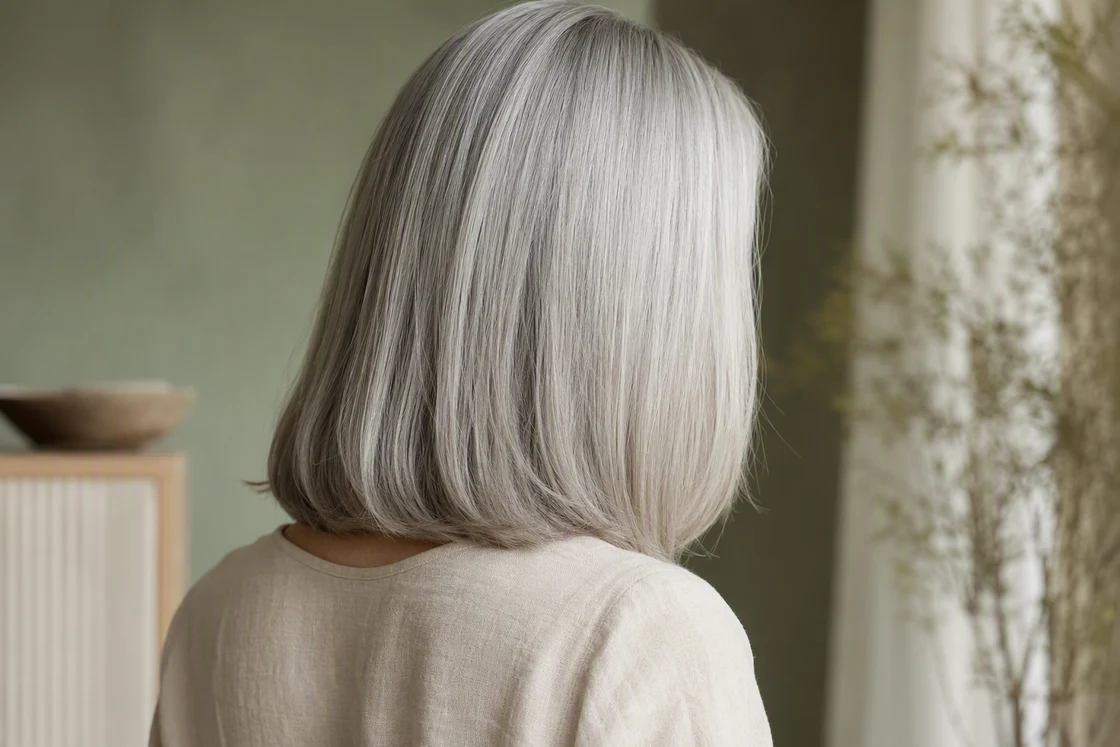
Most guides to hairstyles after 50 start from a rule: cut it short, add layers, get bangs. This one starts from your hair. Density, texture, gray progression, and how many minutes you want to spend on styling each morning decide which cuts will work for you. Age does not. Two 55-year-olds can have completely different hair situations, and the same woman can move through three different situations between 50 and 70. So the useful question is not “what should a woman over 50 wear” but “what is my hair doing right now, and which cuts are built for that.”
Here is the short version. If your density has dropped, cuts that concentrate hair (blunt bobs, pixies, one-length lobs) serve you. If gray has changed your texture, cuts with room for the new wire and wave serve you. If you want your mornings back, cuts matched to your natural texture serve you. And if your density is strong and you like length, long hair serves you at any age, whatever the convention says. The rest of this guide is the detail: what actually changes in the fiber, a decision table, and a section on each cut family with its costs spelled out.
What actually changes in hair after 50?
Four things, and they are measurable. Knowing which of them apply to you is the whole game, because each one points to different cuts.
Density declines. The number of hairs per square centimeter of scalp falls steadily through adult life. In a study of 1,099 Caucasian women aged 18 to 66, hair density was highest in the youngest group and decreased with age at an accelerating rate [1]. This is research-backed and it is the single biggest driver of “my hair feels thinner.” Fewer fibers means less visual mass at any length, and the loss shows most at the ends, where a long cut spreads the remaining hair over the greatest distance.
Fiber diameter changes. Individual hair shafts do not stay the same width. In women, average fiber diameter increases into the early-to-mid 40s, peaks around age 40 to 46, and then declines [1]. Through the 30s, thickening fibers partly offset falling density, which is why many women do not notice change until later: after the diameter peak, both numbers move the same direction at once. Thinner fibers bend more easily, hold less curl, and contribute less bulk per hair. This is also research-backed and it explains why a cut that worked at 42 can stop working at 56 even with the same stylist and the same technique.
Hormonal shift accelerates both. Estrogen extends the growth phase of the hair cycle. When ovarian estrogen production winds down at menopause, the relative influence of androgens rises, growth phases shorten, and some follicles begin miniaturizing: producing progressively finer, shorter hairs [3]. In a cross-sectional study of postmenopausal women, female pattern hair loss was present in 52 percent, most of it mild, with prevalence rising with age and years since menopause [2]. Female pattern loss usually presents as diffuse thinning over the crown and a widening part rather than the bald spots seen in men, and the frontal hairline often thins at the temples while the overall line holds [3, 4]. If your part looks wider or your ponytail circumference has shrunk, this is the likely mechanism, and it is common enough to be close to the default.
Gray fiber is different fiber. Graying is not just a color change. Fibers that have lost pigment show altered lipid content, reduced luster, and frequently increased curvature: the familiar wiry, springy strands that stand away from the rest [5]. The scalp also produces less sebum with age, so there is less natural oil to soften and weight the fiber [4, 6]. The practical result is that gray and white hairs are often drier, coarser-behaving, and less willing to lie flat, even when the fiber itself is not literally thicker. A head moving from 10 percent gray to 60 percent gray is changing texture, not just color, and cuts should be chosen for the incoming texture.
That is the biology. Notice what is not on the list: any finding that particular lengths or shapes stop working after a particular birthday. The research describes fiber and follicle changes. Everything about which cuts to wear on top of those changes is styling judgment, and this guide tags it as such.
How do you actually choose? Density, texture, maintenance budget
Three questions decide the cut family. Answer them honestly, in order.
1. What is your density doing? Grab your ponytail or look at your part in flat light. If density is stable, every length is open to you. If it has dropped, the math favors concentration: shorter or blunter shapes that stack your remaining fibers into a smaller, denser-reading silhouette.
2. What is your texture now? Not what it was at 35. If gray has brought wave, wire, or dryness, the cut needs to accommodate the new behavior. Cutting for the texture you used to have is the most common consultation mistake.
3. What is your maintenance budget? Minutes per morning and weeks between salon visits. A pixie costs little daily time but needs trims every 4 to 6 weeks. Long one-length hair needs almost no salon time but more daily handling. There is no free cut; there are only different bills.
The table below maps the common situations to the cut families that serve them. It is a starting point for a consultation, not a verdict.
| Your situation | Cut families that serve it | Why it works |
|---|---|---|
| Fine and thinning all over | Blunt chin-to-collarbone bob, cropped pixie | Concentrates fibers, blunt perimeter reads dense |
| Fine but still dense | Lob, long bob, one-length with face framing | Density supports length; blunt ends keep the mass |
| Thick, coarsening with gray | Layered bob, layered medium lengths | Internal weight removal channels the extra texture |
| Wavy or curly, drier than before | Layered medium cut to the wave, curly shapes cut dry | The cut follows the pattern instead of fighting it |
| Growing out color to gray | Pixie or short bob during transition | Shortens the grow-out from years to months |
| Temple or hairline thinning | Curtain bangs, side-swept fringe, deep side part | Longer soft fringe covers without needing frontal density |
| Minimal styling time wanted | Texture-matched pixie, air-dry bob | Cut engineered to fall into place from wet |
| Strong density, wants length | Long one-length or long layers | Nothing in the biology argues against it |
Everything below expands each family: who it serves, what it costs, and where the evidence stops and convention begins.
What do short cuts actually do?
Short cuts solve a density problem and a time problem at once, which is why they are so common after 50, and also why they got mistaken for a rule.
The pixie family. A pixie concentrates all of your hair into a few inches of length, so every fiber contributes to the visible shape. For fine or thinning hair, this is the strongest concentration play available: the difference between low density at 20 inches and low density at 2 inches is dramatic, because the short version never asks the hair to cover distance it cannot cover. Pixies come in ranges: a cropped pixie sits tight to the head and suits fine, straight fiber; a longer, textured pixie leaves 3 to 4 inches on top and gives wave or wire somewhere to go; a soft pixie with longer sides eases the transition for anyone nervous about the jump. Daily cost is minimal, usually under five minutes. Salon cost is the highest of any family: a pixie loses its shape in 4 to 6 weeks and there is no hiding an overgrown one. If you want a cut that looks finished with zero effort, this is it. If you dread frequent appointments, it is the wrong economy.
The cropped bob. Chin-length or just below, minimal layering, strong blunt line. This is the halfway house between pixie and classic bob: it keeps enough length to tuck, pin, or wave, while still concentrating density into a short perimeter. It suits fine hair that wants to keep some versatility, and it holds shape for 6 to 8 weeks. On coarse or very curly texture, a cropped bob needs internal shaping or it widens into a triangle; ask your stylist how they will manage the weight.
If short is where you are heading, the full breakdown of the pixie and short bob families, with maintenance schedules and texture matches, is in our guide to short hairstyles for women over 50. It goes cut by cut, with who each one serves and what each one costs.
Why are bobs and lobs the workhorse?
Because they sit at the intersection of every constraint. A bob between chin and collarbone concentrates density like a short cut, keeps styling options like a longer cut, tolerates 6 to 8 weeks between trims, and works across straight, wavy, and blow-dried textures. If you take nothing else from this guide: when in doubt, the answer is usually some version of a bob.
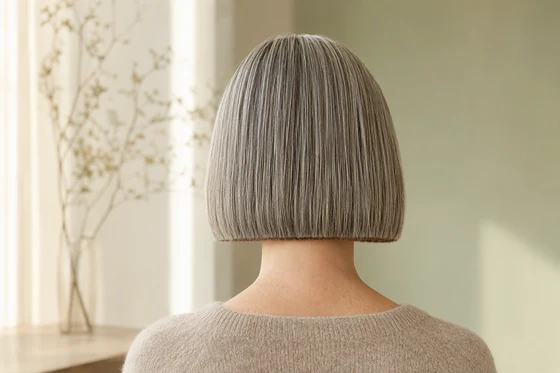
The family splits along two axes.
One-length versus layered. A one-length bob puts every fiber at the same stopping point, which builds the strongest possible perimeter. This is the fine-hair play: blunt ends read dense because they are dense, all the hair arrives at once. A layered bob removes internal weight and staggers the ends, which is the thick-hair play: coarse or gray-textured hair gains movement and loses bulk where it does not need it. Choosing the wrong side of this axis is the most common bob mistake. Layers on fine hair thin an already thin perimeter; a solid one-length line on heavy coarse hair makes a helmet.
Length: chin, jaw, or collarbone. Shorter concentrates more and demands less daily handling; longer keeps the ponytail option and softens the commitment. The lob, sitting at collarbone, is the least demanding entry point in the whole guide: long enough to tie back on a skipped-styling day, short enough that reduced density still reads full, and forgiving of an extra month between trims. Worn blunt, it applies the same perimeter logic as the short bob at more length.
Angle is a free variable on all of these. An A-line bob, slightly longer in front, weights the face-framing sections. A perfectly level line reads more classic. Neither is more correct; they are different placements of the same mass.
What a bob costs: some daily commitment to shape. Most bobs look their best with a few minutes of round-brush or flat-wrap drying, and a bob cut against your natural texture will demand that time every single day. The escape hatch is asking for the cut to be adapted to your actual pattern: a wave-friendly bob with soft internal layering air-dries into shape. Say the words “cut this for air drying” and watch the consultation change.
What about medium length with layers?
Medium, meaning collarbone to a few inches past the shoulder, is where layering earns its keep. At this length there is enough hair below the shoulder line for layers to create shape rather than just remove ends, and enough length for wave and gray texture to organize into movement instead of frizz.
This range serves two situations especially well. First: thick or coarsening hair that wants length without bulk. Long layers starting at the chin or below take out interior weight while the perimeter stays substantial. Second: wavy hair that has gotten drier and springier with gray. Layers cut to the wave pattern let each section curl at its own length, which turns the new texture from a liability into the actual style.
The risk at medium length is the same one that runs through this whole guide: layering fine, low-density hair strips the perimeter. If your density has dropped, keep medium-length layering long and subtle, or stay one-length with face framing only. If you are between “my hair is fine” and “my hair is thick,” medium length is also the best testing ground, because it preserves your options in both directions.
Face framing deserves its own mention because it is the lowest-cost layering there is: a few graduated pieces from cheekbone to jaw around the front hairline, with the rest left one length. It gives the moving, styled-looking front that people usually want from layers while spending almost none of the perimeter.
We break down the full range, layer placement, curtain-layer variants, and air-dry routines, in the guide to medium-length hairstyles for women over 50.
Is long hair actually fine after 50?
Yes. Let us take the rule apart properly, because this is the piece of hairstyle folklore with the widest reach and the thinnest support.
“Women should cut their hair short after 50” is pure convention. There is no study behind it, no mechanism in the dermatology literature, nothing. It appears to descend from mid-century social norms about age-appropriate presentation, repeated until it sounded like fact. The research on hair aging describes density and fiber changes [1, 3, 4]; it says nothing about which lengths anyone should wear, at 50 or ever.
What is true is narrower and more useful: long hair is a density-dependent style. Length spreads your fiber count over maximum distance, so ends are the first place reduced density shows. Long hair also carries compounding wear; the hair at your waist is years old and has survived years of sun, friction, and heat, and older fiber with less lipid weathers faster [4, 5]. So the honest statement is: long hair after 50 works exactly as well as your density and your end-maintenance allow, and no better.
That means the decision procedure is simple. Look at your ends in good light. If the bottom third of your hair is noticeably see-through compared to the mid-lengths, your current density does not support your current length, and moving the perimeter up (to where the density is) will make the hair you keep look like more. If your ends are substantial, your density supports your length, and the only person with standing to shorten it is you.
If you keep length, budget for it: trims every 8 to 12 weeks to keep the perimeter honest, conditioning aimed at the older fiber in the bottom half, and less heat, because aged fiber has less margin for it. A blunt perimeter helps long hair for the same reason it helps a bob. And one practical note that gets left out of the myth-busting: one-length long hair worn air-dried is one of the lowest-maintenance styles in this entire guide. The idea that long hair is inherently high-effort assumes daily heat styling. Skip that assumption and long hair costs a trim four to six times a year.
Do bangs make sense, and which kind?
Bangs are a hairline tool. The question is not whether bangs are permitted after some birthday, it is what your frontal hairline can support and what you want covered.
Curtain bangs part in the middle and sweep to each side, longest at the outer edges, blending into face-framing layers. They are the low-risk entry: because they are long and split, they need less density than any other fringe, they grow out gracefully, and they soften the forehead line without committing you to daily fringe management. If the temples have thinned, which is a common pattern in female hairline change [3, 4], curtain bangs place hair exactly over the thinned zones. This use of fringe for temple coverage is stylist convention, but it is convention with an obvious mechanism: hair positioned over a sparse area covers it.
Side-swept fringe does the same job asymmetrically, one longer panel crossing the forehead. It needs slightly less hair than curtain bangs and pairs naturally with a deep side part, which itself redistributes crown hair toward whichever side you want fuller. A widening part can often be managed with nothing more than moving the part, no scissors involved.
Blunt full fringe is the demanding one. A straight-across fringe needs solid, even density along the entire front hairline, because it is a solid curtain of hair and any gap in it reads as a gap. On a strong hairline it is a striking, deliberate line. On a thinned hairline it exposes exactly what it was meant to cover. It also books the most maintenance: a blunt fringe needs a trim every 3 to 4 weeks and cooperates poorly with strong wave or wiry gray at the front.
One caution that belongs here: constant traction on the front hairline, from tight ponytails, heavy extensions, or hard daily pulling, is associated with hairline loss, and mature fiber is not the place to spend margin [6]. If you are relying on a tight scrape-back to manage texture, a cut that manages the texture instead is the cheaper trade.
What is a gray strategy, and which cuts help?
Going gray is a logistics problem: you have one color growing in and another color on the lengths, and the line between them moves at about half an inch a month. Every gray strategy is a way of managing that line, and cut length is the biggest lever you have.
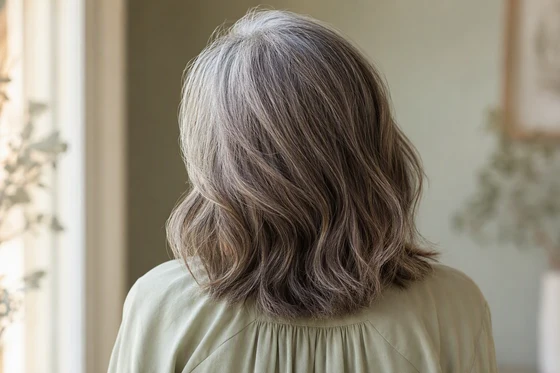
The short transition. The fastest route through is a pixie or cropped bob, because the demarcation line reaches the ends and gets cut off in months instead of years. Many women use a short cut purely as a transition vehicle: cut, grow the gray in clean, then decide the final length from scratch in their actual new color and texture. This is worth saying plainly, because it reframes the short cut as a tool you pick up and can put down, not a destination you are assigned.
The blended transition. If you want to keep length while you transition, the line gets softened instead of removed: fine highlights and lowlights woven through the grow-out zone break the hard edge into a gradient, and a skilled colorist can make an inch-a-month grow-out look intentional for the year or two it takes. It costs salon time and money for the duration, and it works best on hair that is graying in a salt-and-pepper scatter rather than a solid front.
The hard-line transition. Some women simply let the line grow and wear it. This costs nothing and requires nothing. It is also increasingly common, which is changing what “normal” looks like at the salon and everywhere else.
Whichever route you take, plan the cut for the destination texture, not the departure one. As the proportion of gray rises, the fiber mix shifts drier, springier, and more curved [5], with less sebum arriving to soften it [4]. Cuts with a little layering give the incoming wire room to sit down; hard glassy one-length shapes ask gray fiber for a smoothness it no longer produces on its own. Silver and white also read as their own color: sharper geometric cuts tend to show it off the way a strong cut shows off any deliberate color choice. Whether the incoming gray reads better against short or long shapes is mixed evidence territory at best; treat every claim of that kind as taste, including ours.
What should you bring to the consultation?
The consultation is where this guide either converts into a good haircut or evaporates. Stylists are not mind readers, and “something fresh, you decide” is how you end up with the default cut the salon gives everyone your age. Bring facts.
Bring your actual constraints. How many minutes you will genuinely spend styling on a Tuesday. How many weeks you will genuinely go between appointments. Whether you will use heat. Whether you need a ponytail option. A cut that assumes 20 daily minutes you will not spend is a bad cut for you no matter how good it looks leaving the salon.
Bring your hair’s current state, named. “My part has widened over the last two years.” “My ends are see-through below my shoulders.” “The gray at my temples grows in wiry.” “My hair is drier than it used to be.” Each sentence maps to a technical decision, and a stylist who hears the situation described this precisely can work with the hair you have instead of the hair the photo has.
Bring photos of both kinds. One or two inspiration photos, ideally on hair with texture and density like yours, and, just as useful, a photo of your own hair on an ordinary day. The gap between the two is the honest scope of the consultation.
Ask the four questions. What will this cut do with my density and texture? How many minutes a day does it assume? How many weeks between trims does it need? What does it look like if I skip styling entirely? Specific answers mean your stylist has a plan. Vague answers mean the plan is hope.
We built a printable one-page version of this: the salon consultation checklist has the constraint prompts, the four questions, and space to note your density and texture observations before you go. Print it, fill it in, hand it over if you like. Stylists tend to love clients who arrive with it.
Where to go from here
This is the head of our over-50 series, and the spoke guides go deeper on everything above: short hairstyles cut by cut, medium lengths and layering placement by placement, and the rest of the cluster as it grows from the over-50 hub.
The summary that fits on an index card: density decides how much length and layering your hair can carry. Texture, especially incoming gray texture, decides which shapes will fall into place and which will fight you. Your maintenance budget decides everything else. Cuts are tools with specs and running costs, and now you know how to read the spec sheet. What you want to look like is the one input nobody else gets a vote on.
Frequently asked questions
Is long hair OK after 50?
Yes. There is no evidence that long hair works less well after any particular birthday. Long hair works when your density supports it and you are willing to maintain the ends. The relevant question is whether your hair, at its current density and texture, holds a long shape you like, not what year you were born.
What is the best cut for thinning hair?
Cuts that concentrate the hair you have: a one-length or lightly layered bob between chin and collarbone, a cropped pixie, or a blunt lob. Blunt ends stack density at the perimeter where thinning shows most. Avoid heavy layering and long lengths that stretch reduced density over more distance.
What cuts work during a gray transition?
Shorter cuts shorten the transition because the line between colored and gray hair grows out faster. A bob or pixie can clear old color in months rather than years. If you want to keep length, ask about blending techniques like fine highlights or lowlights through the grow-out zone so the demarcation line softens while it moves.
What are wash-and-wear cuts?
Cuts engineered to fall into shape from wet with minimal tools: a texture-matched pixie, a softly layered bob cut to your natural wave pattern, or curly shapes cut dry to the curl. The key is that the cut follows what your hair does on its own instead of fighting it. Tell your stylist your styling budget is near zero and ask them to cut for air drying.
How often should you trim?
Short cuts hold their shape for 4 to 6 weeks. Bobs stretch to 6 to 8 weeks. Longer layered shapes can go 8 to 12 weeks before the shape blurs. Drier, more fragile fiber splits faster, so if your ends fray you may need the shorter end of each range. A trim schedule is a maintenance cost: budget it like one.
Do bangs work after 50?
Bangs work whenever the hairline supports them. Curtain bangs and long side-swept fringe need less density than a blunt full fringe, so they suit hairlines that have thinned at the temples. A blunt heavy fringe needs solid frontal density; if yours has receded, a longer, softer fringe gives coverage without exposing gaps.
How do fine and thick hair differ in what they need after 50?
Fine hair loses volume fastest when it loses density, so it needs blunt ends, shorter-to-medium lengths, and minimal layering to keep visual mass. Thick hair often gains coarseness and wave as gray comes in, so it needs the opposite: internal weight removal, layers, and shapes that channel the extra texture instead of compressing it.
What should you ask your stylist at a consultation?
Ask what your hair's density and texture will do with the cut you want, how many minutes of daily styling the cut assumes, how many weeks between trims it needs, and what it looks like when you skip styling entirely. A good stylist answers in specifics. Bring photos of your own hair on a normal day, not just inspiration photos.
Which cuts reduce styling time the most?
A texture-matched pixie is usually the fastest: wash, a fingertip of product, done. A softly layered bob cut for your natural wave is close behind. One-length long hair is slow only if you heat-style it; worn air-dried, it can also be low effort. The cut that fights your natural texture is always the most expensive in minutes, regardless of length.
Does short hair make thin hair look thicker?
Often, but by mechanism, not magic: shorter hair concentrates the same number of fibers over less length, and blunt perimeters read denser than tapered ones. The effect is real for fine or thinning hair. It does not follow that everyone with thin hair must go short; a blunt collarbone lob applies the same principle at more length.
Layers or one length for fine hair?
Mostly one length, or long subtle layers only. Every layer removes hair from the perimeter, and a fine-haired perimeter is already the weak point. Face-framing pieces around the front are fine; aggressive internal layering thins the ends and makes the cut look sparser than the hair actually is.
How do you deal with wiry gray texture?
Gray fiber carries less lipid, holds less water, and often grows with more curvature, so it behaves drier and springier than pigmented hair. Cuts with some layering give the wire somewhere to go, and consistent conditioning improves how the fiber bends. Cutting to the new texture works better than trying to iron it back to the old one.
- Robbins C, et al. What women want: quantifying the perception of hair amount, an analysis of hair diameter and density changes with age in Caucasian women. Br J Dermatol. 2012;167(2):324-332.
- Chaikittisilpa S, et al. Prevalence of female pattern hair loss in postmenopausal women: a cross-sectional study. Menopause. 2022;29(4):415-420.
- Gupta AK, et al. Menopause and hair loss in women: exploring the hormonal transition. Maturitas. 2025.
- Trüeb RM. Aging of hair. J Cosmet Dermatol. 2005;4(2):60-72.
- O'Sullivan JDB, et al. Human hair graying revisited: principles, misconceptions, and key research frontiers. J Invest Dermatol. 2024.
- Sadgrove NJ, et al. Hair longevity: evidence for a multifactorial holistic approach to managing hair aging changes. J Clin Med. 2025;14(6):1894.