Hair after 50
Hairstyles for Women Over 40: Cut for What Is Changing, Not for the Number
The best haircuts after 40 are decided by what is actually changing in your hair, usually early and subtle: the first density loss at the part and temples, a texture shift as fiber and oil production change, and the first scattered grays, weighed against how much styling time you genuinely have. Age itself sets no rules. The strongest cut families for this decade are layered mid-lengths, lobs, and soft shags, because they work with early change while keeping every option open.

Your 40s are the decade when hair starts to change and almost nobody tells you what is happening. The part looks a little wider in bathroom light. A few wiry grays appear at the temple. The blowout that used to last three days lasts one. None of it is dramatic, all of it is real, and the standard advice, which is either “you are too young for any of this” or a copy of the over-50 playbook served a decade early, misses the actual situation: early change plus the busiest schedule of your life.
So here is the frame this guide runs on. The right cut in your 40s is decided by three things: which changes have actually started in your hair, what your texture is doing now rather than at 30, and how many minutes you will honestly spend styling on a working Tuesday. Age rules decide nothing. The cut families that come up again and again this decade are layered mid-lengths, lobs, and soft shags, not because they are assigned to an age bracket but because they are built for exactly this combination: enough structure to work with early density and texture shifts, enough length to keep every future option open, and shapes that air-dry into themselves when the morning disappears. The rest of this guide is the detail.
What actually starts changing in your 40s?
Four things, all measurable, all early-stage. Knowing which ones apply to you is most of the work, because each points to different cuts.
Fiber diameter peaks, then turns. Individual hair shafts are not a fixed width across life. In a study of 1,099 women aged 18 to 66, average fiber diameter increased into the 40s, peaked in the early-to-mid 40s, and then began to decline [1]. This is research-backed and it makes the 40s a genuinely strange decade for hair: for many women it is literally the peak of fiber thickness, and the downturn happens quietly inside it. Through your 30s, thickening fibers partly masked slowly falling density. After the peak, both numbers move down together, which is why hair that felt unchanged for fifteen years can start feeling different within two or three.
Density keeps its slow decline. The number of hairs per square centimeter falls steadily through adult life, and in the same study the decline accelerated with age [1]. In your 40s this mostly shows up as small tells rather than obvious thinning: a ponytail that wraps one more turn of the elastic, a part line that catches your eye in overhead light. For a minority of women it goes further. In a UK study of adult women, female pattern hair loss was present in about 6 percent of women under 50, with prevalence rising steeply in later decades [2]. So early pattern loss in your 40s is real but not the default: research-backed on both counts. The typical presentation in women is a widening part and diffuse thinning over the crown, often with finer growth at the temples, rather than the receding line or bald spot seen in men [2, 4].
Hormonal shift begins for many. Perimenopause commonly starts in the mid-40s, and the hormonal transition matters to hair because estrogen supports the growth phase of the hair cycle; as ovarian estrogen production becomes irregular and declines, growth phases can shorten and some follicles begin producing finer, shorter hairs [4, 5, 7]. The midlife hair literature also describes shedding events layered on top of the slow trends: telogen effluvium after childbirth, illness, or major stress can produce months of heavy shedding followed by a halo of short regrowth [4]. Since plenty of women are postpartum in their late 30s and early 40s, it is common to be growing back one shedding event while the background hormonal shift begins. That overlap is an over-40 situation specifically, and it changes which cuts serve you: shapes that absorb regrowth instead of fighting it.
The first grays arrive, scattered. Most women meet their first gray hairs in their 30s or 40s, but coverage stays low for a long time. In a survey of over 4,000 people worldwide, only 6 to 23 percent of people around age 50 had reached even half-gray [3], which means the famous claim that half of us are half gray by 50 is wrong, and it means the typical 40s pattern is a scatter of silver strands, often concentrated at the temples, in an otherwise pigmented head. This is research-backed and it reframes the whole first-gray question: you are not managing a color change yet, you are managing a texture change in a few dozen strands. Gray fiber tends to be drier and springier than its pigmented neighbors, with altered lipid content and often more curvature [6], which is why the first grays are usually noticed as the wiry ones standing up at the part rather than as a color.
That is the biology, and notice its shape: everything is beginning, little is established. The research describes fibers and follicles; it says nothing about which lengths or shapes anyone should wear at any age. Everything from here on is styling judgment applied to those facts, tagged as such.
How do you choose a cut in your 40s?
Three questions, answered honestly and in order. The over-40 versions are subtler than they will ever be again, which is exactly why they are worth asking now.
1. What stage of change are you at? Look at your part in flat overhead light and feel your ponytail. “Nothing has changed” is a real and common answer in this decade, and it means every cut in this guide and beyond is open to you. “Something has started” (a slightly wider part, a thinner tail, temple wisps) points toward shapes that build perimeter density and cover the specific spots. “A shedding event is regrowing” points toward layers that absorb the halo.
2. What is your texture doing now? Not at 30. Drier, wavier, springier, a few wiry grays: any of these means the cut should be designed for the incoming texture. Cutting for the texture you used to have is the single most common consultation mistake at every age, and the 40s are when it starts mattering.
3. What is your real time budget? For many women the 40s are peak load: career, kids, parents, all at once. A cut that assumes twenty daily minutes of round-brushing is a bad cut for a person with four minutes, full stop. Decide the number before the consultation and say it out loud.
The table maps common over-40 situations to the families that serve them. It is a starting point for a conversation with your stylist, not a verdict.
| Your situation | Cut families that serve it | Why it works |
|---|---|---|
| No change yet, wants versatility | Layered mid-length, long layers | Density supports everything; keeps all options open |
| Part just starting to widen | Deep side part with a lob or mid-length | Repositions crown hair over the widening line |
| Ponytail thinner than five years ago | Blunt lob, one-length collarbone cut | Blunt perimeter stacks density where thinning shows |
| Texture newly wavy, drier | Soft shag, layers cut to the wave | Gives the new pattern a shape instead of a fight |
| First grays scattered at temples | Curtain layers, face framing, gloss or fine blending | Movement blends wiry strands; covers temples softly |
| Postpartum regrowth halo | Layered mid-length, face-framing layers | Short regrowth blends into staggered lengths |
| Four-minute mornings | Air-dry lob, texture-matched shag, pixie | Cut engineered to fall into shape from wet |
| Strong density, loves length | Long one-length or long layers | Nothing in the biology argues against it |
Now the families, one by one, with who each serves and what each costs.
Why are layered mid-lengths the workhorse of this decade?
Because they match the over-40 profile almost exactly. Mid-length means collarbone to a few inches past the shoulder, and layered means internal and face-framing layers that start at the chin or below. This range does four jobs at once.
It keeps the ponytail. That sounds trivial and is not: on the days when there is no styling time at all, hair that ties back cleanly is the difference between a cut that works for your life and one that does not. It absorbs early change. Staggered lengths make a slightly widening part and a postpartum regrowth halo read as intentional movement, where a rigid one-length shape would show every deviation. It carries texture shift. As wave and dryness arrive, layers cut to the emerging pattern turn the new behavior into the style. And it preserves every option. From a layered mid-length you can go longer, shorter, blunter, or shaggier next year without a grow-out project.
The cost side: mid-lengths need trims every 8 to 12 weeks to keep the layers legible, and layering spends perimeter. If your density has visibly dropped, keep the layers long and subtle or shift to the blunt lob below. And a layered mid-length cut against your texture, straight layers on wavy hair, is the classic time trap: it demands a blow-dry to look like the photo. The way out is in the words you use at the salon: ask for the layers to be cut to your natural pattern and finished for air drying.
Face-framing on its own deserves a mention as the minimum viable version: a few graduated pieces from cheekbone to jaw, everything else left alone. It costs almost no perimeter, frames the face, blends temple grays and regrowth, and grows out invisibly. If you are unsure about layers, start there.
The full breakdown of layer placement, curtain layers, and air-dry routines in this length range is in our guide to medium-length hairstyles; it is written for the over-50 stage of the same mechanics, so read it with your own dial readings in mind.
What does a lob actually do?
The lob, a long bob sitting at or just below the collarbone, is the density-insurance cut, and in the 40s it is usually bought before it is strictly needed, which is precisely when it is cheapest.
Mechanically, a blunt lob does one thing well: it puts every fiber at the same stopping point, building the densest possible perimeter at a length that still ties back. If your ponytail has thinned or your ends have started to look sparse below the shoulder, moving the perimeter up to the collarbone concentrates the same number of fibers over less distance, and the hair you keep reads as more. This is arithmetic, not magic, and it works at 44 exactly as it works at 64.
The lob is also the lowest-commitment cut in this guide. It tolerates 8 to 12 weeks between trims, air-dries acceptably on straight and wavy hair alike, accepts a curling iron on occasions, and leaves both directions open: grow it out and nothing was lost, go shorter and you have already rehearsed the length. Worn with a deep side part, it also quietly handles a widening part line by moving crown hair across it, a repositioning trick that costs nothing and involves no scissors.
Who should not choose it: very curly hair, which tends to spring a blunt collarbone line into an unintended triangle without internal shaping, and anyone who wants visible movement without daily styling, which is the shag’s job. If the blunt line feels severe, an A-line version, slightly longer toward the front, softens it while keeping the perimeter logic.
When does a soft shag or curtain layers make sense?
When texture has started to arrive and you want to spend it instead of suppressing it. The modern soft shag, heavily layered through the interior with the layers cut to the natural bend, plus curtain bangs or curtain layers framing the face, is the cut that treats incoming wave, spring, and even wiry early grays as raw material.

The mechanism is simple: shag layers let each section of hair curl or bend at its own length, so a head of mixed textures, which is exactly what early gray scatter creates, organizes into deliberate-looking movement instead of frizz over a smooth base. On wavy hair the shag is the closest thing to a wash-and-wear style at medium length: dry shampoo or a light cream, scrunch, done. Curtain bangs earn their place on the same logic plus one more: they are the lowest-density fringe there is, long and split, and they sit directly over the temples, which is where both first grays and first hairline thinning tend to appear [2, 3]. Covering the temples with hair positioned over them is stylist convention rather than research, but the mechanism is as plain as convention gets.
The honest costs. A shag is a committed shape: it needs a stylist who actually cuts them well, trims every 6 to 10 weeks to stay a shag rather than grown-out layers, and some texture to work with. On genuinely straight hair a shag needs product or a light wave routine to activate, which moves it out of the zero-effort column; whether a shag can work on dead-straight fine hair at all is mixed evidence in the practical sense, meaning stylists disagree and results vary with the individual head. And a shag spends perimeter density on interior movement, so if your ponytail has clearly thinned, the lob serves you better than the shag does.
Is long hair still on the table in your 40s?
Entirely, and it is worth dismantling the doubt properly, because the 40s are when women start hearing that a cut is coming due.
The rule “cut it short at 40” or “long hair ends at some birthday” is pure convention: there is no study behind it and no mechanism in the dermatology literature. The research on hair aging describes density and diameter curves [1, 2]; it is silent on length. What is true is narrower: long hair is a density-dependent style, because length spreads your fiber count over maximum distance and the ends are years old, having survived years of sun, friction, and heat on fiber that gets drier with age [6]. In your 40s, density is usually still near its lifetime plateau and diameter is at or near its peak [1], which means the biology of this decade supports length about as well as it ever will. If anything, the evidence points the opposite way from the folklore.
So run the actual test. Look at the bottom third of your hair in good light. Substantial ends: your density supports your length, keep it as long as you like it, and budget for the upkeep, meaning trims every 8 to 12 weeks, conditioning aimed at the oldest fiber in the bottom half, and a light hand with heat. See-through ends compared to the mid-lengths: your current length is outrunning your density, and moving the perimeter up, to a lob or mid-length, will make the hair you keep look like more. Either way the decision is a reading of your hair, not your birth year.
One reframe worth carrying: one-length long hair worn air-dried is among the lowest-maintenance styles that exist, a trim four to six times a year and nothing else. The belief that long hair is high-effort assumes daily heat styling. Drop the assumption and long hair competes with the pixie on total cost.
If you have seen the adjacent claim, lists of cuts that promise to take years off, we take those claims apart mechanism by mechanism in haircuts that make you look younger: some describe real visual effects, most are repetition.
Is a pixie a good idea in your 40s?
If you want one, yes, and that is the entire criterion. The pixie needs its own paragraph in an over-40 guide mostly to clear away two opposite errors: the old one, which prescribes short cuts at some age, and the newer one, which treats a pixie as a concession you should postpone as long as possible. Both treat the cut as a verdict about age. It is a tool with a spec sheet.
What the spec sheet says: a pixie concentrates all your hair into a few inches, so every fiber contributes to the shape, which makes it the strongest play for genuinely fine or thinning hair and a striking, deliberate choice on any hair. Daily styling cost is the lowest of any cut, usually under five minutes. Salon cost is the highest: the shape blurs in 4 to 6 weeks and an overgrown pixie hides nothing about itself. It also commits you: growing out a pixie to a bob takes most of a year through awkward lengths, so it rewards certainty.
In your 40s specifically, the pixie is more often an aesthetic choice than a density solution, because most 40s density does not yet need the concentration [1, 2]. Choose it because you want the shape, the speed, or the change, not because a rule says the clock ran out on length, and skip it without apology if frequent salon visits are exactly what your calendar cannot absorb. The full short-cut family, pixie ranges through cropped bobs with maintenance schedules and texture matches, is covered in our short hairstyles guide.
What do you do about the first grays?
First, know the scale of the thing: the data says most people around 50 are nowhere near half gray [3], so in your 40s you are almost certainly dealing with a scatter, not a coverage problem. That changes the sensible playbook completely. You are not choosing a gray strategy yet; you are choosing how to handle a few dozen strands that are drier, springier, and more visible than their neighbors [6], while keeping your future options cheap.
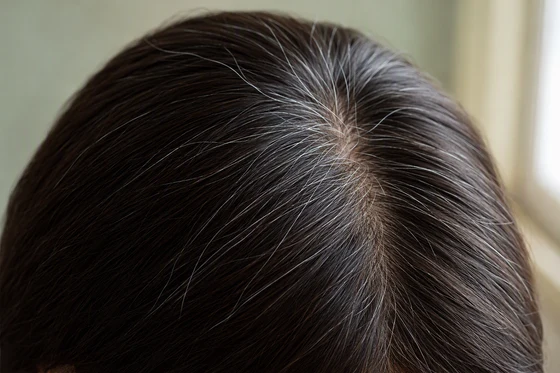
Doing nothing is a real option. Scattered silver in pigmented hair is a look people pay colorists to fake. If the strays bother you only when they stand up wiry at the part, the actual problem is texture, not color: a lightweight smoothing cream or a clear gloss, which adds shine and makes the fiber lie down, handles it without committing you to a color schedule. Do not pluck; it does nothing about graying and repeated traction can damage the follicle over time.
Blending buys quiet. Fine highlights or babylights woven near your natural base soften the contrast between silver strands and pigmented hair, so new grays disappear into an existing pattern instead of announcing themselves at the roots. This is the low-commitment color play: it grows out without a hard line and needs refreshing a few times a year, not every four weeks. All-over permanent color is the opposite economy: it covers completely and then bills you a demarcation line every month for as long as you run it.
Cut shape decides how expensive your future transition is. Whenever you eventually decide to let gray grow in fully, whether at 48 or 68, the cost of that transition is set by length and structure: the line between colored and gray hair moves at about half an inch a month, so a pixie clears it in months, a lob in a year or so, waist-length hair in several. Layered, moving shapes also blur the line as it travels, where glassy one-length shapes display it. None of this means you should cut now. It means that if you start all-over color in your 40s, you are opening a subscription whose cancellation fee is measured in inches, and it is worth knowing the price going in. The full transition playbook, short, blended, and hard-line routes, is in the over-50 pillar, which is written for the stage when coverage is actually high.
How much styling time do these cuts really take?
The honest unit of a haircut’s cost is minutes per weekday morning, and in your 40s that number is set by the rest of your life before you ever pick a cut. So pick the cut to the number.
Zero to five minutes. A texture-matched pixie, a soft shag on wavy hair, a lob or one-length mid-length cut for air drying. The common ingredient is that the cut follows what your hair does wet-to-dry on its own; the styling is product and placement, not reshaping. The magic words at the consultation are “cut this to air-dry”; they change the technique the stylist uses, not just the pep talk.
Five to fifteen minutes. The same cuts finished with intent: a diffused shag, a rough blow-dry on a lob, a bend put through mid-length layers with an iron used sparingly. This tier is sustainable if the minutes are honestly there.
Fifteen minutes and up, daily. Any cut styled against its texture: straightened waves, curled straight hair, a blunt bob ironed glassy every morning. Sometimes that ritual is genuinely wanted, and then it is fine. The trap is inheriting it by accident, by choosing a cut whose photo assumed a blowout.
The heat budget deserves its own line, because the 40s are when it starts compounding. Hair fiber cannot repair itself, mature fiber runs drier as sebum declines [6], and the ends you have now may need to last another decade of length. Every routine degree and daily pass is spent from condition that does not come back. The cheap wins are structural: lower iron temperatures, one pass on dry hair instead of three on damp, heat protectant when you do use tools, and above all a cut that makes the tools optional. A cut that fights your texture is the most expensive thing in your bathroom; it just bills in minutes and fiber instead of money.
How does this differ from the over-50 playbook?
Same mechanics, different stage, and it is worth being precise because this article and the over-50 pillar are siblings, not rivals.
The over-50 stage is established change: density measurably down for many, texture visibly shifted, gray often approaching or past the tipping point where transition logistics dominate. The advice there concentrates: blunt perimeters, shorter shapes for genuinely low density, cuts planned around a full grow-out, wash-and-wear engineering as the default. The over-40 stage is early change: diameter at or just past peak [1], pattern loss present in a minority [2], gray still a scatter [3], and the tightest time budget of adult life. So the advice here preserves: mid-lengths and lobs that keep every option open, layers that absorb small shifts, color moves chosen for cheap exits, and a bias against solving problems you do not have yet.
Practically, that means you graduate from this article to that one not at a birthday but when the readings change: when the ends thin faster than trims can keep honest, when gray coverage gets high enough that transition strategy matters, when texture change stops being an accent and becomes the material. Some readers will get there at 47, others at 60, others never quite at all. The whole cluster lives at the over-50 hub, organized by situation rather than by year, and it is built to be read that way.
What should you tell your stylist?
The over-40 consultation has one special property: you are describing changes your stylist may not be able to see yet, because early shifts show in trend lines, not snapshots. You are the only person who knows what your ponytail felt like three years ago. Bring that knowledge as data.
Name the deltas. “My part looks wider than it did two years ago.” “My ponytail is thinner.” “My hair dries wavier than it used to.” “The grays at my left temple grow in wiry.” Each sentence maps directly to a technical decision: part placement, perimeter weight, layer pattern, blending plan. Vague dissatisfaction maps to nothing.
State your numbers. Minutes per weekday morning, honestly. Weeks between salon visits, honestly. Whether the ponytail option is mandatory. Whether you will use heat at all. A stylist given real constraints can design inside them; a stylist given “something fresh” designs for the photo shoot your Tuesday will never be.
Ask the four questions. What will this cut do with my density and texture as they are now? How many minutes a day does it assume? How many weeks between trims does it need? What does it look like if I skip styling entirely? Specific answers mean there is a plan for your hair. Vague answers mean the plan is hope.
Bring both photos. One inspiration shot, ideally on hair with texture and density like yours, and one photo of your own hair on an ordinary day. The distance between them is the honest scope of the appointment.
We keep a printable one-pager for exactly this: the salon consultation checklist has the constraint prompts, the four questions, and space to note your density and texture observations before you go. It works at 42 exactly as it works at 62, because it never asks your age.
The index-card summary for this decade: your 40s are early days, and early days reward cuts that keep options open. Read your own trend lines, cut for the texture arriving rather than the one leaving, spend heat like the nonrenewable it is, and treat every rule that starts with an age as what it is, a convention someone forgot to question. The hair is yours; so is the call.
Frequently asked questions
What changes in your hair during your 40s?
Fiber diameter peaks in the early-to-mid 40s and then begins to decline, while the number of hairs per square centimeter continues its slow fall. A minority of women see the first signs of female pattern hair loss, usually a gradually widening part or a thinner ponytail. Most people also find their first scattered grays, and the fiber often gets drier as sebum production drops. The changes are real but early: for most women in their 40s they are shifts you notice before anyone else does.
Is 40 too old for long hair?
No, and there is no evidence behind the idea that any birthday is. Long hair depends on density and end maintenance, not on age. In your 40s, density is usually still strong enough to support length; the honest check is whether your ends look substantial in good light. If they do, the length is yours to keep for exactly as long as you want it.
First grays: should you cut them, color them, or leave them?
All three are legitimate, and nothing about a first gray requires action. Leaving scattered grays alone costs nothing. Blending with fine highlights or a gloss softens contrast if the strays bother you. Cutting does not remove gray, but shorter shapes make any future color decision cheaper because there is less length carrying old color. The one move to skip is plucking: it does not reduce graying and repeated traction can damage the follicle.
Layers or one length in your 40s?
For most 40-something hair, layers still pay: density is usually high enough that the perimeter can afford them, and layers absorb early texture change. Switch toward one length or blunter shapes if your ponytail has clearly thinned or your ends look sparse, because every layer removes hair from the perimeter and a thinning perimeter needs all of it. The deciding factor is your current density, not the decade.
What cut works when postpartum regrowth runs into perimenopause?
Face-framing layers and layered mid-lengths handle it best. Postpartum shedding is typically followed by a halo of short regrowth at the hairline and part, and layered shapes let that regrowth blend into the cut instead of standing against a solid line. If shedding has left your ponytail thinner, a blunt collarbone lob rebuilds a dense-reading perimeter while everything regrows.
How do you cut down on heat styling?
Have the cut built for your natural texture, then let the cut do the work: a shape cut to your wave pattern air-dries into itself. Beyond the cut, use lower iron temperatures, single passes on mostly-dry hair, and a heat protectant, and keep hot tools for occasions rather than mornings. Mature fiber is drier and repairs nothing, so every degree and every pass you skip is condition you keep.
Do bangs work in your 40s?
Bangs are a hairline decision, not an age decision. Curtain bangs are the low-risk version: long, split in the middle, needing little density, and they cover temples if yours have started to thin. A blunt full fringe needs solid, even frontal density and a trim every three to four weeks, so treat it as the high-commitment option. If your hairline is unchanged, everything is open.
How is over-40 hair advice different from over-50 advice?
Same variables, different stage. In your 40s the changes are mostly beginning: a slightly wider part, a scatter of gray, texture just starting to shift, so the smart cuts preserve options, which is why layered mid-lengths and lobs dominate. After 50 the changes are usually established, and the advice concentrates harder: blunter perimeters, shorter shapes for low density, cuts planned around a full gray transition. The mechanics never change; the readings on the dials do.
What should you tell your stylist in your 40s?
Tell them what has changed in the last two or three years, specifically: whether your part looks wider, whether your ponytail feels thinner, whether your texture has gotten wavier or drier, where gray is coming in. Then give your real numbers: minutes you will style on a weekday, weeks you will go between appointments, whether you need a ponytail option. Specific inputs get you a cut designed for your hair this year instead of a generic one.
How much daily styling time do these cuts actually take?
A lob or layered mid-length cut for your texture and air-dried runs a few minutes: product, rough shaping, done. A soft shag on wavy hair is similar, scrunch and go, though it looks best refreshed with a light product. A pixie is the fastest daily cut of all but needs trims every four to six weeks. Any cut styled against its natural texture costs fifteen to thirty minutes of heat every single day, which is the real number to compare.
When is shedding worth a professional opinion?
Gradual, diffuse change over years is the normal pattern described in the research. Sudden heavy shedding, distinct patches, a rapidly receding hairline, or scalp symptoms like itching, pain, or scaling are different: those are reasons to see a dermatologist, ideally one who works with hair, because some causes are treatable and respond best early. A stylist can flag what they see, but diagnosis is not their job or ours.
- Robbins C, et al. What women want: quantifying the perception of hair amount, an analysis of hair diameter and density changes with age in Caucasian women. Br J Dermatol. 2012;167(2):324-332.
- Birch MP, Messenger JF, Messenger AG. Hair density, hair diameter and the prevalence of female pattern hair loss. Br J Dermatol. 2001;144(2):297-304.
- Panhard S, Lozano I, Loussouarn G. Greying of the human hair: a worldwide survey, revisiting the '50' rule of thumb. Br J Dermatol. 2012;167(4):865-873.
- Mirmirani P. Managing hair loss in midlife women. Maturitas. 2013;74(2):119-122.
- Mirmirani P. Hormonal changes in menopause: do they contribute to a 'midlife hair crisis' in women? Br J Dermatol. 2011;165(Suppl 3):7-11.
- Trüeb RM. Aging of hair. J Cosmet Dermatol. 2005;4(2):60-72.
- Gupta A, et al. Menopause and hair loss in women: exploring the hormonal transition. Maturitas. 2025;198:108378.