Hair after 50
Short Hairstyles for Women Over 50: Choosing by Density, Texture and Styling Time
Short cuts after 50 work when they are matched to your hair's current density and texture, not to your age. The strongest families are the pixie, the cropped bob and the shag, and the right choice mostly comes down to how much styling time you want to spend each morning. Less length means less hanging weight, which lets finer hair sit fuller at the root.
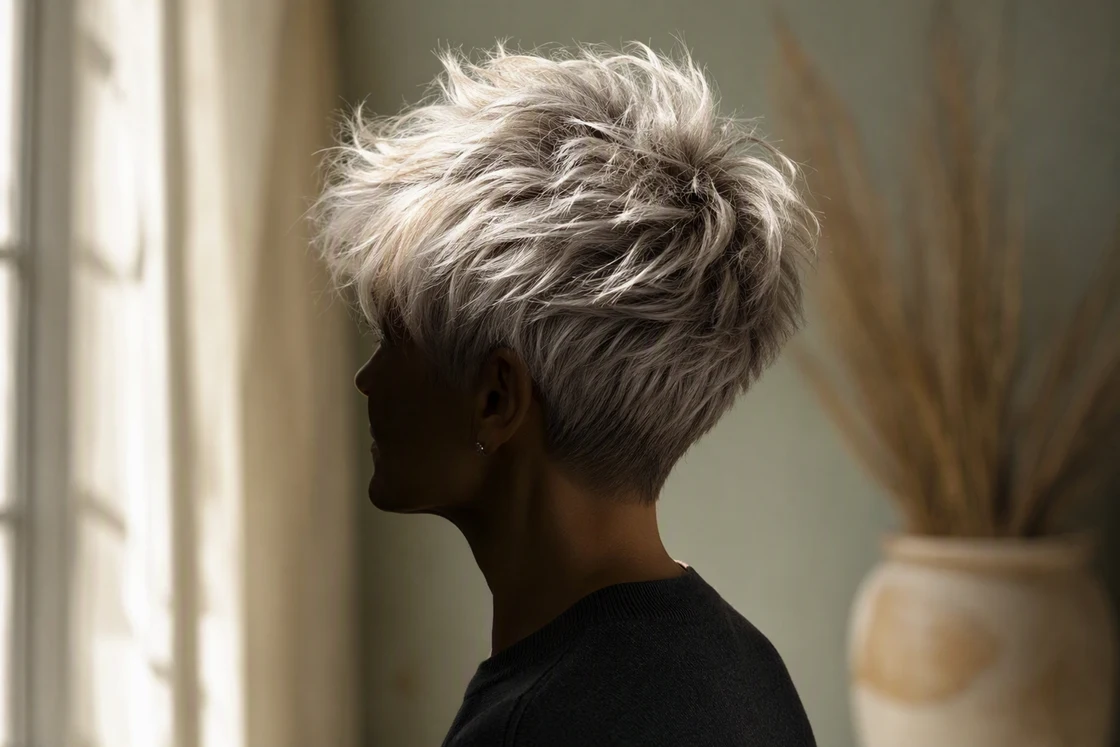
Short hair after 50 is not a rule, a rite of passage, or a surrender. It is a set of engineering decisions about weight, density and time, and when those decisions are made well, a short cut does more with changed hair than almost any other length. This guide covers the four cut families worth knowing, who each one serves, and what each one costs you in trims and morning minutes. It is a spoke of our full guide to hairstyles for women over 50, which covers every length; this page goes deep on short only.
Why does short hair work better on hair that has changed?
Because short cuts solve a physics problem that longer hair makes worse. Hair changes measurably with age: strand diameter in Caucasian women peaks around the early-to-mid 40s and then declines, and density, the number of strands per square centimetre, declines steadily from the 20s onward [1]. Density is also the strongest driver of how much hair people perceive you to have [2]. Around menopause, shifting estrogen and androgen levels shorten the growth phase for many women, so individual strands also reach shorter maximum lengths before shedding [3][4]. The practical result: the same head of hair carries less mass, and each strand is finer, than it was at 35. That is research-backed, and it is the honest starting point for every recommendation on this page.
Here is why length matters to that equation. A strand of hair is a cantilever anchored at the root. The longer it is, the more of its own weight it carries, and the more that weight pulls the root flat against the scalp. Cut the length and you cut the load: the same follicles, at the same density, produce visible lift because nothing is dragging them down. This is ordinary mechanics, not marketing. Short hair does not add a single strand. It lets the strands you have stand up.
Two more things short does. It concentrates whatever density you have into a smaller silhouette, so coverage reads fuller. And it puts the freshest, least weathered part of each strand on display: the centimetres nearest the root are the newest fiber, before years of washing, heat and UV exposure have roughened the cuticle [3].
None of this means short is mandatory. If your hair is still dense and you love your length, keep it. But if you have noticed flatness at the crown, a ponytail that has halved in circumference, or ends that thin to nothing, shortness is the single most reliable lever you can pull.
What does a pixie actually do, and which version fits your hair?
The pixie is the shortest family: cropped through the back and sides, with a top that ranges from one inch to four or five. The differences between versions matter more than the shared name.
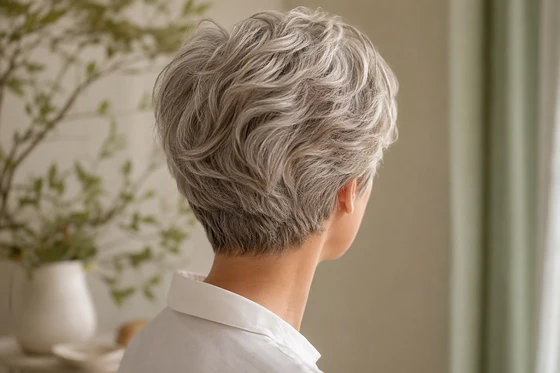
The classic pixie keeps the top short, roughly 1.5 to 3 inches, with tailored sides and a clean neckline. It is the most architectural of the three and the least forgiving of low density on top, because there is no length to layer over thin spots. It serves medium-to-thick hair with decent crown coverage, and it rewards straight or slightly wavy texture. Styling cost: 3 to 5 minutes with a dab of paste, or nothing at all on a good hair day. Stylist convention holds that a classic pixie suits oval and heart-shaped faces best; treat that as convention, not law, since face-shape rules have never been rigorously tested.
The long or soft pixie leaves 3 to 5 inches on top and around the fringe, with softer graduation at the sides. This is the workhorse for fine hair: the extra top length gives strands something to lie against, so coverage builds without weight returning. It also flatters wave, because a few inches is enough for a bend to form. Styling cost: 5 to 8 minutes, usually a quick rough-dry with a light mousse for root lift.
The textured or choppy pixie can be either length, but is cut with irregular, point-cut ends so the surface separates into pieces rather than lying as a solid cap. On thick or coarse hair it is close to essential, because it removes interior bulk that would otherwise make the cut sit like a helmet. On fine hair, use texturizing sparingly: every choppy piece is hair removed, and fine hair has less to spare.
If you wear your hair gray, a pixie is arguably the strongest showcase for it: the shorter fiber keeps the wirier texture that often accompanies gray under control, and salt-and-pepper variation reads as intentional dimension at this length.
Is the cropped bob the safer short cut?
For most people, yes, and there is no shame in that. The cropped bob sits between the jaw and the chin, shorter than a classic bob, and it is the least committal member of the short family: enough length to tuck, pin or curl, short enough to shed most of the weight that flattens roots.
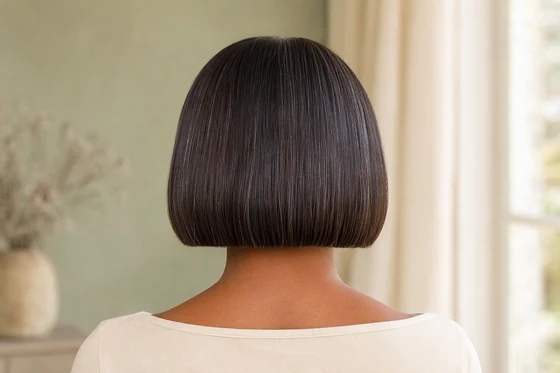
The French bob is the sharpest version: cut at or just above the jaw, often with a fringe, minimal layering, blunt-ish ends. The blunt line is the point. Cutting every strand to the same length stacks the ends into a single dense edge, which makes the perimeter of the cut read thick even when individual strands are fine. If your ends have gone wispy, this is the cut that does the most with them. The cost is styling honesty: a French bob wants to be smooth, which on most hair means 10 to 15 minutes with a round brush or flat iron. On naturally straight hair it can genuinely air-dry.
The layered or textured crop bob trades that dense edge for movement. Light interior layers let wave express itself and cut drying time. It serves fine-to-medium wavy hair well and is the better choice if you refuse to own a round brush.
One structural warning for thick, coarse hair: a one-length bob at chin length can expand into a triangle, narrow at the crown and wide at the jaw, as humidity rises. If your hair is dense, ask for internal weight removal, or move to the shag family below. The convention that a jaw-length bob suits square faces less well than longer bobs is exactly that, convention: repeat it to your stylist as a discussion point, not a verdict.
Who is the shag for?
The shag and its choppy-layer cousins are the short-to-mid family built entirely from layers: short crown layers falling into longer perimeter pieces, usually with curtain fringe or face-framing at the front. Where the French bob concentrates weight at one edge, the shag distributes hair vertically, so every layer supports lift in the one above it.
That structure makes the shag the best short-adjacent option for two groups. First, wavy and curly hair: layers release curl pattern that a one-length cut would drag straight, and the cut is designed to look better slightly undone, which is what curl does naturally. Second, anyone who wants short-hair lift without a short silhouette: a shag can keep collarbone-grazing front pieces while the crown is cut short enough to stand up.
The honest costs. A shag needs some product, typically a curl cream or texture spray scrunched into damp hair, and it needs a stylist who actually cuts shags, because the whole cut is layer placement and a bad one takes months to grow out. On very fine, very straight hair a shag can read stringy, since each layer contains few strands and straight fiber will not plump the gaps; a soft pixie or crop bob serves that hair better. On thick, coarse or curly hair the shag is often the single best answer at any length, which is why convention among curl specialists treats it as the default recommendation.
What about the crop with a longer top?
The fourth family is newer to salon menus for women, though barbers have cut it forever: short, tight back and sides with 4 to 6 inches left on top, worn pushed back, swept sideways, or scrunched into its natural wave. Think of it as a pixie’s silhouette with a bob’s worth of hair on top.
It exists for one hair situation in particular: wavy hair that is too short-cropped for the wave to form in a pixie, but goes flat under the weight of a bob. Four inches is roughly one full wave’s worth of length, so the top breaks into movement while the shorn sides keep the overall shape crisp. It also serves thick hair well, because the sides remove a huge fraction of total bulk in one decision.
Styling is a genuine choice each morning: five minutes with a dryer for a polished sweep, or one minute of scrunching with sea-salt spray for texture. The trade-off is the sides, which grow visibly within three weeks and need the most frequent maintenance of any cut on this page.
Which short cut fits your situation?
| Your situation | Best-fit family | Why |
|---|---|---|
| Fine and straight | French or crop bob | The blunt perimeter stacks your ends into one dense line; straight fiber lets it air-dry smooth |
| Fine and wavy | Long / soft pixie | Enough top length for the bend to form and build coverage, no hanging weight to pull roots flat |
| Thick and coarse | Textured pixie or shag | Both remove interior bulk on purpose; a blunt cut would trap it and expand outward |
| Curly | Shag with curl-cut layers | Layers release the curl pattern and the style improves as it dries undone |
| Minimal styling time | Textured pixie or short shag | Both are cut to air-dry into shape with one product and zero tools |
The table is a starting point, not a sentence. Density, growth patterns at the crown and hairline, and your own tolerance for trims move the answer, which is exactly what a good consultation is for.
How much maintenance does short hair really take?
Short hair trades daily styling time for salon frequency, and you should make that trade with open eyes.
Trim cadence. A pixie holds its shape for 4 to 6 weeks; the crop-with-longer-top needs its sides tidied on a similar or tighter clock. A cropped bob stretches to 6 to 8 weeks, and a shag, whose grown-out state is just a softer shag, can go 8 to 10. Over a year, a pixie means roughly 9 to 12 appointments against 5 or 6 for a shag. Price that into the decision honestly, because a grown-out pixie is not a longer pixie, it is a shapeless in-between.
At-home styling, honestly. The wash-and-go claim attached to short hair is true for texturized cuts on hair with some natural movement, and false for sleek ones. A smooth French bob or polished classic pixie needs heat most mornings. What short reliably delivers is a lower ceiling: even the fussiest short style tops out around 15 minutes, where long hair’s bad days run to 40. Product needs are small: one root-lift mousse or one texture paste covers most cuts here.
Growing out. If you try short and want out, the road back runs through the awkward middle: pixie to shag to bob to shoulder length, roughly a year to 18 months with shaping trims along the way. Read our guide to medium-length hairstyles for women over 50 before you start, both because it is the first stop on the way out and because a deliberate mid-length cut can be the destination rather than a phase.
Do glasses change which short cut works?
They change the geometry the cut has to answer. Glasses draw a strong horizontal line across the middle of the face, and short hair leaves that line fully exposed, with no side length to soften the temples. Two adjustments do most of the work: keep some height or texture on top so the silhouette does not read as two stacked horizontals, and ask for softness rather than a hard shorn line where the arms of your frames pass the temple. A fringe can work with glasses but should clear the top of the frame or commit to sitting well above it; a fringe that lands on the frame edge fights it all day. Bring your everyday frames to the appointment and wear them while the stylist assesses your hair, then check the cut with them on before you leave the chair.
What should you ask for at the salon?
Photographs help, but the words matter more, because they tell the stylist what the picture cannot: your hair’s behavior and your time budget. Exact phrases, per cut:
- Classic pixie: “A classic pixie, about two to three inches on top, tailored around the ears, soft neckline. My priority is that it holds shape between cuts.”
- Long / soft pixie: “A longer pixie with four to five inches through the top and fringe, softly graduated sides. I want root lift on fine hair, so please keep the top full rather than heavily texturized.”
- French bob: “A jaw-length bob, blunt perimeter, minimal layering. My ends are fine and I want them cut to one strong line.”
- Textured crop bob for thick hair: “A cropped bob, but remove weight through the interior so it does not expand at the jaw. Point-cut the ends rather than leaving them blunt.”
- Shag: “A shag with short crown layers into longer front pieces, cut for my natural texture to air-dry. Please cut the layers dry or check them dry.”
- Crop with longer top: “Short and tight through the back and sides, four to six inches left on top to wear with my natural wave. Show me how fast the sides will grow out.”
Then add the two sentences that improve any consultation: how many minutes you will actually spend styling each morning, and how often you are truly willing to book a trim. A stylist can only cut for the maintenance you will really do. Our printable consultation checklist packages these questions with a hair-assessment worksheet you can fill in before the appointment, and the rest of our over-50 guides cover color, thinning and length-by-length decisions in the same evidence-tagged format.
The short version of this whole page: your hair’s density and texture pick the family, your calendar picks the version, and your age picks nothing.
Frequently asked questions
Does short hair suit everyone over 50?
No cut suits everyone, but the short families are broad enough that almost every density and texture has a workable option. The real question is not whether short suits you but which short: a soft long pixie behaves nothing like a blunt French bob. Match the cut to your hair's density, growth patterns and your styling budget, and ignore any rule that starts with your birth year.
What is the shortest workable length for fine hair?
Most stylists put the floor around 2 to 3 inches on top, roughly a classic to mid-length pixie. Shorter than that, fine hair can lose the ability to hold a direction and starts showing scalp under bright light. A pixie with a slightly longer, texturized top usually holds shape better on fine hair than an all-over crop.
How often does a pixie need cutting to keep its shape?
Every 4 to 6 weeks. A pixie carries its structure in the perimeter and the shape around the ears and neckline, and those areas blur first as hair grows. Stretching to 8 weeks is possible with a softer, more texturized pixie, but a sharp classic pixie loses its line by week six.
How do I grow out a pixie without an awkward stage?
There is no way to skip the transition entirely, but you can manage it: keep the neckline and sides trimmed while the top grows, so the cut passes through a longer pixie, then a short shag, then a bob. Plan on 9 to 15 months to reach a chin-length bob, and book smaller shaping trims every 6 to 8 weeks rather than letting everything grow at once.
Which short cuts work for thick or coarse hair?
Cuts that remove interior weight: a heavily texturized pixie, a shag with real layering, or a bob with internal thinning rather than a blunt one-length line. A blunt crop on dense coarse hair tends to expand into a triangle as it grows. Ask specifically for weight removal through the interior, not just shorter length.
Do glasses change which short cut works?
They change the proportions the cut has to work with. Glasses add a strong horizontal line across the mid-face, so short cuts with some height or texture on top, and softness at the temples, tend to balance them better than flat, close-cropped sides. Bring your frames to the consultation and keep them on while your stylist assesses the shape.
Are there genuinely wash-and-go short cuts?
Yes, with honest limits. A texturized pixie on wavy hair and a well-cut short shag on curly hair can air-dry into shape with a styling cream and nothing else. A blunt French bob is not wash-and-go on most hair; it usually needs a brush and dryer to sit flat. If zero styling is the goal, say so at the consultation and let the stylist cut for your air-dried texture.
Will going short make thin hair look thinner?
Usually the opposite, within limits. Removing length removes the weight that pulls hair flat against the scalp, so the same number of strands sits with more lift at the root. The limit is extreme shortness: below about 2 inches on top, coverage can drop enough that scalp shows through. A short cut with layers sitting on top of each other reads denser than the same hair at shoulder length.
Is gray hair too coarse to wear short?
No. The texture change that often arrives with gray, individual strands that are wirier or less uniform, is frequently easier to manage short than long, because there is less length for the fiber to bend unpredictably along. Short cuts also make the most of gray's natural lift. Coarser gray responds well to texturizing and a small amount of smoothing cream.
- Robbins C, et al. What women want: quantifying the perception of hair amount, an analysis of hair diameter and density changes with age in caucasian women. British Journal of Dermatology. 2012;167(2):324-332.
- Birch MP, Messenger JF, Messenger AG. Hair density, hair diameter and the prevalence of female pattern hair loss. British Journal of Dermatology. 2001;144(2):297-304.
- Trüeb RM. Aging of hair. Journal of Cosmetic Dermatology. 2005;4(2):60-72.
- Grymowicz M, et al. Hormonal effects on hair follicles. International Journal of Molecular Sciences. 2020;21(15):5342.