Hair after 50
Does Short Hair Make You Look Older? Honest Answers to the Age Questions
No. Length is not what shifts an age read: perception research points to movement, apparent density, shape currency, condition, and contrast, and a short cut concentrates your fiber into its densest, most current read when the shape is right. Short hair reads older only when the shape is dated or stiff, which is a cut problem, not a length problem. This page gives every 'does X age you' question the same treatment: a straight verdict, then the mechanism behind it.
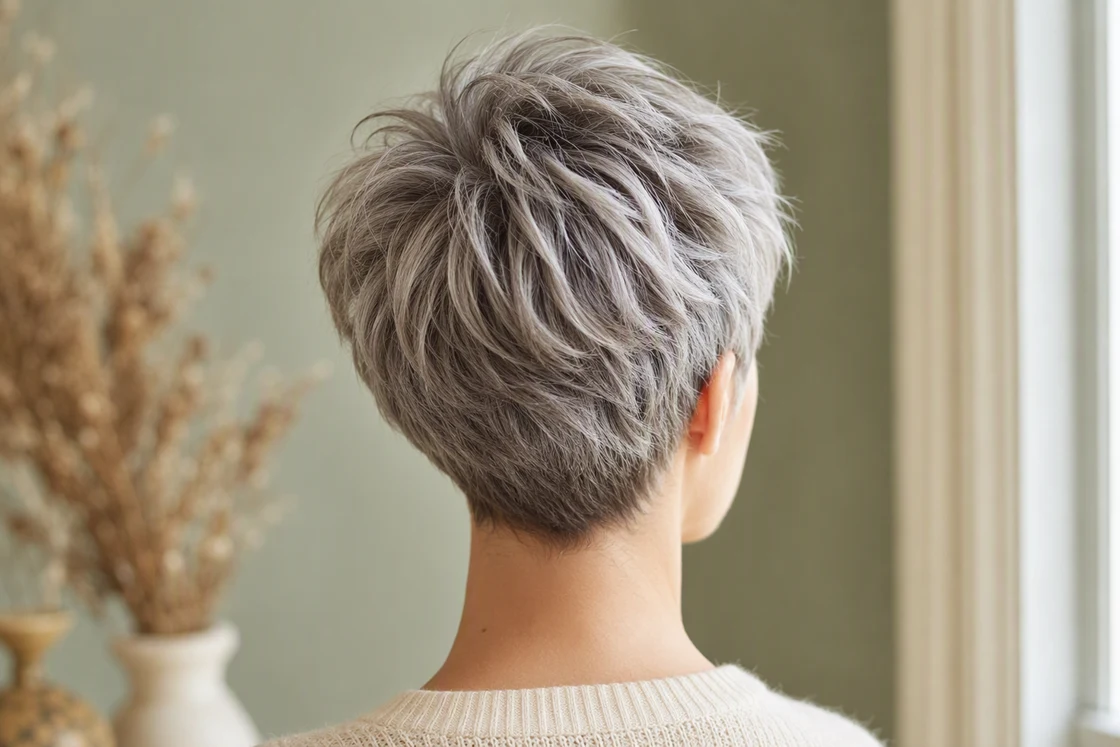
Search any hair question that starts with “does” and the autocomplete fills in the worries for you: does short hair make you look older, does gray hair, do bangs help, is long hair over after 50. The answers on offer are mostly forum threads and comment sections, where one stranger’s taste gets dressed up as a law of nature. This page audits the six most-searched of those questions against the perception mechanics we mapped in haircuts that make you look younger, which is the framework everything below leans on. Every verdict is a “no, but” or an “only when,” because that is what the evidence actually supports: no length, color, or part carries an age by itself, and each one has a specific mechanism that decides how it reads.
What decides these questions before taste gets a vote?
Five inputs, all of them measurable or at least observable, and none of them a birthday.
Movement: hair that separates and resettles when you move reads alive; hair locked in position reads tired at any age. Apparent density: how full the hair reads at the perimeter and the part, which a cut can raise or squander independent of your actual fiber count. Shape currency: whether the silhouette belongs to this fashion cycle or a previous one. Those three are the core levers from our cut guide, and they do most of the work in every question below.
Two more join for the color and length questions. Condition: shine and intact ends are direct perception inputs. In eye-tracking experiments, identical hair rated significantly younger, healthier, and more attractive in its undamaged version than after controlled cuticle damage, purely from the change in optical properties [5]. research-backed Contrast: the relationship between hair color and skin, which shifts as skin gradually lightens and gets less even over the decades [4, 6].
One honest caveat before the verdicts. The cleanest studies in this field work by editing photographs: same face, hair digitally altered, strangers asked to rate age [1, 2]. That design isolates single variables beautifully, and it also means the numbers describe first-glance averages of one manipulated cue, not how a whole person reads in a room where cut, condition, posture, and styling all arrive together. Treat the findings as pricing information, not verdicts on your head.
Does short hair make you look older?
No, but a dated short shape does, and short shapes date visibly because there is nowhere to hide the shape.
Start with what short hair mechanically does. Hairs per square centimeter decline steadily with age, and average fiber diameter starts declining too after peaking in the early-to-mid 40s [3]. research-backed A short cut takes that reduced supply and concentrates it: every fiber arrives at a perimeter that is close to the scalp, so the hem reads dense, the crown can be built with lift, and no fiber is spent covering distance. On fine or thinning hair, short is the single most reliable way to raise apparent density, which is the opposite of an aging move. Perception work that manipulated hair amount directly found that fuller-reading hair shifted age and health estimates in the favorable direction [2].
So where does the myth come from? Association, not mechanics. For roughly two generations, one specific short cut, the tight, rollered, sprayed helmet, was the institutional default, so “short” and “that shape” fused in cultural memory. The shape was the signal: stiff, uniform, zero movement, visibly effortful. A modern short cut is built on opposite physics, length variation in the crown, textured rather than sealed ends, cut to the natural growth pattern so it air-dries into place. Same length category, opposite read.
There is one honest cost to name. Short hair removes the frame and puts more of the face and neck on display, and it commits you to the salon: a cropped shape needs a trim every four to six weeks, typically 40 to 80 dollars a visit in US salons, or it loses its line. If you want the density payoff with more frame, a chin-to-collarbone bob buys most of the same read with an eight-week schedule. The cut families that do this best, with specs, are in our guide to short hairstyles for women over 50.
The screenshot for your stylist: “I want short with movement, not a set shape. Keep some length and lift in the crown, texture the ends instead of blunting them shut, and show me how it falls air-dried with no product.”
Does gray hair make you look older?
On average, yes, by a little, in photo ratings. In practice, the cut and the condition decide far more than the pigment, and those stay in your hands either way.
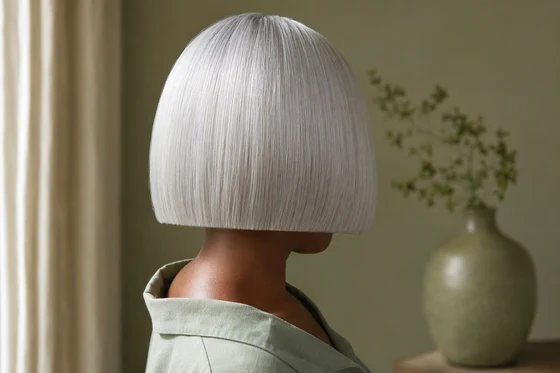
This is the one question on the page with a direct experiment behind it. In a 2025 study, researchers digitally altered the same faces to have gray or pigmented hair and had participants rate them. Gray-haired versions were rated meaningfully older and somewhat less attractive; perceived social status did not move, and a trust penalty appeared only among male raters [1]. research-backed So the average first-glance effect is real, and pretending otherwise would be selling you something.
Now the context the photo design cannot capture. The edited images changed pigment and nothing else, but on a real head, gray never arrives alone. The fiber itself changes: unpigmented strands often grow coarser, drier, and with more spring, and the scalp delivers less oil to smooth them [7]. Left unmanaged, that reads as frizz and dullness, and dull, weathered fiber independently pushes age estimates up [5]. Managed, silver takes and holds shine unusually well because of its translucency. The same divergence applies to shape: gray inside a current, deliberate cut with maintained ends reads as a decision; identical gray in a grown-out shape gets read as neglect, and neglect is the harsher signal than the pigment ever was.
Which means the question “does gray make me look older” is really three separate decisions. Keep covering, which buys back the rated average at the price of a hard regrowth line every three to five weeks. Blend, which softens the transition and cuts visits roughly in half. Or go fully silver and spend the budget on the cut and the condition instead. We priced all three paths, in dollars and chair hours, in gray blending vs gray coverage. There is no wrong door. There is only an honest price tag on each, and the study above is part of the price information, not an instruction.
Does long hair age you after 50?
Only when your density can no longer fund the length. The rule “no long hair after 40” is a convention with no evidence behind it.
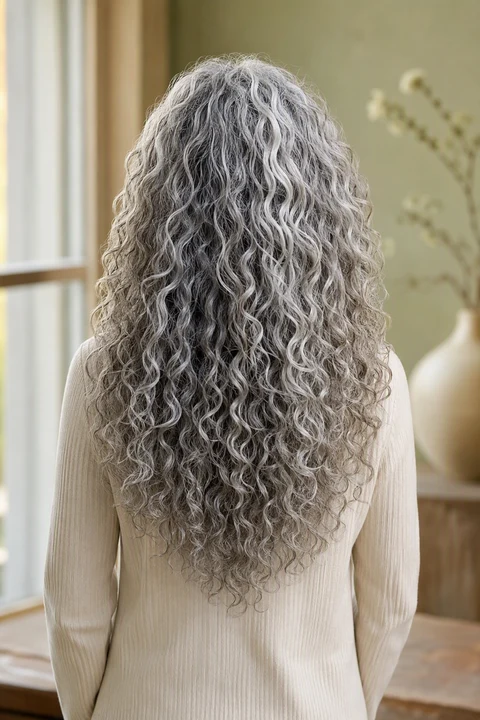
The arithmetic is the whole answer. You have a fixed and gradually declining number of fibers [3], and length is how far you ask them to stretch. Long hair spreads that count over maximum area, so it is the first place reduced density becomes visible: the ends go translucent while the mid-lengths still read fine. Add that the oldest hair on your head lives at those ends, eight-plus years of cumulative weathering on a 24-inch length, and the tips are also where condition breaks down first, the exact cue raters punish [5]. See-through, dry ends are what people are actually seeing when they say long hair “ages” someone. The length is innocent; the ends are guilty.
Run the test in a mirror: is the bottom third as visually substantial as the middle third? If yes, your length is funded, and long hair after 50 reads exactly as well as its condition and front. Keep it working with the same levers as any cut: face-framing pieces for movement, real trims that remove the spent inches rather than dusting them, and no daily flat-ironing of fiber that has less margin for heat than it used to [7]. If the answer is no, the repair is not a rule about your age, it is a hemline moved up to where the density still is, which makes everything you keep read fuller. The collarbone-to-shoulder range that solves this for most women is mapped in medium length hairstyles for women over 50.
The “cut it off at 40” convention deserves its label: convention. It dates from eras when long hair on adult women read as unfinished because the norm said so. Norms moved. Density math did not, and it was always the real mechanism hiding under the rule.
Do bangs make you look younger?
Only the soft kinds, and only through three specific mechanical effects. The heavy blunt kind can spend more than it pays.
The pro-bangs case is real. A curtain fringe or long, soft bangs do three things at the highest-traffic zone of the head. They add movement at the front, pieces that shift and separate right where people look during conversation. They break up the part line at its origin, which is where a widening part shows scalp first. And they cover the temples and hairline, which are among the earliest zones to lose density [3]. Those effects are why “get curtain bangs” became the reflex advice of this fashion cycle, and the advice is mechanically sound, which is exactly why it needs its other half stated.
The costs. Fringe is the highest-maintenance real estate on your head: it needs a trim every three to four weeks to stay off your eyes, it is the first section to collapse in humidity or oil, and it demands a few genuine styling minutes most mornings. A heavy, straight-across blunt fringe raises the stakes further: it requires a dense hairline to look like the reference photo, so on a thinned front it reads sparse precisely where you wanted coverage, and it deletes movement from the one zone the soft version animates. If your hairline is the concern, the soft version is the only version that helps. Note the shape-currency component too: the curtain fringe is current this cycle, the heavy side sweep of the 2000s is not, and both facts will eventually expire. convention
The screenshot for your stylist: “Cut me a curtain fringe I can grow out without a bad phase: start it at cheekbone length, blend it into the face frame, and show me the two-minute morning version.”
Does dark hair make you look older than light hair?
No shade carries an age by itself. The working variable is contrast against your skin, and that is a moving target.
Two findings anchor this one. First, facial contrast, how much features stand out from surrounding skin, measurably declines with age and is itself a cue people use when estimating age [4]. Second, in a study on lightly pigmented young women, hair color and skin color interacted: lighter hair shifted age ratings downward on light skin, and the effect depended on the skin it sat against [6]. Read together, the honest summary is that color effects are real but contextual, and the popular one-liner “everyone should go lighter with age” flattens a conditional finding into a universal rule. mixed evidence
The mechanism worth keeping is the edge. Skin gradually lightens and grows less even over the decades, so a solid, single-field jet black sits against light mature skin with a harder boundary than it did at 35, and it resells that boundary every morning at the roots, where white regrowth shows within days. The repair is not necessarily lightening: a deep brunette broken up with dimension keeps the depth while softening the edge, and on deeper skin tones dark hair sits naturally at every age because the contrast math is entirely different. Flat platinum has its own failure mode, removing so much contrast that hair and light skin read as one washed-together field. Both extremes lose to shades within a few levels of your natural depth, worn with some dimension, which is the full argument of hair color for women over 50, including how the math changes across skin tones.
Does a center part make you look older?
No. The part debate is fashion cycling. The real question is what your part exposes, and that is a density question.
The center-versus-side argument went viral as a generational purity test: side parts read millennial, center parts read current. That entire framing is convention, and it has already begun rotating again, which is what conventions do. No perception study supports an age effect for part geometry, and a rule that flips every few years was never about your face.
What a part actually does is allocate hair and expose scalp. A center part is the least forgiving allocation: it splits your hair into two equal curtains, holds each flat against the head, and displays the scalp line at its most symmetric and visible. On thick hair this reads sleek and architectural. On fine or thinning hair it is the single easiest way to make a widening part the focal point of your face. A side part, especially a deep one, folds the heavier side over the sparser one, adds asymmetric lift at the crown, and shortens the visible scalp line. A zigzag or diffused part erases the line altogether.
So choose by exposure, not by decade. If your density is even and strong, part wherever your growth pattern cooperates, center included. If your part line has widened, move the part an inch off its worn track, in either direction: hair trained into one position for years leaves a groove, and relocating it is the cheapest fuller-reading change in this entire FAQ, requiring no scissors, no color, and no money.
Every verdict in one table
| The question | The verdict | The lever actually doing the work |
|---|---|---|
| Does short hair make you look older? | No, but a dated or stiff short shape does | Apparent density up, but shape currency and movement must come from the cut |
| Does gray hair make you look older? | On average yes, slightly, in photo ratings | Pigment is one input; condition and shape currency dominate in practice |
| Does long hair age you after 50? | Only when density no longer funds the length | Apparent density at the ends, plus condition of the oldest fiber |
| Do bangs make you look younger? | Only soft, movable kinds on a hairline that supports them | Movement at the front, coverage of temples and part line |
| Does dark hair age you? | No shade does by itself | Contrast against skin that has lightened and softened |
| Does a center part age you? | No, the debate is fashion cycling | Scalp exposure and volume allocation, decided by your density |
Six questions, one pattern. Nothing on the list carries an age. Each one either raises or lowers a mechanical read, movement, density, currency, condition, contrast, and the same choice can point opposite directions on two different heads.
The bottom line
None of the things people fear, short, gray, long, bangs, dark, center-parted, does what the forum threads claim, and each has a narrow “only when” that the mechanics explain. The rating studies are worth taking seriously as averages [1, 2], and they still measure single cues in edited photos, while you get to play every lever at once. So run any future “does X age you” question through the same audit this page did: what does it do to movement, apparent density, shape currency, condition, and contrast on your actual hair? If the answer is “raises them,” the calendar is irrelevant. The full playbook for pulling those levers on purpose is in haircuts that make you look younger, and every choice on this page remains exactly that: a choice, priced honestly, made by you.
Frequently asked questions
Is a pixie cut aging on women over 50?
No cut is aging by itself. A pixie concentrates all of your hair into its shortest, densest read, which is why it is a standard recommendation for fine and thinning hair. What reads dated is a stiff, set pixie with no movement, or a shape left unchanged for a decade. A textured pixie with length variation in the crown reads current on any birthday, at the cost of trims every four to six weeks.
Does gray hair age a woman's face?
In the best available study, faces digitally edited to have gray hair were rated as older and somewhat less attractive than the same faces with pigmented hair, so the average effect is real. It is also only one input: the study could not vary cut, condition, or styling, which are the levers that decide whether gray reads deliberate or neglected in real life. Whether that average is worth the cost of covering it is a personal calculation, not a rule.
At what age should you stop having long hair?
There is no such age, and no study supports one. The honest test is density, not birthdays: long hair works as long as your ends still read substantial rather than see-through, because length spreads a fixed number of fibers over maximum area. If the bottom third has gone sparse, raising the hemline makes everything you keep read fuller. That can happen at 35 or never.
Do curtain bangs make you look younger?
They add movement at the front of the face, soften the part line, and cover the temples, where density commonly drops first. Those are real mechanical effects, which is why the recommendation is so common. They are not a general rejuvenator, and they cost styling minutes most mornings plus a trim every three to four weeks to stay out of your eyes.
Does a center part make you look older than a side part?
No. The center-versus-side debate is fashion cycling, not perception science. The real difference is exposure: a center part shows the scalp line symmetrically and splits hair into two equal halves, so it is the least forgiving choice on fine or thinning hair. A side part folds more hair over the sparser side. Pick by density and growth pattern, not by which generation currently claims which part.
Does dark hair make you look older after 50?
Not by itself. The working variable is contrast between hair and skin, and skin gradually lightens and gets less even with age, so a solid jet black sits harder against light mature skin than it did at 35. On deeper skin tones the same black can sit naturally. Softening a dark shade with dimension keeps the depth while easing the hard edge, which is a different move than going light.
Does thin hair make you look older?
Reduced density does shift age estimates in perception studies that manipulate hair amount directly, so the concern is not imaginary. The practical lever is apparent density rather than fiber count: a shorter, blunter perimeter placed where your hair is still substantial reads fuller than long, tapered ends, and a moved part or soft fringe covers the zones where scalp shows first.
Is it better to go shorter as you get older?
Shorter is a tool, not a duty. It raises apparent density and cuts styling time, which is why so many women choose it, but the same reads can be achieved at collarbone length with a substantial perimeter and face-framing movement. If your density supports the length you love, keep it. The only expensive choice is keeping a length your ends can no longer fund.
- Nutt KM, Thorstenson CA, Yorzinski JL. Gray hair influences perceived age and social perceptions. Front Psychol. 2025;16:1541836.
- Will F, Fink B, et al. Perceptions of female age, health and attractiveness vary with systematic hair manipulations. Int J Cosmet Sci. 2026.
- Robbins C, et al. What women want: quantifying the perception of hair amount, an analysis of hair diameter and density changes with age in Caucasian women. Br J Dermatol. 2012;167(2):324-332.
- Porcheron A, Mauger E, Russell R. Aspects of facial contrast decrease with age and are cues for age perception. PLoS One. 2013;8(3):e57985.
- Fink B, Neuser F, Deloux G, Röder S, Matts PJ. Visual attention to and perception of undamaged and damaged versions of natural and colored female hair. J Cosmet Dermatol. 2013;12(1):78-84.
- Fink B, et al. Hair colour and skin colour together influence perceptions of age, health and attractiveness in lightly pigmented young women. Int J Cosmet Sci. 2018;40(3):303-312.
- Trüeb RM. Aging of hair. J Cosmet Dermatol. 2005;4(2):60-72.