Hair color, decoded
Hair Color for Women Over 50: What Works, What Ages You, and Why
The best hair color after 50 is decided by contrast, not by a shade list. Skin gradually lightens, yellows, and gets less even with age, so a solid jet black reads harsher against it and a flat all-over platinum reads flatter than either once did. Shades within a few levels of your natural depth, broken up with dimension, work with those changes, and the real decision, keep coloring, blend, or go fully gray, is a maintenance contract with honest costs on every path.
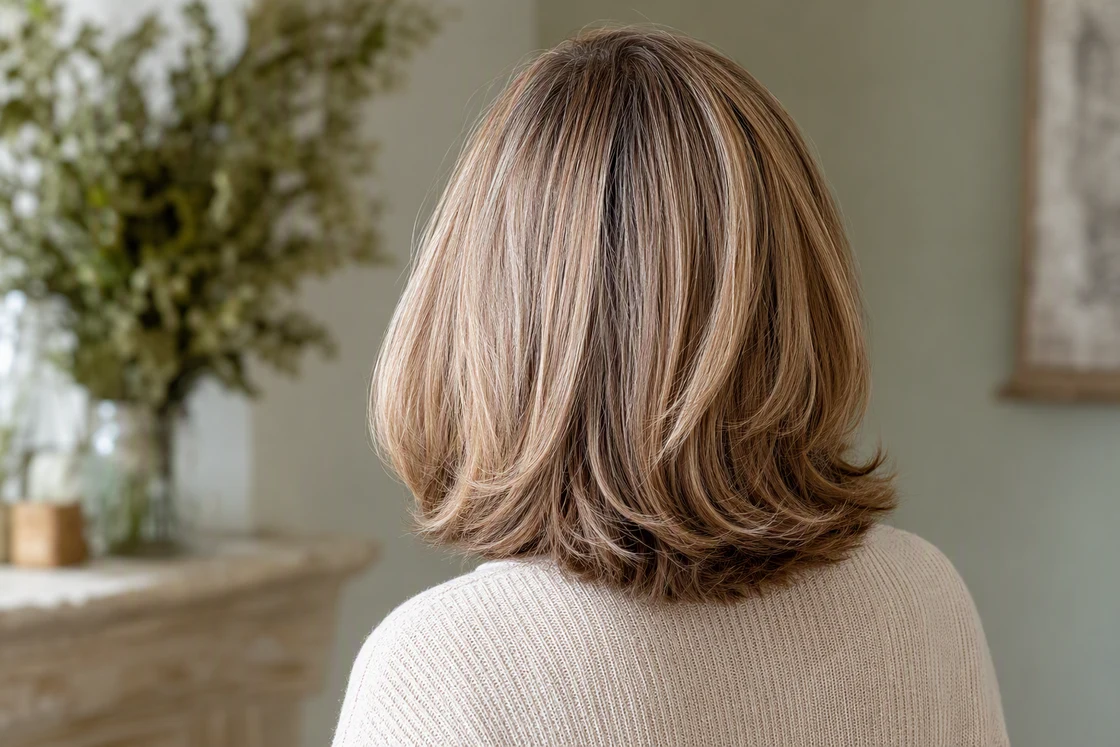
Most hair color advice for women over 50 is a shade list: go caramel, avoid black, add honey. Lists date fast and explain nothing. The useful version is a mechanism: your skin has been slowly changing tone and evenness for decades, your hair is changing its base color from underneath, and every dye decision is really a decision about how much contrast to place next to your face and how much upkeep to sign up for. Once you see those two variables, contrast and cost, the entire topic gets simpler, and you can evaluate any shade yourself instead of waiting for a list.
This guide covers what measurably changes in skin and hair, why the two famous extremes, solid jet black and flat platinum, behave differently than they did at 35, what the warm-versus-cool debate actually rests on, and the three honest paths forward: keep coloring, blend, or go fully gray, each with its real price in dollars, weeks, and chair time.
What actually changes, and why does your old formula stop working?
Two things drift at once: the background your hair sits against, and the hair itself.
The skin field lightens, yellows, and gets less even. The number of active pigment cells in skin declines by roughly 10 to 20 percent per decade, while the pigment that remains distributes less evenly, which is why overall tone lightens as spots and patches increase [3]. On top of that, facial skin measurably shifts toward yellow with age; a study of Japanese women found yellowish discoloration correlated with age and with the accumulation of glycation products in the skin, independent of melanin [2]. This is research-backed, and it means the canvas next to your hair color is not the canvas your twenties formula was mixed for: it is lighter, warmer, and less uniform.
Facial contrast declines, and observers read it. In a large sample of adult women, the contrast between facial features and surrounding skin, the darkness of brows against forehead, the redness of lips against cheek, decreased steadily with age, and when researchers artificially raised or lowered that contrast in photos, raters judged the same face as younger or older accordingly [1]. Also research-backed, and directly relevant: hair is the largest color block adjacent to your face, so hair-to-skin contrast is the biggest single contrast decision you control. We use the same principle for cut and shape in haircuts that make you look younger; color is where it operates most literally.
The hair changes underneath the dye. Graying is not only pigment loss. Fibers that stop producing melanin also show altered lipid content, reduced luster, and often more curvature, so the incoming hair is optically and mechanically different fiber, not just white fiber [4]. Dye takes differently on it, it reflects light differently, and the percentage of it rises on its own schedule, which is why a formula that was stable for fifteen years can start producing a slightly different result with no change at the salon.
None of this says any shade is forbidden. It says the same tube of color now produces a different picture, because half the picture changed.
Why do jet black and flat platinum read differently now?
These two get named in every article on this topic, usually with a scolding tone. Drop the scolding and the mechanism is actually interesting: they are the two ends of the same dial.
Solid jet black is the maximum-contrast setting. A level 1 to 2 black against light or medium skin is the strongest hair-to-skin contrast a colorist can build, and it is applied as a single unbroken field. Two consequences follow. First, maximum contrast sharpens everything at the boundary: the hairline, and every shadow and texture variation in the skin beside it, reads more emphatically against a black frame, and skin that has become less even gives that frame more to emphasize. Second, single-process black over graying roots creates the most visible regrowth line in all of hair color: white against near-black shows within days, which converts jet black from a color into a 3-week maintenance contract. On deep skin tones the math is different: black hair against deep skin is moderate contrast, sits naturally, and carries none of this penalty. That distinction alone should make you suspicious of any one-size shade rule.
Flat platinum is the minimum-contrast setting. Take the same dial to the other end: an all-over level 10 against light skin that has itself lightened with age produces almost no boundary at all. Face, hairline, and hair merge into one pale field, which is precisely the low-contrast condition that the age-perception research associates with older ratings [1]. The common colorist description, “washed out,” is a reasonable plain-language summary of a measurable effect. Add the fiber cost: reaching platinum requires persulfate-boosted bleach, which is documented to damage both cuticle and cortex, leach structural proteins from the whole fiber, and oxidize the disulfide bonds that give hair its strength [6]. That is research-backed, and it lands on fiber that is already running drier with age [4]. Platinum is achievable after 50; flat, single-field platinum on drier fiber is simply the most expensive possible way to get the least structured result.
Dimension is the middle of the dial. The colorist consensus answer to both extremes is the same word: dimension, meaning two or three related levels woven through the hair instead of one flat field [7, 8]. The mechanism is plausible, variation within the hair restores structure without extreme block contrast at the boundary, but no controlled study has tested dimensional versus flat color on perceived anything, so file the specific claim as convention: near-universal among working colorists, unproven in a lab, and consistent with the contrast research without being confirmed by it.
Warm versus cool: what is actually known?
Less than the confidence suggests. The standard advice runs: warm tones (golden, honey, caramel, copper) soften mature skin, while ash and cool tones drain it. You will also find experienced colorists arguing the exact opposite: that skin yellows with age [2], so adding golden hair beside yellowing skin doubles down on sallowness, and a cooler, beiger tone balances it. Both camps cite the same underlying skin shift and reach opposite prescriptions, which is the signature of taste, not evidence. Label the whole debate mixed evidence at best, and treat any confident undertone rule as a hypothesis about your face, testable in an afternoon.
The test costs nothing. In daylight, hold something distinctly gold and something distinctly silver at your jaw, or warm and ash swatches from a drugstore color wall, and photograph each. One will usually make your skin look more even and awake and the other slightly gray or sallow. Your camera is a better instrument than the rule, because the rule was written for an average face and you are not obligated to have one. The full undertone method, including how to run it when your skin has both warm and cool zones, is in our guide to the best hair color for your skin tone.
One asymmetry is worth keeping: very ashy, matte cool shades absorb more light than they reflect, and on lower-contrast faces a light-absorbing field beside the skin flattens the picture further. If you test cool and it wins, colorists usually steer toward reflective cool, beige, pearl, silver, rather than flat ash. That steer is convention, but it is cheap to follow and easy to reverse.
Which colors add contrast, and which soften it?
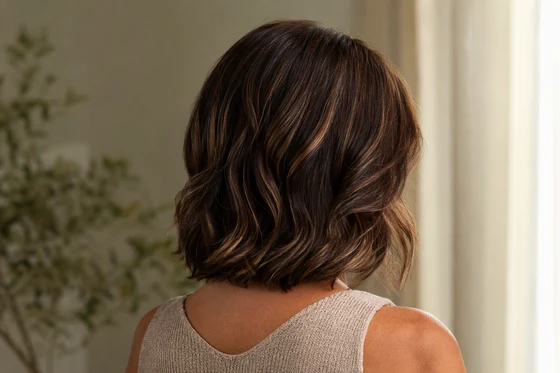
Here is the framing that replaces every shade list. Decide first whether your face benefits from more contrast (a stronger frame beside the skin) or softer contrast (a gentler gradient into it), then pick the shade family that delivers that. Women with strong natural contrast, dark eyes, dark brows, deeper or olive skin, generally carry high-contrast hair easily. Women whose overall coloring has softened often find high-contrast hair now wears them. The table prices each family honestly.
| Shade family | Contrast effect | Tends to serve | Honest upkeep |
|---|---|---|---|
| Soft black, espresso brown | Maximum frame, strong edges | Deep skin, dark eyes, low gray percentage | Retouch every 3 to 4 weeks once gray shows; hardest regrowth line |
| Rich brunette with fine dimension | High but broken up | Strong natural contrast, wants depth without a solid block | Retouch 4 to 6 weeks; dimension softens the line slightly |
| Chocolate, chestnut mid-brown | Medium; the workhorse zone | Most light-to-medium skin, 20 to 50 percent gray | 5 to 8 weeks; forgiving of a missed appointment |
| Dark blonde, bronde balayage | Medium-low, gradient built in | Growing gray in slowly, wants low visits | 8 to 14 weeks; the regrowth line barely exists |
| Honey, beige blonde | Low against light skin | Mostly gray already, light eyes | 6 to 10 weeks plus toner; brass management is the real chore |
| All-over platinum | Minimal; single pale field | Rarely the best version of light hair after 50 | 4 to 5 weeks plus toner plus bond repair; highest total cost |
| Natural silver, embraced | Depends on skin depth; can be striking on deep skin | Anyone done paying for color | Gloss or purple shampoo to manage yellowing; otherwise near zero |
Two notes on reading it. The middle rows are cheap in upkeep because they sit close to most natural bases, so regrowth arrives as a soft gradient instead of a stripe: proximity to your root color, not the shade itself, is what buys you weeks. And the last row is a real option, not a consolation row; on deep skin especially, full silver against darker skin is a genuinely high-contrast, deliberate look that costs almost nothing to run.
Keep coloring, blend, or go gray: what does each path cost?
This is the actual decision, and it is a maintenance contract before it is an aesthetic one. Three paths, priced.
Path 1: full coverage. Permanent color over all regrowth, on schedule. Once gray is concentrated enough to show at the part, that schedule is set by your regrowth rate, about half an inch a month, and your contrast: dark shades over white roots need a retouch every 3 to 4 weeks, mid-browns stretch to 5 or 6. In most US salons a root retouch runs 65 to 120 dollars, so the annual bill is roughly 800 to 1,700 dollars and 15 to 25 hours. Hair that is more than half gray often needs specific formulation and processing to grip coverage evenly [8], which is a reason to use a colorist rather than a box once you are past that line. Full coverage buys you a completely consistent color and costs you the treadmill; the honest question is whether you will still want this schedule in ten years, because the exit gets longer the darker you go.
Path 2: blending. Instead of covering gray, a colorist weaves highlights and lowlights through it so the gray reads as intentional dimension and regrowth arrives without a hard line. L’Oréal’s French Blending and equivalent techniques from other houses are built exactly for this: fine vertical weaves that integrate incoming gray with the base [7]. Sessions are longer and pricier, commonly 150 to 300 dollars, but you need only 4 to 6 a year, so the annual bill lands around 600 to 1,200 dollars with far fewer hours. Blending works as a destination, permanently managed salt-and-pepper, or as a multi-year off-ramp that ends at fully gray with no awkward stripe at any point. The full comparison, including which gray percentages each approach handles best, is in gray blending vs gray coverage.
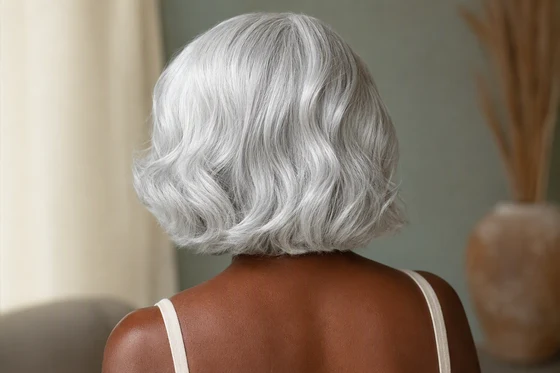
Path 3: fully gray. Stop coloring and let it grow, either cold turkey, wearing the line, or with a shorter cut that removes old color in months; the cut-length lever is covered in our hairstyles for women over 50 guide. Running cost after the transition is close to zero: a violet shampoo or an occasional gloss to keep white fiber from yellowing, and nothing else.
Price the perception side honestly too, because pretending it does not exist is its own kind of condescension. In a 2025 study, 120 participants rated faces that had been digitally altered to have gray hair as older and somewhat less attractive than the identical faces with pigmented hair; gray hair did not change ratings of social status or aggression [5]. That is research-backed, and it is also one study, using manipulated images rather than real people, measuring first-glance ratings rather than anything about your actual life. The finding prices the trade; it does not make the decision. Plenty of women look at that price, put it beside 1,500 dollars and 20 hours a year, and take the gray, and the growing number who do is itself shifting what the first glance reads.
There is no correct row in this table. There is only the trade you would rather make, chosen with the real numbers in front of you.
What does lightening do to fiber that is already drier?
If your path involves going lighter, blending, balayage, or blonde, the chemistry deserves two honest paragraphs.
Bleach does not tint hair; it demolishes pigment inside it. Peroxide and persulfate penetrate the fiber, and the electron-microscopy and proteomics work on bleached hair shows the collateral damage plainly: structural damage in both cuticle and cortex, proteins leached from the whole fiber, and the disulfide bonds that hold hair’s shape oxidized into non-functional forms [6]. Damage scales with how far and how fast you lift. Meanwhile the fiber you are lifting has less lipid and less natural oil arriving at it than it did twenty years ago [4], so the same process starts from a smaller margin.
The practical translation is not “do not lighten.” It is: lift fewer levels per session, accept two appointments where a 25-year-old might do one, use bond-building treatments as standard rather than as an upsell, and prefer techniques that lighten strands rather than the whole head, since a woven highlight leaves most of the fiber untouched. A colorist who proposes going slower on hair like yours is reading the chemistry correctly, not padding the bill.
How do you ask your colorist for this?
Consultations fail on vague inputs. These scripts carry the whole guide into the chair; screenshot the ones that match your path.
Staying dark without the block: “I want to keep my depth, but break up the solid field. Can we add fine dimension one to two levels lighter, mostly around the face, and keep the rest rich?”
Cutting the maintenance treadmill: “Show me the math on my current shade: how many weeks do I really get before the regrowth line shows? If we moved my base one level closer to my natural, how many weeks would that buy?”
Starting a blend: “I’m about 40 percent gray. Instead of covering it, can we weave highlights and lowlights through it so the gray reads as intentional? I want a grow-out with no hard line.”
Planning the exit: “I want to be fully gray in about 18 months. Walk me through the plan visit by visit: what happens at each appointment and what it costs, so there’s never a stripe.”
Managing white fiber: “My white hair yellows. Should I be on a violet shampoo, a salon gloss, or both, and how often?”
Testing tone honestly: “I’ve always been told I’m warm. Before we commit, can you hold cool and warm swatches at my face in daylight and give me your read?”
A colorist who answers these with specifics, levels, weeks, dollars, is planning your hair. One who answers with reassurance is planning your next appointment.
The bottom line
Hair color after 50 is a contrast decision wearing a fashion costume. Skin lightens, yellows, and loses evenness on a measurable schedule, so the two flat extremes, solid black and single-field platinum, read differently than they once did, while shades near your natural depth with some dimension work with the shift and cost the least to run. The warm-versus-cool rule is a coin with colorists on both faces: test it on your own skin in daylight and believe the photo. Then choose your contract, coverage, blending, or fully gray, by its real price in dollars, weeks, and hours, because that price, not your birth year, is the thing the decision actually turns on.
Frequently asked questions
Should I go gray or keep coloring my hair?
It is a cost and preference decision, not a rule. Full coverage costs roughly 10 to 14 salon visits a year and shows a hard regrowth line between visits; blending costs 4 to 6 visits with a soft grow-out; fully gray costs nearly nothing after the transition. One 2025 perception study found faces edited to have gray hair were rated as older, so weigh that honestly against the time and money, and decide which trade you prefer.
Is black hair dye too harsh after 50?
Solid jet black is the highest-contrast choice available, and because skin lightens and gets less even with age, that contrast reads stronger than it used to on light and medium skin. It also shows white regrowth within days, which makes it the most demanding color to maintain. On deeper skin tones the contrast math is different and black can sit naturally. If you love dark hair, a soft black or deep brunette with subtle dimension keeps the depth without the solid-block effect.
Does platinum blonde work on gray hair?
It can, but flat single-field platinum removes almost all contrast between hair and lighter skin, which tends to read as one washed-together block, and the bleach required is measurably damaging to fiber that is already drier with age. If you want very light hair, dimensional blonde with beige or silver tones and a darker root is easier on the fiber and keeps some structure. Expect toner refreshes every 6 to 8 weeks either way.
What is the lowest-maintenance hair color?
A shade within one to two levels of your current natural depth, applied with a blended or rooted technique. The closer the dye sits to what grows out of your scalp, the softer the regrowth line and the longer you can go between visits, often 10 to 16 weeks. High-contrast choices, very dark over gray or platinum over dark, are the highest-maintenance colors on the menu.
Does gray hair make you look older?
In the best available study, faces digitally altered to have gray hair were rated as older and somewhat less attractive than the same faces with pigmented hair, so the perception effect appears real. It is one study using edited images, it found no effect on perceived status, and it cannot weigh your time, money, or preferences. Many women decide the trade is worth it; the data just prices it honestly.
Should hair color get lighter as you age?
The rule that everyone should go lighter is a stylist convention, not a research finding. The mechanism behind it is real but narrower: lighter shades within a few levels of your base soften the line where gray grows in, which cuts maintenance. If you have deep skin or strong natural contrast, staying dark can suit you better than an imposed lightening schedule.
Are warm tones better than cool tones after 50?
Unproven either way. Skin measurably yellows with age, and colorists disagree about whether warm hair harmonizes with that shift or amplifies it, which tells you this is taste, not science. Test it cheaply: hold gold and silver fabric, or warm and ash color swatches, at your face in daylight and photograph both. Trust the photos over the rule.
How much does covering gray actually cost per year?
Full permanent coverage on visible regrowth needs a retouch every 3 to 5 weeks at roughly 65 to 120 dollars in most US salons, so 800 to 1,700 dollars a year plus 15 to 25 hours in the chair. Blending techniques drop that to roughly 600 to 1,200 dollars across 4 to 6 longer visits. Box color at home costs 10 to 20 dollars a month plus your time, with less control over the result on hair that is more than half gray.
- Porcheron A, Mauger E, Russell R. Aspects of facial contrast decrease with age and are cues for age perception. PLoS One. 2013;8(3):e57985.
- Ohshima H, et al. Melanin and facial skin fluorescence as markers of yellowish discoloration with aging. Skin Res Technol. 2009;15(4):496-502.
- Kang HY, et al. Alterations of the pigmentation system in the aging process. Pigment Cell Melanoma Res. 2021.
- O'Sullivan JDB, et al. Human hair graying revisited: principles, misconceptions, and key research frontiers. J Invest Dermatol. 2024.
- Nutt KM, Thorstenson CA, Yorzinski JL. Gray hair influences perceived age and social perceptions. Front Psychol. 2025;16:1541836.
- Grosvenor AJ, et al. The physical and chemical disruption of human hair after bleaching: studies by transmission electron microscopy and redox proteomics. Int J Cosmet Sci. 2018;40(6):536-548.
- L'Oréal Professionnel. French Blending: The Art of Grey Blending by Hair Professionals.
- Wella Professionals. All You Need to Know About Gray Coverage.