Hair color, decoded
Gray Blending vs Gray Coverage: Which Is Right for You?
Gray blending weaves highlights, lowlights, and a demi-permanent gloss through your natural gray so regrowth comes in soft and salon visits stretch to 3 or 4 months. Gray coverage uses permanent dye to cover gray completely, which commits you to a root line and touch-ups every 4 to 6 weeks. Under about 25% gray either works; between 25% and 50% blending usually wins on upkeep; past 50% the honest choice is full coverage with its schedule, or working with the gray instead of against it.
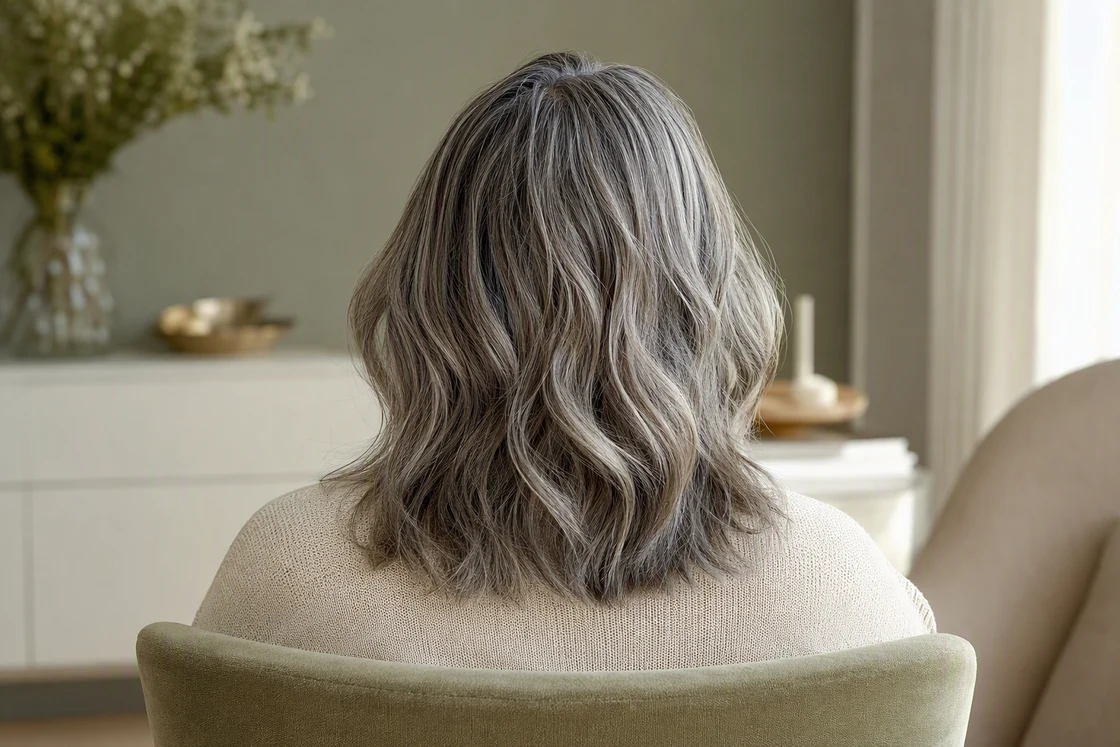
Somewhere between the first scattered silver strands and a fully gray head, every colored-hair owner hits the same fork: keep covering it, or start blending it. The two paths cost different amounts, age differently between appointments, and lock you into very different salon calendars, and almost nobody lays that math out before you have already committed to one of them. This guide does. It is a decision framework built on your actual gray percentage, the chemistry of what each service does to the fiber, and honest US pricing, not on a product line’s marketing calendar.
One framing note before the mechanics: neither path is the responsible one and neither is giving up. Covering gray completely, blending it, or wearing it untouched are three valid answers to a maintenance and contrast question. The only mistake available here is choosing a path whose upkeep you will not actually do, because every one of these looks is defined less by day one than by week five.
What is the actual difference between blending and coverage?
Coverage is subtraction: permanent, opaque dye makes every strand read as one pigmented color, and the gray is gone until it regrows. Blending is contrast management: the gray stays, and the colorist reduces the visual gap between gray and pigmented hair with fine highlights, strategic lowlights, and a translucent gloss, so the gray reads as deliberate dimension instead of as regrowth.
That difference in goal drives everything downstream. Coverage produces a uniform field of color, which is exactly why it fails loudly: the moment new growth appears at the scalp, a contrasting stripe sits against that uniform field, and on medium to dark shades it is visible within 3 to 5 weeks. Blending produces a varied field, light and dark strands interleaved, and new gray growth appears inside that variation rather than against it. There is no single line to police, which is why blended heads go 10 to 16 weeks between appointments and coverage heads do not.
The trade runs the other way too, and it deserves equal honesty. Coverage is the only option that makes gray invisible. Blending never does; it makes gray look chosen. If what you want is zero visible gray, blending will read to you as a compromise every time you look in the mirror, and you should pick coverage with full knowledge of its schedule rather than be talked into a blend you resent.
What is actually happening when hair goes gray?
Two mechanisms, both one-directional for most follicles. Each hair follicle keeps a small reservoir of melanocyte stem cells that rebuild the pigment factory at the start of every growth cycle; with age and accumulated cellular stress those reservoirs deplete, follicle by follicle, and a follicle whose reservoir is gone grows unpigmented hair from then on [3, 6]. On top of that, graying follicles accumulate hydrogen peroxide because the enzymes that normally break it down decline, and that oxidative load blunts the pigment machinery directly [2]. This is research-backed, and it explains the pattern you actually see: graying is not a uniform fade but a strand-by-strand conversion, which is precisely why scattered early gray takes so well to a strand-by-strand technique like blending.
Two useful corrections to folklore. First, the “50% of people are 50% gray by 50” rule is wrong: in a worldwide survey of 4,192 people, only 6% to 23% of those around 50 had half-gray hair depending on ancestry, and across ages 45 to 65 about 74% had some gray at an average intensity of 27% [1]. research-backed If you are 48 with a quarter of your hair gray, you are not behind or ahead of anyone; you are the statistical center of the range this article’s framework is built for. Second, graying is mostly but not perfectly permanent: a small quantitative study documented individual strands regaining pigment along their length, correlated with periods of lower reported stress, mainly in early gray [4]. The effect is real but modest and documented in few subjects, so treat “reduce stress, reverse gray” claims as mixed evidence. Plan your color around gray increasing, because for the population as a whole it does.
The planning consequence is the part colorists rarely say out loud: whatever percentage you have today is the floor, not the ceiling. A coverage habit signs you up for a workload that grows. A blending pattern, built correctly, absorbs new gray into itself for years before it needs restructuring.
How much gray do you have, and what does it recommend?
Colorists estimate gray as a rough percentage, usually judged at the front hairline and part, where gray concentrates first and shows most. Do it yourself in daylight with your hair parted where you normally wear it. Distribution matters as much as the number: gray focused in a front streak behaves differently from gray salted evenly through the head.
Under 25% gray. Everything works, so choose by maintenance appetite, not by panic at the first strands. A demi-permanent gloss alone will soften scattered gray into something that reads like subtle highlights and fades without a line. Salt and pepper highlights, fine woven lights that echo where your gray already is, make the gray part of a pattern. Full coverage also works effortlessly at this stage, and that is exactly its trap: it is the easiest moment to start a permanent-dye habit and the hardest habit to exit later, because from the first application you have created the root-line problem you did not have before. convention among colorists is to delay opaque permanent color as long as a gloss or blend still satisfies you, purely to keep your options open.
25% to 50% gray. This is blending’s home range and the range where the decision genuinely matters. There is enough gray that a bare gloss no longer fully convinces, and enough pigmented hair that the blend has material to work with. A highlight-lowlight-gloss build here typically holds 10 to 16 weeks. Coverage still works, but this is where its schedule bites: with this much gray, regrowth contrast is strong, and dark-based coverage needs touch-ups every 4 to 5 weeks to stay clean. Run the annual math below before defaulting to it. If you are also rethinking overall color placement, our guide to low-maintenance hair color covers the general principles this range rewards.
Over 50% gray. The logic flips. Blending works by presenting gray as light pieces within a pigmented field; once gray is the majority, the field is gray, and there is not enough pigmented hair to carry the illusion. Your real options become: full coverage, accepted with open eyes and its 4-week rhythm; lowlights, which reverse the blending direction by weaving pigmented strands through the gray for dimension while letting gray remain the base; or wearing the gray with a clear or toned gloss for shine and to neutralize yellowing. All three are legitimate. What stops being on the menu is the 12-week soft-regrowth blend that works so well in the middle range, and a colorist who promises it at 70% gray is selling the wrong service.
What does each technique actually do?
Blending highlights (including salt and pepper highlights). Fine sections of pigmented hair are lifted lighter, toward the tonal neighborhood of your gray, using lightener or high-lift color in foils or painted freehand. The placement logic is the same family of choices covered in balayage vs highlights: foils give more lift and precision, painting gives a softer diffusion. The blend is then usually finished with a gloss to unify tone. Cost: roughly $150 to $300 for partial work, $200 to $400 for full or freehand work in city salons. Interval: 10 to 16 weeks. Regrowth: diffuse, no hard line. Damage: concentrated in the lightened strands; this is the component that costs fiber integrity, particularly on dark hair.
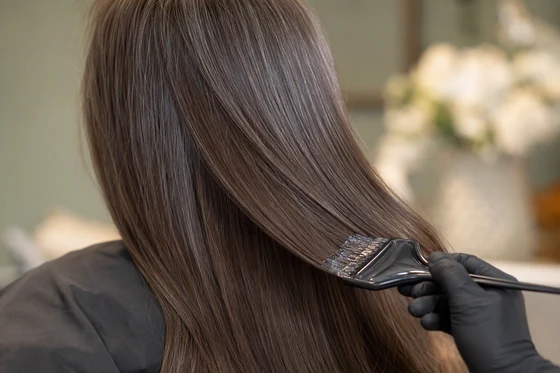
Lowlights. The mirror image: strands of pigment-matched or slightly darker color woven into heavily gray zones, depositing rather than lifting. On 50%-plus gray this restores dimension without committing the whole head to coverage. Usually done with demi-permanent color so the lowlights fade soft instead of growing out as dyed stripes. Cost: $100 to $250 depending on how much is woven. Interval: 8 to 14 weeks, because demi lowlights fade as well as grow.
Demi-permanent gloss. The chemistry matters here, because demi is the most misunderstood service on the menu. Demi-permanent color uses the same oxidative dye intermediates as permanent color but pairs them with a gentler alkalizer, typically an ethanolamine rather than ammonia, and a low-strength developer around 1% to 3% peroxide versus 3% to 6%-plus for permanent [5]. research-backed The practical consequences: it deposits translucent color without meaningfully lightening your natural pigment, it penetrates less deeply and therefore fades gradually over roughly 4 to 8 weeks instead of growing out as a line, and on gray it produces a sheer, lighter version of the target shade rather than opaque coverage. Colorists describe the effect on gray as smoke or a veil: the gray is toned and dimmed, not gone. Cost: $40 to $120 standalone, often $25 to $75 as an add-on. Interval: 6 to 8 weeks if worn alone. Damage: minimal; this is the gentlest oxidative service available.
Permanent full coverage. Ammonia opens the cuticle, peroxide at 3% to 6% or more lifts some of your natural melanin, and small dye precursors penetrate the cortex and polymerize there into large, wash-fast pigment molecules [5]. The result is opaque, uniform, and durable, which is the entire point and the entire problem: durable color does not fade at the roots to meet regrowth, so the demarcation line is sharp. Resistant gray, which colorists report takes color less readily, is conventionally handled with more natural-series pigment in the formula and sometimes longer processing; that resistance is widely observed in salons but thinly studied, so file it under convention. Cost: $65 to $130 for a root touch-up, $80 to $180 for all-over color. Interval: 4 to 6 weeks, closer to 3 to 4 on dark shades with high gray contrast. Damage: moderate and cumulative with monthly repetition, though each session is gentler than a lightener session.
The decision table
| Technique | What it does to gray | Sweet spot | Cost per visit (US) | Return interval | Regrowth line | Exit difficulty |
|---|---|---|---|---|---|---|
| Demi gloss alone | Tones and sheers it, does not cover | Under 25% | $40-120 | 6-8 weeks | None, fades out | Easy: stop, it fades |
| Blending highlights + gloss | Makes gray read as dimension | 20-50% | $150-400 | 10-16 weeks | Diffuse, soft | Easy-moderate: grow out soft |
| Lowlights through gray | Adds dark dimension, gray stays base | 50%+ | $100-250 | 8-14 weeks | Soft | Easy: fade + grow |
| Permanent full coverage | Covers it completely | Any %, if you accept the schedule | $65-180 | 4-6 weeks (3-4 on dark hair) | Sharp stripe | Hard: 12-24 month transition |
Why is dark hair the hardest case?
Contrast. The visibility of regrowth is a straight function of the gap between scalp-line hair and the color sitting on the lengths. White regrowth against a level 8 blonde is a whisper; against level 3 espresso it is a stripe you can read across a room at three weeks. Dark hair therefore pays the highest coverage tax, the shortest intervals on the menu, and also faces the steepest blending problem, because blending asks you to lift some of that dark hair toward the tonal range of gray, and dark hair does not go quietly.
Lifting level 3 to 5 hair exposes its underlying warm pigment in sequence: red, then orange, then yellow. To get lifted pieces anywhere near a silver-adjacent tone takes a lightener, usually multiple levels of lift, and a toner to cancel the warmth, and the fiber pays for every level [5]. On dark hair you are really choosing between two blends. The silver-smoke blend: lift selected strands high enough to meet the gray, tone them cool, accept more chemistry, more cost per session, around $250 to $450, and a colorist skilled enough to do it without visible brass. The warm-dimension blend: lift less, settle for caramel or soft brown highlights that reduce contrast without matching the gray, gentler and cheaper, but the gray remains somewhat visible as the lightest element in the mix. Both are legitimate; the second is honest about dark hair’s chemistry, the first is honest about its budget. What does not work on dark hair is demi gloss alone once gray passes roughly 20%: a deposit-only product cannot close a five-level gap, and asking it to leads to the muddy translucent result that makes people distrust glosses. Tone choice for either route, warm or cool, is covered in best hair color for your skin tone.
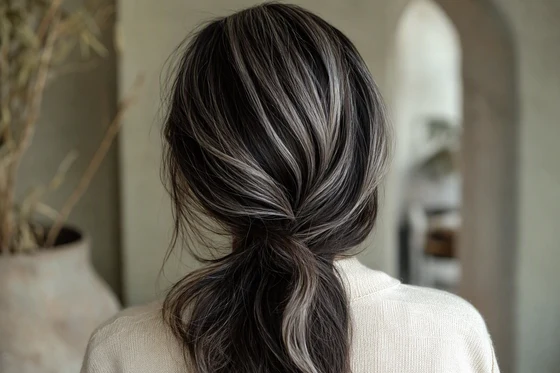
Salt and pepper deserves its own line here because dark hair is where it was invented: on naturally dark hair graying in streaks, fine cool highlights plus the existing gray genuinely mimic the mixed steel-and-pepper heads that read as striking rather than unfinished. It is the strongest argument that dark hair’s high contrast can be an asset, since the finished blend has a depth that blonde blending cannot produce.
What does each path cost per year?
Run the numbers over twelve months, because per-visit prices are designed to look small.
Permanent coverage on dark hair, 4-week interval: 12 to 13 visits at $70 to $120 per root touch-up is $840 to $1,560 per year, before the two or three all-over refreshes most coverage heads add, call it $1,000 to $1,800 all-in, plus 25 to 40 hours of chair time.
Permanent coverage on lighter hair, 6-week interval: 8 to 9 visits, roughly $600 to $1,100 per year.
Blending, 12-14 week interval: 4 sessions at $175 to $350 is $700 to $1,400 per year, minus one if you stretch, plus optional $50 gloss refreshes between. Chair time around 8 to 14 hours.
Lowlights or gloss on majority-gray hair: 4 to 6 short sessions, $300 to $800 per year.
The headline is that blending is not cheaper per visit, it is cheaper per year and dramatically cheaper per hour of your life, while coverage buys something blending cannot: zero visible gray. Price both against what you actually value. And factor the exit: leaving coverage means growing out a solid dyed length at about half an inch a month, so a chin-length head is looking at 18 to 24 months of transition, while leaving a blend mostly means letting it fade. That asymmetry is the strongest argument for choosing blending in the middle range even when the annual costs tie.
How do you ask your colorist for this?
Colorists work better with mechanism than with mood words. Screenshot whichever of these matches your case.
Under 25%, first color service: “I have early scattered gray, maybe 15 to 20%. I do not want permanent color on my roots yet. Can we do a demi gloss, or fine salt and pepper highlights, so the gray blends in and there is no line when it grows?”
Middle range: “I’m around 35% gray, heaviest at my part and hairline. I want blending, not coverage: highlights and lowlights woven through the gray, demi gloss over the top, and I want to be able to go 12 weeks or more between visits without a root line.”
Dark hair: “My base is dark brown with about 40% gray. I know blending means lifting. Can we talk through both versions: lifting some pieces cool enough to meet the gray with a toner, versus warmer caramel dimension that just softens the contrast? I want to know the cost and the damage difference before we pick.”
Leaving coverage: “I’ve been on all-over permanent color every five weeks and I want off. Can you map a transition over the next three or four appointments: highlights to break up the solid color, demi gloss to blend the dyed lengths with the gray coming in, and trims as we go? Tell me honestly how many months it takes at my length.”
Staying with coverage, eyes open: “I want full coverage and I understand the schedule. Formulate for resistant gray, and tell me the realistic interval for my base color so I can budget the year.”
What if you are transitioning to fully gray?
The transition-to-gray path is really a managed exit from coverage, and blending is the vehicle. Cold turkey works, costs nothing, and looks like a hard two-tone line for a year or more; most people who quit quitting were defeated by that line, not by the gray. The blended exit runs: session one, highlights through the dyed length to shatter the solid color; session two, 8 to 12 weeks later, more lift where needed plus a demi gloss toned to sit between the dyed remainder and the incoming gray; sessions three and four, gloss and trim as the natural line moves down. From the second session onward the head reads intentional rather than half-done, which is the entire value of paying for the exit. A shorter cut compresses the timeline mechanically, since less length means fewer months of old dye to remove; if you are open to it, pairing the transition with a shape update from haircuts that make you look younger or the density-first thinking in hairstyles for women over 50 turns one disruption into one deliberate reset. Once fully transitioned, upkeep drops to an occasional violet-based or clear gloss to keep white hair from yellowing, which is the cheapest line item in this entire article.
The bottom line
Blending and coverage are not rival philosophies, they are tools for different gray percentages and different tolerances. Under 25% gray, a gloss or fine blend keeps every option open and permanent color is the one choice that quietly closes doors. Between 25% and 50%, blending usually wins the year on cost, hours, and regrowth grace, unless zero visible gray is the non-negotiable, in which case buy coverage knowing its 4-to-6-week rhythm. Past 50%, choose coverage, lowlights, or a toned gloss on open-eyed terms, because the soft middle path has run out of pigmented hair to work with. Whatever you pick, pick it by the week-five view and the twelve-month invoice, not the day-one mirror.
Frequently asked questions
What is the difference between gray blending and gray coverage?
Coverage uses permanent, opaque dye to make every strand one pigmented color, so gray disappears until it regrows as a visible root line. Blending does not try to eliminate gray: it uses fine highlights, lowlights, and a translucent demi-permanent gloss to reduce the contrast between gray and pigmented hair, so the gray reads as intentional dimension and regrowth has no single hard line.
How long does gray blending last?
The highlight and lowlight work typically holds 10 to 16 weeks because there is no solid line to grow out. The demi-permanent gloss layered over it fades sooner, usually 4 to 8 weeks or roughly 24 to 28 shampoos, and some clients refresh just the gloss between full appointments. Compare that with permanent coverage, which shows a root line in 3 to 5 weeks on medium to dark hair.
How much does gray blending cost?
In US salons, a blending session built on partial or full highlights with a gloss generally runs $150 to $350, more in major cities. The math works because you go 3 or 4 times a year instead of 9 to 12, so annual cost usually lands near or below a permanent-coverage habit at $70 to $130 per root touch-up every 4 to 6 weeks.
Does gray blending work on dark hair?
Yes, but it is the hardest case and the most technique-dependent. Dark brown or black hair must be lifted several levels to approach the tone of gray, which passes through strong orange and red stages and usually requires a lightener plus toner rather than one-step color. Expect either a silver-smoke blend that needs a skilled colorist and more chemistry, or a warmer caramel-dimension blend that is gentler but keeps some contrast.
What are salt and pepper highlights?
Salt and pepper highlights are a blending pattern for hair that is graying in scattered strands: fine cool-toned highlights are woven through the pigmented hair to echo the existing gray, and sometimes dark lowlights are added through heavy gray patches. The result mimics the look of natural mixed gray so new gray growth simply joins the pattern instead of standing out against it.
At what percentage of gray does blending stop working?
There is no hard cutoff, but past roughly 50% gray the logic flips. Blending works by making gray read as highlights within pigmented hair; once gray is the majority, there is not enough pigmented hair to carry the pattern, and you are really choosing between full coverage, lowlights through the gray, or wearing the gray with a gloss for tone and shine.
Can you blend gray with demi-permanent color alone?
Partly. A demi-permanent gloss deposits translucent color that softens gray to a lighter, blended version of your base shade rather than covering it, and because it cannot lighten hair it leaves your pigmented hair untouched. On its own it suits lower gray percentages and low-contrast hair; on darker hair most colorists pair it with highlights, because demi color cannot close a large gap between dark hair and white regrowth.
Is gray blending damaging to hair?
The gloss component is among the gentlest salon services, using low-level peroxide and an ammonia-free alkalizer. The highlight component is where damage lives, especially on dark hair that needs a lightener to reach gray-adjacent tones. Because blending touches only selected strands a few times a year, total chemical exposure is usually lower than monthly all-over permanent color, but a single aggressive lightening session can outweigh that.
How do I transition from permanent dye to my natural gray?
The standard route is a mapped transition over 2 to 4 appointments: highlights to break up the old solid color, a demi gloss to marry the dyed lengths to the incoming gray, then trims to remove the last dyed ends. Hair grows about half an inch a month, so a chin-length grow-out takes roughly 18 to 24 months cold turkey but looks intentional within 3 to 6 months with blending support.
- Panhard S, Lozano I, Loussouarn G. Greying of the human hair: a worldwide survey, revisiting the '50' rule of thumb. Br J Dermatol. 2012;167(4):865-873.
- Wood JM, et al. Senile hair graying: H2O2-mediated oxidative stress affects human hair color by blunting methionine sulfoxide repair. FASEB J. 2009;23(7):2065-2075.
- Inomata K, et al. Genotoxic stress abrogates renewal of melanocyte stem cells by triggering their differentiation. Cell. 2009;137(6):1088-1099.
- Rosenberg AM, et al. Quantitative mapping of human hair greying and reversal in relation to life stress. eLife. 2021;10:e67437.
- de Souza JC, et al. Comprehensive review of hair dyes: physicochemical aspects, classification, toxicity, detection, and treatment methods. ACS Omega. 2025.
- O'Sullivan JDB, et al. Human hair graying revisited: principles, misconceptions, and key research frontiers. J Invest Dermatol. 2024.