Hair color, decoded
Going Gray: The Complete Transition Timeline, Month by Month
There are two honest routes to gray: cold turkey, which costs nothing but shows a hard demarcation line for a year or more, and a blended transition, where highlights, lowlights, and gloss make the grow-out read as intentional within 3 to 6 months. Scalp hair grows roughly 0.85 to 1.25 cm per month, so total time is simply your dyed length divided by that rate: a pixie finishes in 6 to 8 months, a chin-length bob in 12 to 18 months, shoulder length in 2 to 3 years. The awkward phase peaks around months 3 to 6 on both paths; blending spends money to skip it, cold turkey spends patience to outlast it.
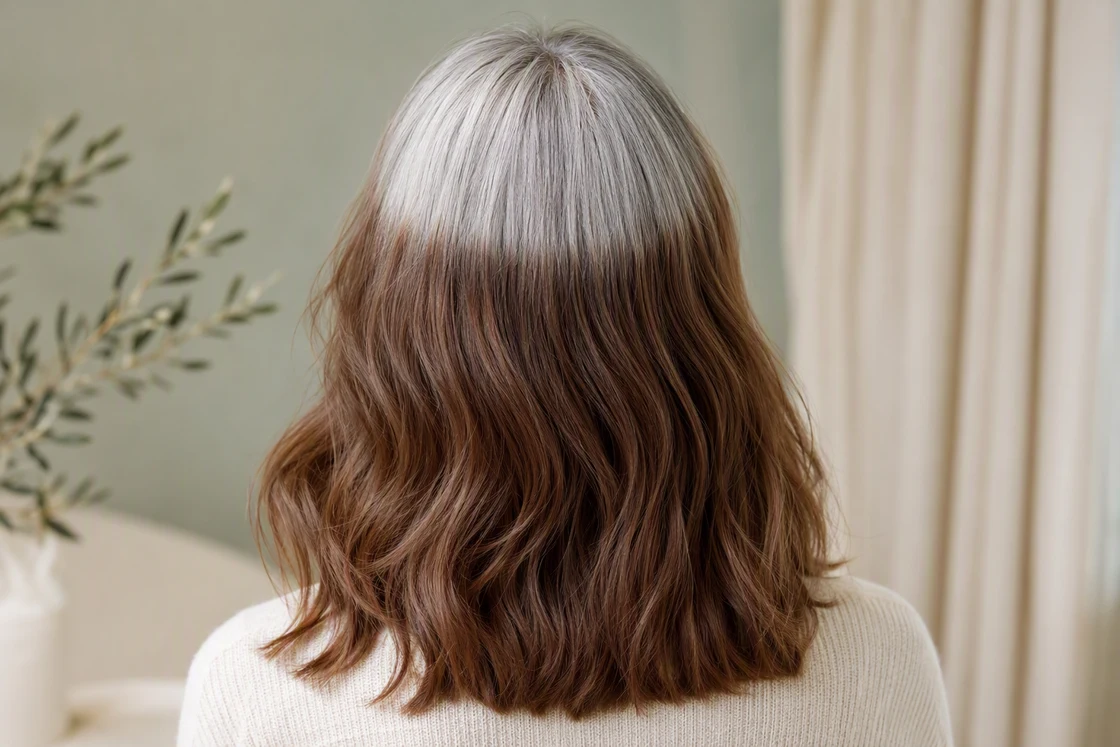
Deciding to stop coloring is the easy part. The hard part is the eighteen or so centimeters of dyed hair between your scalp and your ends, because every one of them has to either grow past your shoulders or meet a pair of scissors, and nobody hands you a schedule for that. This guide is the schedule: the two honest paths out of the dye cycle, what the demarcation line actually looks like at month 2, month 6, and month 12 on each, when the awkward phase peaks, and what each route costs in dollars and patience. Going gray here is treated as what it is, a color decision with logistics attached, not a surrender and not a statement you owe anyone.
One number runs underneath everything in this article, so meet it now: scalp hair grows roughly 0.85 to 1.25 centimeters per month. Everything else, every timeline, every technique, every budget line, is arithmetic built on that rate.
What are the two honest paths to gray?
Cold turkey means you stop applying color and let the line between new gray growth and old dyed length march down your head at growth speed. It costs almost nothing, adds zero chemistry to hair that has usually had plenty, and shows the world a hard two-tone line for as long as the math says, which for medium-length hair is one to two years. Its failure mode is well known: the line gets socially loud around month three, and a large share of cold-turkey attempts end at the drugstore box that week. Colorists widely report months 3 to 6 as the peak relapse window, an observation that is consistent and useful but not formally studied, so file it under convention.
The blended transition means you pay a colorist to camouflage the line while it grows. Highlights shatter the old solid dye, lowlights echo your natural depth, and a demi-permanent gloss marries the dyed length to the incoming gray, so the head reads as an intentional multi-tone color from about the second appointment onward. It costs real money, typically $450 to $1,600 across the first year, and it adds some chemistry, but it deletes the awkward phase almost entirely. The full decision framework between softening gray and covering it lives in our companion piece on gray blending vs gray coverage; this article assumes you have already decided the dye habit ends and only the exit route is in question.
There is a third lever rather than a third path: the big chop, cutting off most of the dyed length at once. It compresses either path’s timeline mechanically and gets its own section below.
Neither path is more principled than the other. Cold turkey pays in patience, blending pays in dollars, and the correct choice is the one whose price you will actually keep paying through month five.
How fast does the line actually move?
The demarcation line moves away from your scalp at exactly your growth rate, and growth rate is one of the better-measured numbers in hair science. In an in vivo study of 2,249 young adults across 24 ethnic groups on five continents, measured scalp growth averaged about 280 micrometers per day in participants of African ancestry, 367 in Caucasian participants, and 411 in Chinese participants [1]. Converted, that is roughly 0.85, 1.1, and 1.25 centimeters per month. research-backed The half-inch-a-month figure you hear in salons sits at the optimistic end of that range, so build your personal timeline on about 1 centimeter per month and let anything faster be a bonus.
From there, total transition time is division: dyed length in centimeters, divided by monthly growth. The table assumes you keep your current length, trimming only what you grow.
| Current length | Dyed hair to replace | At 1.25 cm/month | At 0.85 cm/month | Realistic call |
|---|---|---|---|---|
| Pixie | 5-8 cm | 4-6 months | 6-9 months | 6-8 months |
| Chin-length bob | 13-18 cm | 10-14 months | 15-21 months | 12-18 months |
| Shoulder length | 28-35 cm | 22-28 months | 33-41 months | 2-3 years |
| Mid-back | 45-60 cm | 3-4 years | 4.5-6 years | 3.5-5 years |
Two levers move these numbers. First, cutting: every centimeter you trim beyond your monthly growth comes straight off the clock, which is why a shoulder-to-bob cut at the start of a transition can delete a year in one appointment. Second, nothing else: no supplement, scalp serum, or brushing ritual has credible evidence of meaningfully accelerating scalp growth beyond your baseline, so treat any product promising a faster transition as marketing. Worth knowing as context: gray arrives more gradually than folklore claims, with a worldwide survey finding that across ages 45 to 65 about 74% of people had some gray at an average intensity of only 27%, far below the old 50-50-50 rule [2]. research-backed Most transitions are therefore blends of gray and pigmented natural hair, not a switch to solid silver, and that mixed result is worth previewing before you commit to expectations of a uniform white head.
What does cold turkey look like, month by month?
This timeline assumes medium-contrast hair, dyed medium brown over mixed gray, at average growth. Higher contrast between dye and gray makes every stage louder; lower contrast makes the whole thing quieter and faster to socially disappear.
Months 1-2. One to two and a half centimeters of regrowth. To the world this reads as a missed salon appointment, not a decision, and that misread is the psychological grind of the early phase: you know it is intentional, nobody else does. Parting changes, root-concealing powders, and headbands do real work here if you want them to.
Months 3-4. Three to five centimeters. The band is now a band, fully readable across a room, and this is where the relapse window opens. The single cheapest intervention if you waver: a demi-permanent gloss in a shade between your dye and your gray, which softens the line’s edge for $40 to $120 and fades out without creating a new one.
Months 5-6. Five to seven and a half centimeters, the peak of the awkward phase. The regrowth is too wide to pass as roots and too narrow to read as a chosen two-tone look. On a pixie, however, you are nearly done by now, which is the entire time-compression argument for short hair.
Months 7-9. Seven to eleven centimeters. The balance tips: around the face and part, where gray usually concentrates first [2], the new growth starts reading as the real color and the dyed ends as the remnant. Many people report the social commentary quieting here, because observers now parse the look as deliberate.
Month 12. Ten to fifteen centimeters of natural growth. Pixies and short bobs are finished or one trim away. Chin-length hair is one to two trims from done. Shoulder-length hair is roughly halfway, wearing an ombré it never asked for.
Months 18-30. Bobs finish by around month 18 with normal trims; shoulder length finishes between months 24 and 36. The final trims that remove the last dyed centimeters are oddly ceremonial, and you should let them be.
What does a blended transition look like, month by month?
The blended path replaces the hard line with a managed gradient. The standard architecture is 3 to 5 appointments across 9 to 15 months, then a taper into cheap maintenance.

Month 0, session one ($150-400). Fine highlights are woven through the dyed length to shatter the solid color, lowlights are placed if your natural depth needs echoing, and a demi gloss tones everything toward a shade that sits between the old dye and the incoming gray. You leave with a dimensional color that has no line to grow out. On dark dyed hair this session leans harder on lightener and prices at the top of the range; the mechanics of why dark hair pays more are covered in gray blending vs gray coverage.
Months 2-3. The gloss has faded by half, which is by design: it fades rather than growing out, so the regrowth arriving underneath is diffuse instead of striped. Where a cold-turkey head at month 3 shows a hard 3 cm line, a blended head shows soft roots inside a highlighted field.
Months 3-4, session two ($150-350). More lift where the old dye still reads solid, gloss refreshed slightly lighter and cooler than last time, walking the whole head toward the gray rather than away from it. From this appointment on, the look reads fully intentional. This is the point the awkward phase would have peaked; on the blended path it simply does not occur.
Months 6-9, session three. Often just lowlights or gloss plus a trim. Each trim removes dyed ends; each gloss shifts the remaining dye closer to the natural tone. Some people stop paying for lift here and coast on gloss alone.
Months 9-15, sessions four and five as needed. The last dyed ends are trimmed away. Longer lengths may carry faint dye remnants into a second year, but they read as subtle balayage, not as a project in progress.
After the transition. Maintenance drops to an occasional clear or violet-toned gloss for shine and cast control, one of the cheapest habits in hair color. If low upkeep was part of why you quit dye, the principles in low-maintenance hair color apply directly, and the color-strategy questions that remain are covered in hair color for women over 50.
How do you manage the demarcation line?
Whatever path you chose, the line is the enemy, and there are exactly four tools against it. Screenshot the scripts; colorists work better with mechanism than mood words.
Gloss (demi-permanent toner). Sheers a translucent in-between shade over everything, softening the line’s contrast without covering the gray or creating new regrowth. Cheapest, gentlest, fades in 4 to 8 weeks. Script: “I’m growing out my dye to gray, cold turkey, but the line is bothering me. Can we do a demi gloss in a shade between my regrowth and my dyed length, nothing permanent, so the edge softens and just fades out?”
Lowlights. Strands of your natural depth woven down through the dyed length and sometimes up through the gray, breaking the line into an irregular, deliberate-looking mix. Best on hair where the old dye is lighter than the natural base. Script: “Can we weave demi-permanent lowlights close to my natural depth through the transition zone so the line stops being one continuous edge?”
Highlights. The reverse: lift pieces of the dyed length toward the gray’s brightness. The workhorse of the blended path, and the most chemistry of the three. Script: “I want a transition plan, not coverage: highlights to break up the old color, a gloss to tie it to the gray coming in, and a realistic map of how many sessions until I’m fully out.”
Scissors. The only tool that removes dye rather than negotiating with it. Every trim beyond your growth rate shortens the sentence, which brings us to the chop.
When does the big chop make sense?
The big chop is the transition compressed into one appointment: cut close to the regrowth, discard most of the dyed length, finish in months instead of years. A pixie or cropped cut taken at month 4 or 5 of a grow-out can end the entire project by month 6.
The honest accounting has three lines. First, it is the cheapest complete solution on the menu: one $40-90 cut plus normal maintenance beats a year of blending appointments by a thousand dollars or more. Second, it trades one adjustment for another: you process a short cut and a new color simultaneously, which some people find clean and decisive and others find like too much change in one mirror. Third, it only makes sense if you can want the short cut on its own merits, because you will be wearing it, not just using it. If you are chop-curious, start with the shape logic in short hairstyles for women over 50 and the broader density-first thinking in hairstyles for women over 50, then decide whether a crop you would enjoy anyway happens to also solve your timeline.
A middle option exists and is underused: the staged chop. Take shoulder-length hair to a bob at month 0, deleting a year from the clock, then grow out the bob cold turkey or with light gloss support. Script: “I’m transitioning to my natural gray. If we cut to here today, how many months of grow-out does that remove, and can we plan trims every 8 weeks that take slightly more than my growth?”
How is gray hair itself different, and what actually fixes the yellow?
The hair arriving at your roots is not just a new color; it is a slightly different fiber, and knowing the mechanics prevents both panic and overspending. Gray happens because each follicle’s reservoir of pigment stem cells depletes over time, follicle by follicle, so unpigmented strands appear alongside pigmented ones rather than the whole head fading uniformly [6]. The fiber itself changes too: measurements comparing pigmented and unpigmented hair, including from the same heads, find that gray fibers tend toward larger diameters and higher bending stiffness, with more waviness and stronger damping when the hair moves [3]. research-backed Add the scalp’s declining oil production and you get the familiar report: the grays feel wiry, stand up at the part, and take longer to lie down. The fixes are mechanical, not corrective: more conditioning slip, occasional bond-building or deep-conditioning treatments, and cuts that work with added volume rather than fighting it.
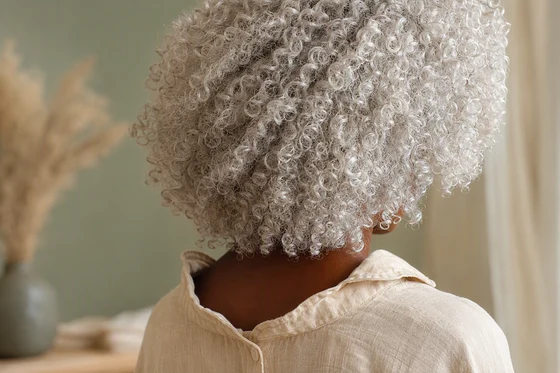
Then there is yellowing, and the evidence here is genuinely interesting. The standing assumption blames sunlight, and ultraviolet light does degrade hair proteins, with tryptophan breaking down into yellow-tinted products [5]. But in a controlled study specifically of grey hair, UV exposure slightly bleached the white fibers, and it was infrared radiation and heat that produced measurable yellowing [4]. Because the sun-versus-heat question is not fully settled across studies, treat the cause as mixed evidence, but the practical takeaway survives either way: your flat iron and blow dryer are prime yellowing suspects, so cap hot tools at moderate temperatures on white hair, and count smoke exposure, chlorine, and product residue among the other known contributors.
Purple shampoo, the default answer to yellow, deserves its evidence check. The optics are legitimate: violet sits opposite yellow on the color wheel, so depositing a trace of violet pigment visually cancels yellow cast. What is thin is the published clinical record; efficacy claims rest on color theory and manufacturer testing rather than independent trials, so grade it convention, well-reasoned but unproven. Used once or twice a week and rinsed promptly it is low-risk and often visibly effective; overused on porous white hair it deposits enough pigment to read lilac. A salon violet-toned gloss does the same job more evenly and lasts weeks rather than washes.
What does each path cost?
Twelve-month accounting, US pricing, assuming a chin-to-shoulder length starting point. The re-dye habit you are exiting is the benchmark: staying on permanent coverage runs roughly $1,000 to $1,800 per year on dark bases, per the math in gray blending vs gray coverage.
| Path | Year-one salon cost | Ongoing annual cost after | Chair hours, year one | What you pay instead |
|---|---|---|---|---|
| Cold turkey, bare | $0-150 (trims only) | $0-150 | 2-4 | 12-24 months of visible line |
| Cold turkey + gloss support | $150-500 | $100-300 | 4-6 | A softened but present line |
| Blended transition | $450-1,600 | $150-400 | 8-14 | Money, some added chemistry |
| Big chop + grow | $50-200 | $200-400 (frequent cuts) | 3-5 | The length itself |
Two budget notes the table cannot hold. First, cold turkey’s zero is real but fragile: one month-four panic re-dye resets the entire clock, so its true expected cost includes the probability of relapse, which is exactly what the gloss line item is buying down. Second, the blended path’s cost front-loads and then collapses: by year two most blended transitions are down to two or three glosses a year, cheaper than any dye habit they replaced. Every path lands somewhere below the coverage treadmill within two years, which is the quiet financial argument for the transition no one frames as one: this is one of the few beauty decisions where the cheaper option and the chosen option can be the same thing.
The bottom line
Going gray is a logistics problem wearing a lot of borrowed emotional weight, and the logistics are solvable with arithmetic. Your timeline is your dyed length divided by roughly a centimeter of growth per month; your two honest paths are cold turkey, which is free and loud for a while, and blending, which is quiet and costs money; and the awkward phase both paths fear peaks around months 3 to 6, precisely where a $75 gloss, a strategic cut, or a mapped blending plan does its best work. Pick the path whose price you will still be willing to pay at month five, put the appointments in the calendar, and let the math run. The line only moves one direction.
Frequently asked questions
How long does it take to fully transition to gray hair?
Divide your dyed length by your growth rate. Scalp hair grows about 0.85 to 1.25 cm per month depending on ancestry and individual variation, so a 5 cm pixie replaces itself in 6 to 8 months, a 15 cm chin bob in 12 to 18 months, 30 cm shoulder-length hair in 24 to 36 months, and longer hair proportionally more. Cutting more than you grow at each trim is the only way to shorten that clock.
What is the awkward stage of going gray, and how long does it last?
The awkward stage is the window when the regrowth band is too wide to pass as a missed root appointment but too narrow to read as a deliberate two-tone look, roughly 3 to 7 cm of visible roots. At average growth that spans about months 3 to 6, which is also when most people give up and re-dye. A gloss, lowlights, or a shorter cut are the standard tools for compressing or disguising exactly this window.
Is it better to go gray cold turkey or with blending?
Cold turkey is nearly free and involves zero additional chemistry, but you wear a visible demarcation line for months and the relapse rate is high. A blended transition costs roughly $450 to $1,600 in salon work over the first year but looks intentional from about month 3 onward. Choose by budget and by honesty about your own patience: the cheapest path is the one you will actually finish.
Can I transition to gray without cutting my hair short?
Yes. Length changes nothing about the mechanics, only the duration: the line simply has farther to travel, so shoulder-length hair takes 2 to 3 years to fully replace and longer hair more. Most people at longer lengths choose blending support, because wearing a hard line for that many months tests anyone. The big chop is a time-compression tool, not a requirement.
Does purple shampoo actually work on gray hair?
The color theory is sound: violet sits opposite yellow on the color wheel, so a violet-depositing shampoo visually neutralizes yellow cast. Rigorous published trials on gray hair specifically are scarce, so treat product claims as convention rather than proven, and know the practical failure mode: porous white hair can grab violet pigment and turn lilac if the product sits too long. Once or twice a week, rinsed promptly, is the standard use pattern.
Why does gray hair turn yellow?
Yellowing comes from degradation of hair proteins, deposits from smoke and product residue, and heat. In a controlled study of grey hair, ultraviolet exposure actually bleached white fibers slightly while infrared radiation and heat produced the yellowing, which puts hot tools and thermal exposure higher on the suspect list than sunlight for many people. Managing heat styling temperature is therefore as important as any toning product.
Why is gray hair coarser and wirier than the rest of my hair?
Measurements comparing pigmented and unpigmented fibers from the same heads find that gray fibers tend to have larger diameters and higher bending stiffness, and they behave with more waviness and damping in motion. Combined with the scalp producing less oil with age, the fiber is thicker, stiffer, and drier, which reads as wiry. It is a real material change in the fiber, not a care mistake.
Can a salon strip the old dye to speed up the transition?
Partly. Color removers can shrink artificial pigment molecules enough to wash some of them out, and a bleach bath can lift dye further, but neither restores your natural color underneath: dark permanent dye usually exposes warm orange-brown tones that then need toning, and both services stress the fiber. Stripping shortens the visual gap between dyed and gray hair rather than the timeline itself, and it works best as part of a blended plan rather than a shortcut around one.
- Loussouarn G, Lozano I, Panhard S, Collaudin C, El Rawadi C, Genain G. Diversity in human hair growth, diameter, colour and shape. An in vivo study on young adults from 24 different ethnic groups observed in the five continents. Eur J Dermatol. 2016;26(2):144-154.
- Panhard S, Lozano I, Loussouarn G. Greying of the human hair: a worldwide survey, revisiting the '50' rule of thumb. Br J Dermatol. 2012;167(4):865-873.
- Bechthold L, Schulze zur Wiesche E, Wortmann FJ. Morphological Changes of Human Hair Related to 'Graying'. J Cosmet Sci. 2018;69(5):347-356.
- Richena M, Silveira M, Rezende CA, Joekes I. Yellowing and bleaching of grey hair caused by photo and thermal degradation. J Photochem Photobiol B. 2014;138:172-181.
- Nogueira ACS, Joekes I, et al. Photo yellowing of human hair. J Photochem Photobiol B. 2007;88(2-3):119-125.
- O'Sullivan JDB, et al. Human Hair Graying Revisited: Principles, Misconceptions, and Key Research Frontiers. J Invest Dermatol. 2024.