Hair color, decoded
What Color Should I Dye My Hair? A Decision Tree, Not a Quiz
Choose your hair color by answering five questions in order: your skin's undertone (warm, cool, neutral, or olive), the weeks you will honestly go between salon visits, the distance in levels between your current color and the target, your gray percentage, and any workplace or identity constraints. Each answer eliminates shade families, and most people land on two or three finalists within about two levels of their natural depth. Strand-test or virtually try on the finalists before you book anything.
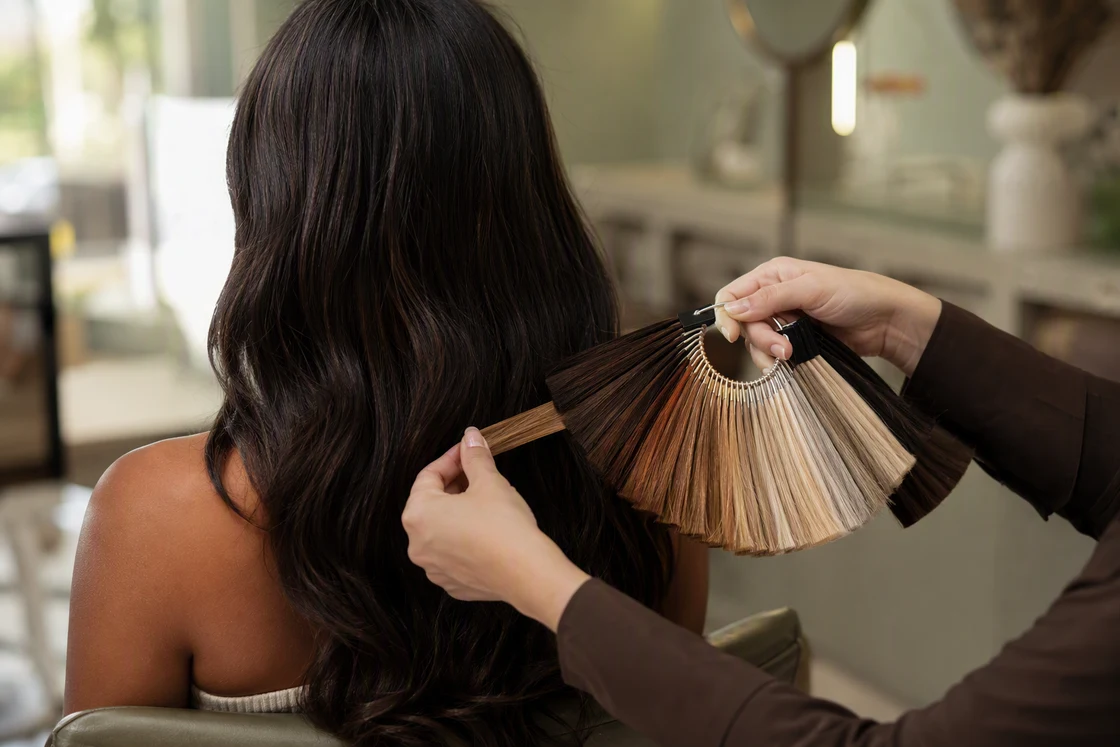
“What color should I dye my hair” collects more photo-scrolling hours than almost any other beauty question, and the scrolling rarely settles it, because a shade that looks wonderful on a stranger tells you nothing about how it will behave on your head, against your skin, on your schedule. The good news is that the question is not one big aesthetic mystery. It is five small practical questions, and each one you answer eliminates entire shade families. This guide is the walkthrough: no quiz widget, no email gate, just the five questions in the order that eliminates fastest, each branch ending in a short list of colors worth testing. It mirrors the format of our what haircut should I get walkthrough, because the method is the same: answer in your head, carry a running shortlist, arrive at two or three finalists.
One framing note before question one. Only the first question is about how a color will look. The other four are about what a color will cost you: in weeks, in dollars, in chemistry, and in friction with the rest of your life. Most color regret comes from answering only the first question, and the order below is deliberate: looks first, then the four budgets that decide whether the look survives contact with your calendar.
Question 1: What is your undertone?
Answer it in two minutes. Three checks in daylight, no products, no filters. Look at the veins at your wrist: greenish suggests warm, blue-purple suggests cool. Hold gold and silver jewelry against your inner arm and note which looks like it belongs. Hold a plain white sheet of paper beside your bare face and see whether your skin casts golden-yellow or pink-blue against it. Two out of three agreeing is your answer; a split vote usually means neutral or olive, which widens your options rather than narrowing them.
Where the branches go. Hair is the largest field of color you wear against your face, and the working rule is that it should share your skin’s temperature. Warm undertones point to the gold, honey, caramel, copper, and warm-brown families. Cool undertones point to ash, beige, cool browns, and blue-based darks. Neutral undertones can borrow from both shelves, and olive skin does best in muted, neutral-to-cool shades, because strongly golden color can amplify sallowness against a green-gray cast. All of this is convention from the colorist trade rather than tested science, but it is grounded in a real optical effect: adjacent colors exaggerate each other’s differences, so the temperature of your hair visibly pushes the apparent tone of the skin next to it.
This one paragraph compresses a whole article’s worth of matrix, so if undertone is your open question, take the deep dive: our guide to the best hair color for your skin tone covers the tests with honest reliability labels and a full shade matrix by undertone and depth, including olive and deeper skin tones. Then come back. You now have a temperature, warm or cool or flexible, and that temperature travels with you through every remaining question: it does not pick your color, it filters every candidate the next four questions produce.
Question 2: How many weeks will you honestly go between salon visits?
Answer it in 30 seconds. Not your intention, your history. Look at your calendar: when was your last appointment, and the one before that? Every 4 to 6 weeks, every 6 to 8, every 8 to 12, longer, or realistically twice a year?
Where the branches go. Scalp hair grows roughly 1 to 1.5 centimeters a month, which is research-backed across large multi-population measurement studies [1], and every color choice is really a choice about what that centimeter of regrowth will look like against the color. High-contrast, scalp-to-ends color, think all-over dark over graying hair, platinum over a dark base, or vivid fashion shades, shows a hard line at 4 weeks and demands the 4-to-6-week branch. Traditional foil highlights and gloss-only routines live at 6 to 8 weeks. Lowlights and soft dimensional work stretch to 8 to 12. Balayage and lived-in color finished with a root smudge, kept within about two levels of your natural depth, honestly stretch 12 to 16 weeks because the regrowth is designed into the color instead of fought against it.
The dollars follow the interval, not the ticket price. A 250 dollar balayage three times a year is cheaper than 90 dollar root touch-ups eight times a year, and the yearly totals routinely surprise people in both directions [5]. If this question is where your shortlist is dying, our low-maintenance hair color guide ranks every lived-in technique by realistic weeks between visits with the cost-per-year math done for you.
The elimination rule: strike any color whose regrowth cadence is shorter than your demonstrated salon habit. A twice-a-year visitor wearing all-over color spends ten months of the year wearing the grow-out, not the color.
Question 3: How far is the target from the color you have now?
Answer it in one minute. Colorists grade depth on a 1 to 10 level scale, black at 1, medium brown around 5, lightest blonde at 10, a convention standardized across cosmetology training [6]. Estimate your current level in a mirror in daylight, unwashed and unstyled hair. Estimate the level of the color you are considering. Subtract. The number you get, and its direction, prices the whole project.
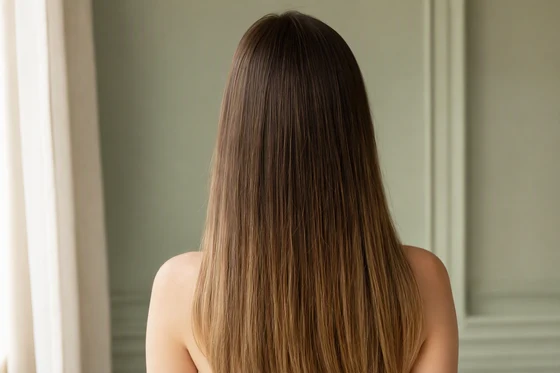
Where the branches go. The house rule here is the two-level rule: within two levels of your natural depth, in either direction, color stays in the easy zone. Regrowth contrast stays soft, a single process or a dimensional service covers it, and home color is even a reasonable option going darker. Beyond two levels, the two directions split sharply.
Going darker is chemically cheap at any distance: dye deposits into the fiber in one gentle session. Its real costs are subtler: dark color over a lightened base can grab too dark or too warm, and if you later change your mind, dark artificial pigment is the hardest thing on the menu to remove.
Going lighter is the expensive direction, and the cost is physics, not salon pricing strategy. Hair does not lighten by adding light pigment; it lightens by oxidative destruction of the pigment already there, and the peroxide and persulfate chemistry that does it measurably damages the fiber itself, causing protein loss and structural disruption through the cuticle and into the cortex, which is research-backed by electron microscopy and proteomic studies of bleached hair [3]. Damage scales with how far and how fast you lift. Three to four levels of lift means highlights or controlled lightening over two or more sessions at roughly 150 to 350 dollars each plus toner [5]. Five or more levels, dark brunette to platinum territory, is a multi-month project with real breakage risk and a standing toner subscription at the end of it. None of that makes lightening wrong. It makes it a project, and projects deserve to be priced before they start, not after. For the middle ground, lightness placed away from the scalp so the grow-out stays civil, see our full balayage vs highlights technique comparison in the hair color hub.
The elimination rule: if the distance to a candidate color is more than two levels lighter and your answer to question 2 was longer than 8 weeks, strike it or restate it as a softer, dimensional version. That single check removes most future regret in this decision.
Question 4: How much gray are you working with?
Answer it in one minute. Part your hair in three places, front hairline, temple, crown, and estimate the percentage of white strands in each: under 25 percent, 25 to 50, or over 50. Front and temple sections usually run ahead of the back, so check more than one spot. If you are in the 45-to-65 age range you have plenty of company: a worldwide survey of over 4,000 people found about three quarters of that age band had some gray, at an average intensity around 27 percent, and far fewer people are half-gray by 50 than the old “50-50-50” rule of thumb claimed, which is research-backed [2].
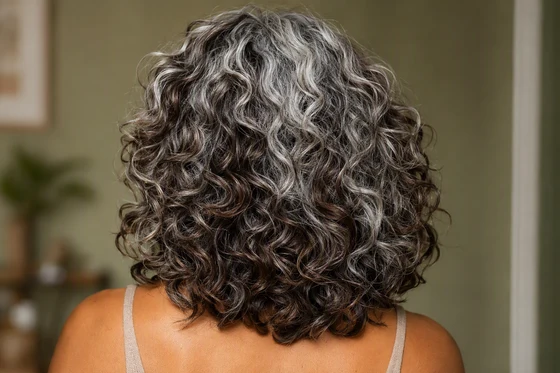
Where the branches go. Gray percentage decides which maintenance stories are even available to you, which is why it outranks shade preference here. Under 25 percent, almost everything works: a gloss can blend the scattering translucently, dimension can make it read as highlights, and you can also simply leave it. Between 25 and 50 percent, you face the real fork: coverage, meaning opaque all-over color and a standing 4-to-6-week root appointment, or blending, meaning highlights and lowlights woven through so the gray becomes part of a dimensional mix on an 8-to-12-week cadence. Over 50 percent, blending gets easier, not harder, because the gray is the base rather than the exception: silver-forward transitions, gray glosses for tone, and lowlights for depth all work with what is growing in rather than against it, while full coverage becomes the highest-maintenance choice on the whole menu.
This fork is consequential enough that we gave it a full article: gray blending vs gray coverage walks the decision with cost tables and exit strategies. For this walkthrough, carry forward one output: your gray branch sets a floor under question 2. Choosing coverage with over 50 percent gray commits you to the 4-to-6-week cadence no matter what you answered earlier, and if those two answers conflict, believe your calendar, not your intentions.
Question 5: What do your job and your identity require?
Answer it in 30 seconds. Two honest checks. First, the room you work in: would a vivid color, a chunky contrast, or a dramatic change read as unremarkable, as a statement, or as a problem in your workplace? Second, your own continuity: do you have a signature look, professional headshots, a public role, or personal or cultural reasons that make some changes feel wrong regardless of how they photograph?
Where the branches go. This question is not about rules, it is about pricing friction you would otherwise discover after the appointment. If the constraint is high, the natural spectrum within two levels of your depth, plus dimension, gloss, and blending work, gives you an enormous field that no workplace anywhere will blink at, and everything the first four questions shortlisted probably survives. If the constraint is low, the field opens to fashion shades, and only mechanics remain: most vivids need a pre-lightened base (question 3’s costs apply in full), and they fade fast, often needing refreshing every 4 to 8 weeks (question 2’s calendar applies in full). A vivid on a schedule that cannot support it does not read as bold, it reads as faded, which is the practical argument for matching ambition to cadence rather than suppressing the ambition.
One deliberate non-rule: age is not a constraint in this tree. There is no shade you age out of. The inputs are your undertone, your calendar, your levels, your gray percentage, and your context, and they are the same five inputs at 25 and at 65.
Putting the five answers together
No table holds every combination, but most readers land in one of these rows. Find the row nearest your answers and leave with a family of two or three candidate shades, not a verdict.
| Your answers, roughly | Start with these color families |
|---|---|
| Warm undertone · 12+ weeks between visits · within 2 levels · little gray | Caramel or honey balayage with a root smudge, warm bronde, copper gloss |
| Cool undertone · 6-8 weeks · within 2 levels · little gray | Ash-beige gloss, cool brown single process, beige babylights |
| Any undertone · 4-6 weeks kept honestly · target 3-4 levels lighter | Foil highlights built toward blonde over 2-3 sessions, toner maintained |
| Warm or neutral · 8-12 weeks · going 1-2 levels darker | Chocolate, chestnut, or espresso single process with a mid-cycle gloss |
| 25-50% gray · 8-12 weeks | Gray-blending highlights plus lowlights, root smudge, silver-friendly toner |
| 50%+ gray · minimal upkeep appetite | Silver-forward transition: gray gloss for tone, sparse lowlights for depth |
| Low workplace constraint · 4-8 weeks · loves change | Vivid or fashion shade over a pre-lightened base, or a demi-permanent vivid within your depth |
Two useful degenerate cases. If every row you match points to roughly your natural color, that is a finding, not a failure: a gloss for tone and shine may be the entire correct answer. And if your undertone answer and your favorite row disagree, the tree is telling you to shift the shade’s temperature, not abandon it: nearly every color family exists in a warm and a cool version, and asking for “copper” versus “auburn” or “golden blonde” versus “beige blonde” is exactly this adjustment.
How do you test the color before you commit?
The tree gives you finalists; it should not give you blind confidence. Three tests stand between a shortlist and a booking, in ascending order of effort.
Virtual try-on first. Color is the thing AI try-on tools simulate best, because recoloring existing hair is an easier graphics problem than resculpting it. Load a bare-faced photo in neutral light and preview your two or three finalists, paying attention to the boundary between hair and skin, which is where temperature mismatches show. Treat the output as a direction check, not a promise: screens are not calibrated, and simulators render every color at zero weeks of fade and regrowth. Our review of AI hairstyle try-on tools covers which apps preview color honestly and which flatter you into a mistake.
Strand test for the color. Before any full application, home or salon, test the actual formula on a thin section from a hidden spot, usually the nape underlayer: full product, full processing time, then judge it dry in daylight. This is the only test that accounts for your hair’s condition, porosity, and any previous color still living in the lengths, which is why the result routinely differs from the box photo and occasionally differs from the swatch ring at the salon.
Patch test for your skin. Separately from the color question, oxidative dyes contain sensitizers, most notably para-phenylenediamine (PPD), a leading cause of allergic contact dermatitis from cosmetics, and manufacturers direct a skin test 48 hours before application for a reason: reactions range from an itchy hairline to severe facial swelling, and sensitization is lifelong once acquired, which is research-backed in the dermatology literature [4]. Do the label’s allergy test every time, even with a brand you have used before, since sensitization can develop between uses. This is the least skippable paragraph in this article.
How to ask your colorist for what you chose
Your five answers compress into a brief a colorist can execute. The magic phrase structure is: current state, target family, the two budgets. Screenshot whichever script is closest:
“My undertone reads warm and I want to stay within two levels of my natural medium brown. I can come in about every 12 weeks. Can we do caramel dimension with a root smudge so the grow-out stays soft?”
“I am about 40 percent gray, mostly at the temples, and I do not want a 4-week root commitment. Can we blend it with highlights and lowlights instead of covering it, on a cadence closer to 10 weeks?”
“I want to go noticeably lighter, and I understand that is a multi-session project. Can we map out the sessions, the total cost including toner, and what condition my hair will be in at each stage?”
“Before we do anything permanent, can we start with a gloss in that family so I can live with the temperature for a few weeks first?”
Expect pushback on mechanics, and welcome it: a colorist who says your level estimate is off by one, or that last year’s box dye is still in your mid-lengths and changes the plan, is doing exactly their job. The answers they cannot supply are the budget ones: your real weeks, your real dollars, your real context. Bring those, hold your ground on them, and let the professional own the chemistry.
The bottom line
There is no single color you are supposed to have, which is why quizzes that promise to reveal it disappoint. There is a small set of colors that match your undertone, survive your real salon cadence, sit within an honest distance of your current level, work with your gray percentage, and fit your context, and five questions find that set in about ten minutes. Test the finalists cheaply, virtually first, then a strand, always the patch test, before you commit a whole head. And rerun the tree every few years without sentiment: gray percentage, calendar, and context all drift, and the right answer drifts with them.
Frequently asked questions
What color should I dye my hair if I have never dyed it before?
Start within one to two levels of your natural color, matched to your undertone, applied as a gloss or a soft dimensional service rather than an all-over permanent color. That combination is the cheapest to maintain, the gentlest chemically, and the easiest to walk back if you dislike it. First-time color is a test of the maintenance relationship as much as the shade, so buy the smallest version of the commitment first.
How do I know what hair color suits me?
Run the undertone checks: vein color at the wrist in daylight, whether gold or silver jewelry sits more naturally against your skin, and how your face reads next to a plain white sheet of paper. Warm undertones pair with gold, caramel, copper, and honey families; cool undertones with ash, beige, and cool browns; neutral and olive undertones do best in balanced, muted shades. These are stylist conventions rather than validated tests, so treat two out of three agreeing as your answer and let a colorist confirm in person.
Should I go darker or lighter than my natural color?
Chemically, darker is the cheap direction and lighter is the expensive one. Depositing darker color is a single gentle process, while lifting lighter requires peroxide or bleach, measurably damages the hair fiber, and often takes multiple sessions. Darker also shows less regrowth contrast for most people, so it is the lower-maintenance bet; the honest exception is heavily gray hair, where dark all-over color creates the sharpest possible root line and lighter or blended choices are easier to live with.
What is a hair color level?
Colorists grade hair depth on a 1 to 10 scale: level 1 is black, 5 is medium brown, 7 is dark blonde, and 10 is lightest blonde. The scale matters because the distance between your current level and your target level predicts cost, damage, and upkeep better than the shade name does. Two levels of change is roughly the boundary between an easy appointment and a project.
How much does it cost to go from dark hair to blonde?
Plan on several hundred dollars and more than one visit. Lifting hair four or more levels usually takes two to four sessions of highlights or controlled lightening at roughly 150 to 350 dollars each, plus toner at 45 to 90 dollars, and then ongoing maintenance every 6 to 10 weeks. If a salon promises dark-to-platinum in one cheap afternoon, the price you skip up front tends to come back as breakage and correction costs later.
How do I do a strand test at home?
Mix a small amount of the product as directed, apply it to a thin section cut or clipped from a hidden spot, usually the nape underlayer, process for the full recommended time, then rinse, dry, and judge the result in daylight. The strand test shows what the formula actually does on your hair, which box-photo simulations cannot. Do the separate 48-hour skin allergy test the label describes as well; they answer different questions and both matter.
Are hair color quizzes accurate?
They are entertainment with a mailing list attached. Most quizzes ask four or five questions, map them to a brand's shade inventory, and cannot see your hair's current level, condition, previous color layers, or gray distribution, which are the variables that decide the result. The five-question walkthrough in this guide covers the same ground with honest mechanics, and a colorist consultation covers what no quiz can.
Should I color my hair at home or in a salon?
Home color is reasonable when you are depositing within two levels of your current color on hair with no previous lightener in it. Go to a salon for any lightening beyond a subtle kit, any correction of a previous color, vivid fashion shades, and major gray transitions, because those jobs depend on judging the hair mid-process. The box costs 10 to 20 dollars and the salon costs ten times that; correcting a failed box job can cost 300 to 800 dollars, which is the number that should decide close calls.
- Loussouarn G, et al. Diversity in human hair growth, diameter, colour and shape. An in vivo study on young adults from 24 different ethnic groups observed in the five continents. European Journal of Dermatology. 2016;26(2):144-154.
- Panhard S, Lozano I, Loussouarn G. Greying of the human hair: a worldwide survey, revisiting the '50' rule of thumb. British Journal of Dermatology. 2012;167(4):865-873.
- Grosvenor AJ, et al. The physical and chemical disruption of human hair after bleaching: studies by transmission electron microscopy and redox proteomics. International Journal of Cosmetic Science. 2018;40(6):536-548.
- Mukkanna KS, Stone NM, Ingram JR. Para-phenylenediamine allergy: current perspectives on diagnosis and management. Journal of Asthma and Allergy. 2017;10:9-15.
- SalonsRated. Salon Prices 2026: Every Service in One Reference Table. 2026.
- Milady Standard Cosmetology, Haircoloring chapter: the 10-level depth system and formulation conventions used across cosmetology training.