Hair color, decoded
Hair Gloss vs Glaze: How Glass Hair Actually Happens
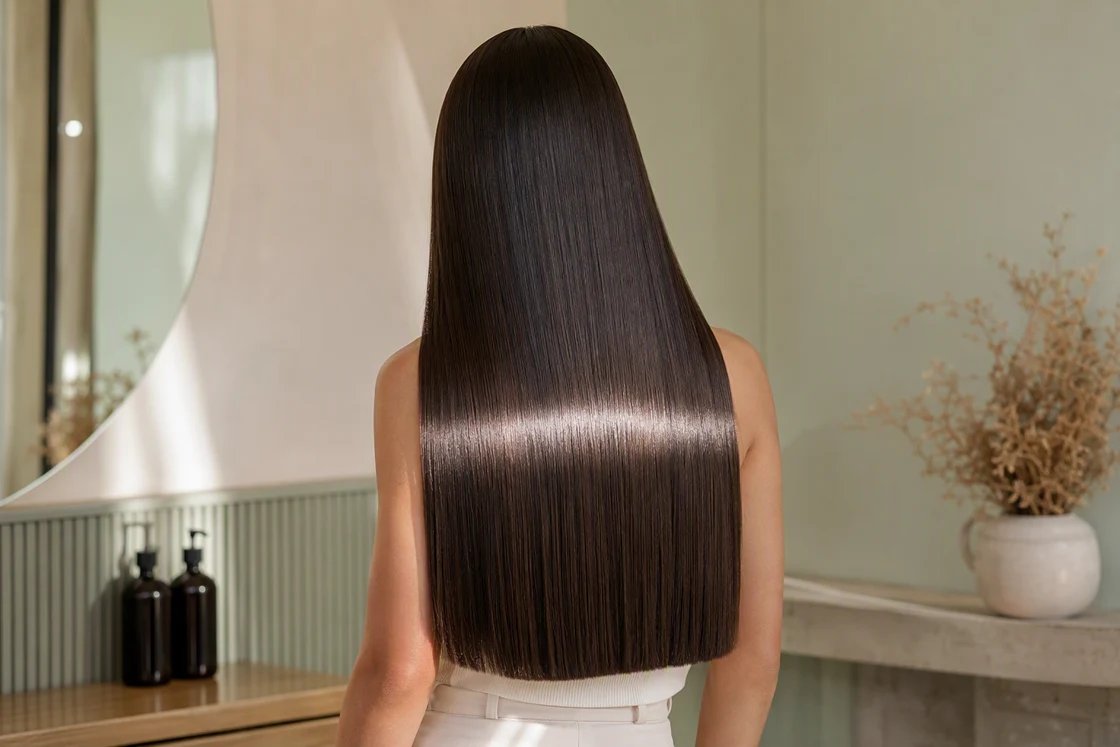
A hair gloss is a demi-permanent, deposit-only color treatment: a low-peroxide, usually acidic formula that deposits tone into the outer layers of the hair and smooths the cuticle so it reflects more light, lasting roughly 15 to 25 washes. A glaze does a similar job with semi-permanent direct dyes and no developer, so it sits closer to the surface and fades in about 6 to 10 washes. Neither one can lighten hair, and glass hair is never a gloss alone: it is a blunt cut plus a gloss plus heat finishing.
Searches for hair gloss have exploded, one in-shower product alone is up over 500 percent, and yet almost everything ranking for the term is a brand page selling you its own bottle. That is a problem, because “gloss” and “glaze” are two of the sloppiest words in hair color: salons, drugstore boxes, and prestige brands all use them to mean slightly different things. This guide sorts it out the only reliable way, by chemistry: what each formula actually contains, what it can and cannot physically do to a hair fiber, and what the glossy results you see online, including glass hair, are really made of.
What is a hair gloss, chemically?
Strip away the branding and a salon gloss is a demi-permanent, deposit-only color service. Three properties define it, and each one explains something you will notice in the chair.
It uses a low-volume developer. Demi-permanent formulas mix with a weak hydrogen peroxide developer, around 2 percent or less, versus roughly 6 percent for permanent color [1]. That trace of peroxide does two jobs: it helps small dye precursors couple into slightly larger colored molecules inside the outer layers of the hair, and it gives the result staying power that no developer-free product can match [4]. What it cannot do at that concentration is meaningfully break down your natural melanin. This is the single most important fact about glosses: research-backed demi-permanent color deposits tone but does not lift, because lightening requires the alkaline, higher-peroxide chemistry of permanent color or bleach [1][4].
It is usually acidic. Most modern salon glosses, the liquid demi formulas colorists reach for, are formulated at an acidic pH. Alkaline formulas swell the fiber and lift the cuticle scales open; acidic formulas do the opposite, encouraging the cuticle to lie flat against the hair shaft [5]. A flat cuticle is the entire physics of shine: light bounces cleanly off a smooth surface (specular reflection), while a rough, lifted cuticle scatters light diffusely and reads as dull. Instrumented studies that measure luster confirm the principle: treatments that smooth the fiber surface and increase the ratio of specular to scattered light produce measurably higher gloss values [3]. A gloss looks shiny not because it adds a shiny coating but because it tidies the surface the light hits.
The pigment sits shallow. Demi color penetrates the cuticle region and the outermost edge of the cortex, not deep into the fiber the way permanent color does [1]. That is why it fades progressively and evenly with washing instead of growing out as a hard line. Shallow deposit is a feature, not a weakness: it is what makes a gloss forgiving.
In practice, a salon gloss appointment is fast and cheap by color-service standards: 20 to 45 minutes in the chair, typically 40 to 90 dollars standalone in most US cities, or 25 to 60 dollars added to a highlight or cut appointment. Premium metro salons can run past 100 dollars. There is no root line to maintain, so there is no obligation to rebook; the color simply washes away over one to two months.
What is a glaze, and why does everyone define it differently?
Here is the honest answer most brand pages skip: the industry has never standardized these words. Some salons call every demi service a gloss. Some brands sell semi-permanent conditioners labeled “gloss.” Others use “glaze” for exactly the same demi formula a competitor calls a gloss. The useful distinction is not the label on the bottle but whether the formula uses a developer.
Gloss, strictly used, means demi-permanent: dye precursors plus low-volume developer, oxidative chemistry, roughly 15 to 25 washes of longevity [1][4].
Glaze, strictly used, means semi-permanent: pre-formed direct dye molecules, no developer, no oxidation. The molecules are small enough to slip into the outer layers of the fiber without any chemical assistance, but nothing bonds them there, so they shampoo out in roughly 6 to 10 washes [2]. Peer-reviewed classifications put semi-permanent longevity at around six washes for the small-molecule formulas, with modern conditioning versions stretching somewhat longer [2].
Both are deposit-only. Both can tone, deepen, or neutralize. Neither can lighten. The differences that matter to you are longevity (a glaze fades two to three times faster), gentleness (no developer means even the trace oxidative step is skipped), and commitment (a glaze is the closest thing hair color has to an undo button). convention Colorists typically reach for a developed gloss when the tone correction needs to survive a month of washing, and a glaze or direct-dye toner when the client wants a low-risk refresh or has fragile, heavily processed hair.
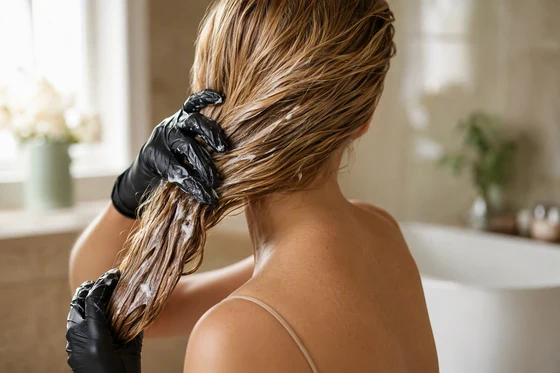
At home, the vocabulary gets even looser. In-shower glosses, pigmented masks, and color-depositing conditioners are all semi-permanent glazes by chemistry, whatever the front label says. A few at-home kits are true developer-mixed demis, and the box will always say so, because mixing two components is the giveaway.
What can a gloss do, and what can it never do?
Deposit-only chemistry draws a hard line. On the possible side:
- Tone correction. Neutralizing brassy orange in brunettes or yellow in blondes is the classic gloss job, and it is where a gloss earns its keep after lightening services. If your highlights have drifted warm, a gloss resets them; this is the standard finishing step colorists pair with the techniques compared in our balayage vs highlights guide.
- Deepening or enriching. A gloss can take hair darker or richer, add a cool ash veil, warm up flat brown, or shift red intensity.
- Shine. The acidic, cuticle-smoothing effect works even with zero pigment: a clear gloss on uncolored hair is a legitimate service, not an upsell.
- Softening demarcation. A translucent wash of color blurs the line between faded ends and regrowth, buying weeks between bigger services.
On the impossible side:
- No lightening. Not one level. Peroxide at demi concentrations with an acidic pH cannot meaningfully decolorize melanin [1][4].
- No opaque gray coverage. Translucent pigment tints gray; it does not hide it [7]. More on why that is often exactly what you want below.
- No structural repair. A gloss smooths the surface and improves how hair behaves and reflects light, but it does not rebuild broken protein bonds. The shine is optical, not restorative.
How long does a gloss last?
Brands answer in weeks because weeks sound long. The honest unit is washes, because shampooing is what removes deposit-only color, and wash frequency varies enormously between readers.
mixed evidence Published and industry figures scatter widely: the dermatology literature cites fading after roughly 10 to 15 shampoos for demi formulas [1], manufacturers claim up to 20 to 25, and semi-permanent classifications cite around 6 washes [2]. The ranges below reconcile those sources with standard salon guidance.
- Salon demi gloss: 15 to 25 washes. At two washes a week, that is roughly two months of visible effect; at daily washing, under a month.
- At-home glaze or gloss (no developer): 6 to 10 washes.
- Pigmented conditioner or in-shower gloss: 1 to 3 washes per application, designed for repeated use.
Fade speed also rises with porosity: heavily lightened hair grabs pigment fast and releases it fast. Hot water, clarifying shampoos, and sulfates accelerate the exit. If stretching color life matters to you, the habits in our low-maintenance hair color guide apply directly to glosses.
Salon gloss vs at-home gloss: what are you actually paying for?
The at-home category is genuinely good now, which makes the honest comparison more interesting than “salon is better.” What you buy in a salon is not stronger chemistry so much as diagnosis: a colorist choosing the right tone family and depth for your current hair, which is the step where at-home glossing goes wrong.
| Salon gloss | At-home gloss/glaze kit | Glaze (semi, no developer) | Clear shine spray | |
|---|---|---|---|---|
| Chemistry | Demi-permanent, low-volume developer, usually acidic | Direct dyes, occasionally true demi (two-part box) | Direct dyes only, deposit at surface | Silicones/polymers coating the fiber |
| Can lift color? | No | No | No | No |
| Can shift tone? | Yes, reliably, custom-mixed | Yes, within the shade on the label | Yes, subtle | No |
| Lasts | 15-25 washes | 6-10 washes | 6-10 washes | Until next wash |
| US cost | $40-90 standalone; $25-60 as add-on | $15-40 per bottle, multiple uses | $15-35 | $10-30 |
| Time | 20-45 min in chair | 5-20 min in shower | 5-20 min | Seconds |
| Main risk | Cost; over-darkening if colorist rushes | Wrong tone choice; buildup turning hair muddy or too dark | Minimal; patchy on very porous hair | Buildup, weighed-down roots |
| Best for | Tone correction, gray blending, event prep | Maintaining a tone your colorist established | Low-commitment refresh, fragile hair | Instant finish on styled hair |
Three honest notes on that table. First, popular at-home options span a wide price band: pigmented in-shower treatments run around 30 to 40 dollars, mass-market gloss lines closer to 15. Per application, home glossing costs a few dollars against 40-plus in a salon; you are paying the difference for judgment and even application. Second, buildup is the quiet failure mode of home glossing: direct dyes stack with each use, so a “sheer” brunette gloss applied weekly for three months can leave you two levels darker than intended, and darker deposit is not removable without lightening. Third, a clear formula sidesteps almost all of this risk, which is why colorists so often recommend clear as the default home choice.
How does glass hair actually happen?
Glass hair, the mirror-shine look that keeps recycling through social feeds, is routinely credited to a gloss treatment. A gloss is one third of it. Decomposed honestly, the look is built from three layers, and skipping any one of them is why home attempts fall short.
Layer one: the cut. Light reflects cleanly off an even plane. A blunt, one-length perimeter with polished ends gives the mid-lengths and ends a continuous surface; heavily layered, texturized, or split ends scatter light no matter what you put on them. This is why glass hair edits are dominated by blunt bobs and one-length lobs: the geometry is doing unacknowledged work. If you are considering the chop itself, see our bob haircuts comparison.
Layer two: the gloss. The chemical step: smoothing and sealing the cuticle so the reflection is specular rather than scattered, plus tone that deepens perceived shine. Instrumented luster research adds a detail brands rarely mention: research-backed darker, more pigmented fibers measure higher luster contrast than lighter ones, because pigment absorbs the scattered light that would otherwise wash out the shine band [3]. Glass hair reads most dramatic on dark brunette and black hair for physical, not stylistic, reasons. Blondes can absolutely wear the look, but the mirror-stripe effect is inherently softer.
Layer three: the finish. Full detangle, blow-dry with tension (round brush or paddle), then a flat iron pass in fine sections with heat protectant, and a drop of lightweight oil or shine serum on the lengths. Oils and silicone-based finishers measurably increase luster by smoothing the air-fiber interface [3]. The finish is also the perishable layer: humidity, sleep, and the next wash take it apart, which is why glass hair is best understood as an occasion style sitting on top of a good cut and gloss, not a permanent state.
Curl-honest caveat: the flat-iron step is a styling preference baked into the trend’s photos. Glossed, well-finished curls and coils show the same physics as high-definition shine along each curl clump rather than one mirror panel. The gloss chemistry is texture-neutral.
Can a gloss soften a gray grow-out?
This is the most underrated gloss use case, and the mechanism is exactly the translucency that stops a gloss from covering gray outright.
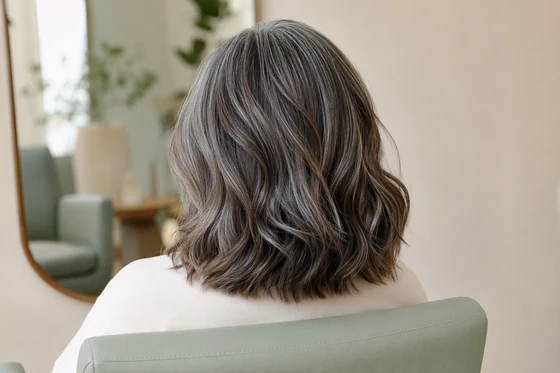
Demi-permanent color on white or gray strands deposits a sheer veil of tone: the strand picks up a softened, semi-transparent version of the shade instead of an opaque block [7]. On a salt-and-pepper head, that turns high-contrast white-against-dark into a blended range of steel, smoke, and softened dark tones. The grow-out line that makes permanent-color maintenance relentless simply is not created, because nothing opaque was deposited in the first place. Wella’s own professional guidance puts demi gray blending at up to about 70 percent coverage, which in practice means “gray, but deliberate” [7].
convention Colorists commonly time glosses at 6 to 8 week intervals through a gray transition, sometimes over a base of fine highlights or lowlights, so the shift from colored to fully gray hair happens in soft stages rather than one hard demarcation. If you are weighing that whole decision, our gray blending vs gray coverage guide covers the strategic choice in depth, and the hair color for women over 50 guide covers shade selection once you have chosen a direction.
Two honest limits. A gloss cannot make gray disappear, and on resistant, glassy gray strands even the blending effect can fade fast, sometimes within 10 to 15 washes. And clear glosses deserve a special mention here: gray hair often reads coarse and dull because of cuticle weathering, and a clear acidic gloss adds shine to silver without committing to any tone at all.
Is a gloss really damage-free?
The claim on nearly every gloss page is “zero damage” or even “repairs hair.” Here is what the evidence actually supports.
Compared with permanent color, the gentleness is real and mechanistic. Damage from permanent coloring comes mainly from the alkaline swelling of the fiber plus higher-concentration peroxide, which oxidizes melanin and, collaterally, the protein and lipid structures around it [1][4]. Demi glosses run acidic and use a fraction of the peroxide, so both damage pathways are sharply reduced. Deposit-only semi glazes skip oxidation entirely; the peer-reviewed classification literature describes small direct-dye molecules entering the fiber without damaging the cuticle scales [2].
“Zero” is still marketing rounding. A demi formula does contain peroxide and does interact with the fiber; trace oxidative change is not nothing, it is just small enough that dermatology reviews class demi-permanent among the gentle options rather than the damaging ones [1]. mixed evidence As for “repair,” there is no evidence a gloss rebuilds internal protein structure; what studies do support is improved surface behavior, smoother cuticle, better light reflection, less friction, which is cosmetic conditioning, not reconstruction [1][3].
The practical reading: if your hair is fragile from bleach, a gloss or glaze is among the safest color services you can sit for, and a developer-free glaze is the safest of all. Just do not book one expecting structural healing.
How to ask your colorist for a gloss
The word “gloss” alone can get you anything from a clear shine rinse to a full demi tone shift, so the screenshot-worthy scripts specify the chemistry and the goal.
For tone correction: “Can we do a demi-permanent gloss to cool down the brassiness in my mid-lengths and ends? I want to stay at my current depth, no darker.”
For shine only: “I’d like a clear gloss, no pigment, just the shine and cuticle-sealing effect. My hair is uncolored and I want to keep it that way.”
For gray blending: “I’m growing my gray out. Can we use a translucent demi gloss to soften the contrast between the gray and my base, rather than covering it? I’d rather blend than commit to a root line.”
For glass hair prep: “I have an event in two weeks. Can we do a gloss now and a blowout plan for the day, and will my current ends hold a sharp finish or do I need a dusting first?”
And the two questions worth asking about any gloss service: “Is this formula mixed with a developer?” (tells you gloss vs glaze longevity) and “How many washes should this last with my routine?” (forces a wash-based answer instead of a weeks-based one).
The bottom line
A gloss is demi-permanent deposit-only color: low peroxide, usually acidic, roughly 15 to 25 washes, capable of toning and shining but never lightening. A glaze is the developer-free version of the same idea, gentler and shorter-lived, and the industry uses both words loosely enough that the only reliable question is whether the formula mixes with a developer. Salon glossing buys you a colorist’s judgment for 40 to 90 dollars; at-home glossing maintains an established tone for a few dollars per wash, with buildup as the main trap. Glass hair is a system, blunt cut plus gloss plus heat finishing, not a product effect. And the quietest win in the whole category is the translucent gloss on a gray transition: it does not hide anything, it just makes the in-between stage look chosen.
Frequently asked questions
What is the difference between a hair gloss and a glaze?
In the strict, chemistry-based sense, a gloss is demi-permanent: it uses a low-volume developer to open the cuticle slightly and bond tone into the outer layers of the hair, lasting roughly 15 to 25 washes. A glaze is semi-permanent: pre-formed dye molecules with no developer that sit at and just under the surface, fading in about 6 to 10 washes. In practice many salons and brands use the words interchangeably, so always ask whether the formula uses a developer.
How long does a hair gloss last?
Count in washes, not weeks. A salon demi-permanent gloss typically survives 15 to 25 shampoos, an at-home gloss or glaze about 6 to 10, and a pigmented shine conditioner 1 to 3. If you wash twice a week, a salon gloss can look good for two to three months; if you wash daily, the same service may fade in three to four weeks.
Can a hair gloss lighten my hair?
No. Glosses and glazes are deposit-only: they can add tone, deepen color, or neutralize brassiness, but they contain too little peroxide and no strong alkalizer, so they cannot meaningfully lift your natural pigment. Anything that promises lightening is a different product category with different damage math.
Does a hair gloss cover gray?
It blends rather than covers. Because demi-permanent color is translucent, it tints gray strands into softer versions of the surrounding color instead of hiding them, which reads as intentional dimension rather than a solid block. Expect roughly 50 to 70 percent visual blending at best; full opaque coverage requires permanent color.
Is a hair gloss damaging?
It is one of the gentlest color services that exists, but demi-permanent formulas still use a low concentration of peroxide, so calling them zero-impact is marketing shorthand rather than strict chemistry. Damage measured after demi services is far below permanent color or bleach. Deposit-only glazes with no developer are gentler still.
Do in-shower gloss products like Ouai actually work?
They deposit small amounts of direct dye and conditioning polymers in 5 to 20 minutes, so they can refresh tone and boost shine between salon visits. The effect is real but shallow and short-lived, usually a few washes, because the pigment never bonds into the hair the way a developed demi formula does. Think of them as maintenance, not a substitute for a salon gloss.
How often can I get a gloss?
Every 6 to 8 weeks is a common salon rhythm, timed to when the previous gloss has mostly washed out. Because the service is deposit-only, glossing more often is not dangerous, but stacking pigment every couple of weeks can make hair progressively darker or muddier than you intended.
Does glass hair work on curly or textured hair?
The gloss part works on every texture: shine chemistry is about a smooth, sealed cuticle, and curly hair benefits just as much. The mirror-flat finish seen in most glass hair photos additionally requires straightening, which is a styling choice, not a requirement. Glossed curls read as high-definition and light-reflective rather than mirror-like, which many stylists argue is the better version of the trend.
Is a clear gloss worth it if I do not color my hair?
Yes, this is one of its most sensible uses. A clear gloss adds no tone, so there is no color risk; it simply smooths and seals the cuticle so virgin hair reflects more light and feels less rough. It is a low-commitment way to test the service, typically 40 to 90 dollars in a salon.
- Gavazzoni Dias MFR. Hair Cosmetics: An Overview. International Journal of Trichology. 2015.
- da França SA, Dario MF, Esteves VB, Baby AR, Velasco MVR. Types of Hair Dye and Their Mechanisms of Action. Cosmetics. 2015.
- McMullen R, Jachowicz J. Optical properties of hair: effect of treatments on luster as quantified by image analysis. Journal of Cosmetic Science. 2003.
- Goebel C. Chemistry of Hair Coloring. Cosmetic Ingredient Review Expert Panel. 2017.
- Redken. Here's Why Acidic Liquid Hair Color Is a Must-Have. Redken.com. 2024.
- Hair.com by L'Oreal. Hair Gloss vs. Glaze: Which Treatment Do You Need? Hair.com. 2024.
- Wella Professionals. Does Demi-Permanent Color Cover Grey Hair? Wella.com. 2024.