Hair color, decoded
Money Piece Hair: The Face-Framing Highlight That Refuses to Fade Out
A money piece is a bold face-framing highlight: the front inch or two of hair at the hairline, lightened from the root through the ends, usually 2 to 4 levels lighter than the base. It works by putting the brightest part of the hair directly against the face, and it is the cheapest high-impact color service in the salon, typically $75 to $175 and 60 to 90 minutes in the US, with touch-ups every 6 to 10 weeks because it sits exactly where regrowth shows first.
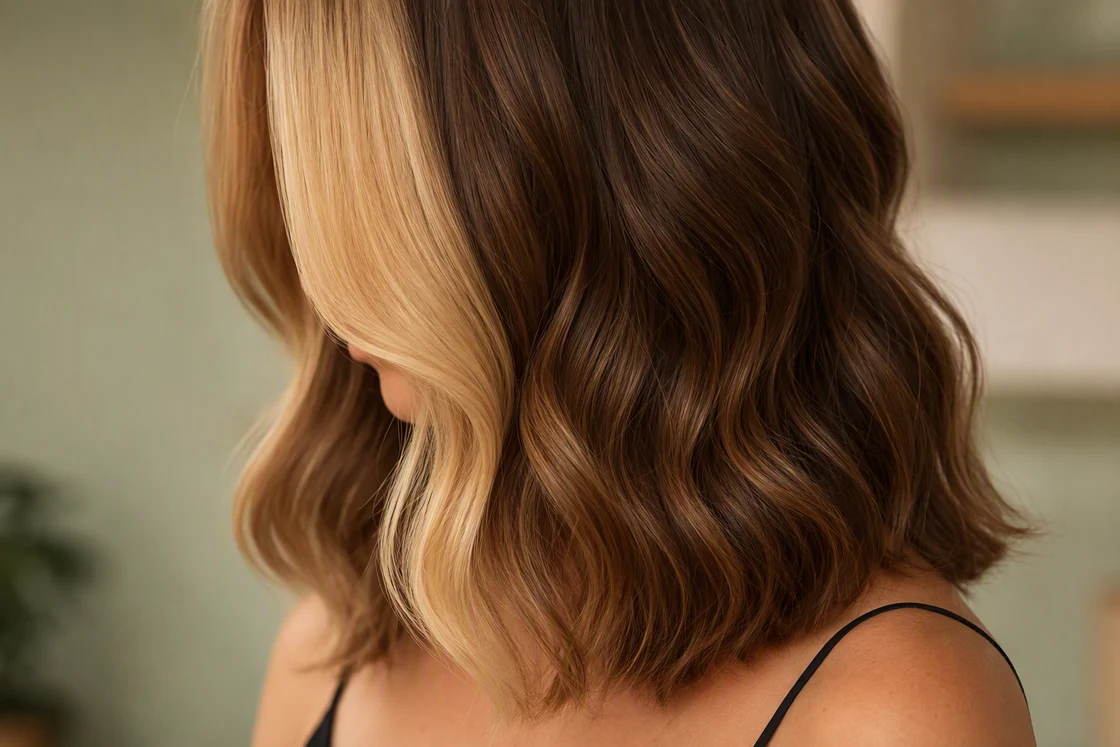
The money piece is the rare hair trend that survived its own hype cycle. It surfaced around 2020, was declared the biggest color trend of 2022, and is still on 2026 trend lists, now in copper [4, 5]. That kind of persistence usually means a technique is not really a trend at all but a piece of optics that works, packaged under a catchy name. This article takes the money piece apart mechanically: what it actually is, why a few square inches of lightness placed at the hairline does more visual work than a full head of foils, what it honestly costs to run per year, and the specific cases where it works against you.
What exactly is a money piece?
A money piece is a concentrated panel of lighter color at the front hairline: the sections that fall directly around your face, usually the front half inch to two inches on either side of your part, lightened from the root through the ends [3]. Three properties separate it from ordinary highlights, and all three matter.
It starts at the root. Classic balayage deliberately avoids the root zone; a money piece deliberately includes it. The brightness begins where your hair begins, at the part line and hairline, so it reads as a feature of your head rather than something applied to your lengths.
It is a panel, not a weave. Face-framing highlights are fine pieces threaded through the front. A money piece is a solid, saturated section. The result is a deliberate stripe of contrast, closer in spirit to the chunky face-frames of the 1990s than to modern diffused color, which is exactly why colorists describe it as the 90s frame modernized [3, 4].
It is bold by definition. The convention is 2 to 4 levels lighter than the base. Go subtler than that and you have bought face-framing babylights, a different service with different math.
The name comes from salon slang: it is the piece that makes the whole color look expensive, the shot of brightness clients point to in reference photos. Technique-wise it is agnostic. A colorist can foil it for maximum lift, hand-paint it, or tone it any direction from butter blonde to copper. The placement is the product; the application method is plumbing. If you want the full map of how those application methods differ, that is covered in balayage vs highlights.
Why does a money piece work optically?
Strip the marketing and two mechanisms are doing the work.
Light placement near the face. Your visual system is drawn to luminance: in any scene, bright regions pull fixation before dark ones. A money piece places the brightest region of your hair immediately adjacent to your eyes and cheekbones, so attention lands on your face first and stays in that neighborhood. A full head of highlights raises average brightness everywhere and therefore points at nothing. The money piece is cheap precisely because it is targeted: it spends all its contrast in the two square inches where looking happens.
Contrast framing. There is real perceptual research on the adjacent principle. Studies of facial contrast, the luminance and color difference between facial features and the surrounding skin, show that the visual system uses feature contrast as a live cue when reading faces, and that experimentally increasing contrast around the eyes, brows, and lips changes how those faces are judged research-backed [1]. A money piece operates one ring further out: it manufactures a high-contrast border between hair and face, a bright frame around the whole composition. To be precise about the evidence, the published studies measure contrast of features within the face, not hair placed beside it, so extending the finding to a highlight panel is an extrapolation that colorists make and the research does not directly test mixed evidence [1]. What is not in dispute is the underlying mechanism: edges and contrast are what the eye is built to find, and a money piece is a manufactured edge in the highest-traffic location on your head.
There is also a mundane third reason the technique refuses to die: it photographs well. The panel sits exactly where a phone camera meters, it survives ponytails and buns because the front sections are the ones that stay out, and it announces itself in video calls. A color service that is fully visible in a selfie crop delivers more perceived change per dollar than one distributed across the back of your head.
What does a money piece cost, and how often does it need upkeep?
Here is the honest ledger, and it is the technique’s strongest argument. A money piece is the cheapest high-impact color service on the salon menu, because the colorist is lightening two small sections instead of thirty foils.
Per visit. In most US salons a standalone money piece runs $75 to $175 and takes 60 to 90 minutes; as an add-on to a color or balayage appointment it commonly prices at $50 to $100. Compare partial foil highlights at roughly $100 to 200, full highlights at $150 to 300, balayage at $160 to 320 and up, and babylights at $200 to 400 [6]. Toner or gloss is the standard hidden line item at $35 to 80, sometimes included, often not; ask.
Per year. The interval is where the money piece claws some of that saving back. Because the panel starts at the root on your part line, regrowth appears exactly where it is most visible, and a high-contrast version asks for attention every 6 to 8 weeks; subtler versions stretch to 10 [4]. Colorists are direct about this: the thicker and bolder the piece, the tighter the cycle convention [4]. Sample math at mid-range prices: $125 every 8 weeks is about 6 visits, roughly $750 per year before tip. That still undercuts a balayage habit at roughly $1,100 to 1,400 per year and babylights at $1,500, while delivering more visible change than either from the front. If your goal is minimum chair time overall, the placement strategies in low-maintenance hair color are the companion read.
Damage, priced honestly. The chemistry is ordinary oxidative lightener, and bleaching measurably degrades the fiber: it oxidizes the cystine crosslinks that give hair its strength, damages the cuticle, and drives protein loss from the strand, with effects that compound each time the same hair is re-lightened research-backed [2]. The money piece’s structural advantage is surface area: you are bleaching perhaps five percent of your hair, so the damage is confined to two sections you can condition hard, wrap at night, or ultimately trim out. The risk concentrates at touch-ups. The panel is small and the target is obvious, so sloppy overlap re-bleaches the same strands every 6 to 8 weeks, which is precisely the repeated-exposure pattern the damage literature flags [2]. The single most protective sentence you can say in the chair is in the scripts section below.
Money piece vs babylights vs balayage: which is the better buy?
This is the table to screenshot. Prices are typical US ranges as of 2025-2026; large-market colorists run above every top number, and toner is often separate [6].
| Money piece | Babylights | Full balayage | |
|---|---|---|---|
| What it is | Solid lightened panel at the front hairline, root to ends | Ultra-fine woven highlights across the head | Freehand-painted lightness through mid-lengths and ends |
| Coverage | Front two sections only | Whole head, fine-grained | Whole head, roots left dark |
| Sitting time | 60-90 min | 3-4 hr | 2-3.5 hr |
| Typical US cost per visit | $75-175 standalone, $50-100 add-on | $200-400 [6] | $160-320+ [6] |
| Visible impact from the front | Highest per dollar: all contrast at the face | Subtle overall luminosity | Soft dimension, concentrated at ends |
| Grow-out behavior | Root line at the part, visible by week 4-6 | Gentle, sections too fine to band | Diffused, no line by design |
| Realistic interval | 6-10 weeks | 8-12 weeks | 12-16 weeks |
| Annual cost, mid-range | ~$750 | ~$1,500 | ~$1,100-1,400 |
| Best for | Maximum change on minimum budget, trying lightness before committing | Fine-grained brightness, early gray | Long gaps between visits, soft dimension |
Two readings of the table. If the question is cost per visible change, the money piece wins and it is not close: it is the only service on the menu where a first-time lightening client can buy a genuinely noticeable result for around a hundred dollars. If the question is cost per calendar year with minimum salon contact, balayage still wins, because the money piece’s root-visible placement puts it on nearly a foil-highlight cadence. The money piece is cheap per event and mid-priced per year; it is not a low-maintenance color, it is a low-commitment one. That distinction is the single most misunderstood thing about the service.
There is also a portfolio logic: the money piece is the standard trial run. Lightening two front sections tells you how your base lifts, how toner behaves on your hair, and whether brightness near your face suits you, all for the lowest possible stake. Colorists routinely use it as the first step of a longer lightening plan, and if you hate it, it is two sections to grow out or tone dark, not a whole head.
Which money piece shade suits your skin tone?
The panel sits against your face all day, closer than any other color decision you will make, so undertone matching matters more here than for overall color. The full framework lives in best hair color for your skin tone; here is the money-piece-specific version.
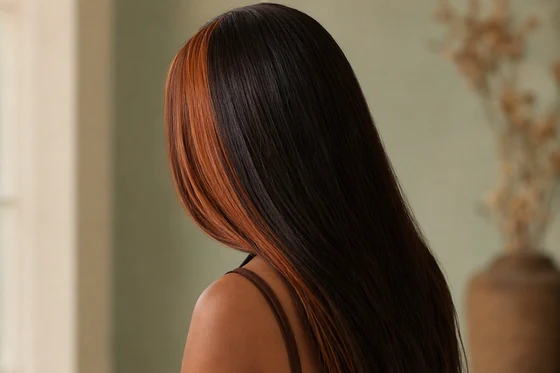
Warm undertones (skin flatters gold jewelry, veins read greenish): honey, butterscotch, caramel, and golden blonde panels harmonize, and the copper family is your home turf. On warm skin a copper or cinnamon money piece reads as an extension of your own coloring rather than an applied stripe.
Cool undertones (silver jewelry, bluish veins): ash blonde, beige, mushroom, and cool platinum panels sit cleanly; overly golden toners are what read brassy fastest against cool skin. If you want warmth anyway, strawberry copper and rose-leaning tones bridge better than orange coppers.
Neutral undertones carry the widest range, which is why colorists steer undecided clients toward neutral beige and soft toffee panels: they drift acceptably in both directions as the toner fades.
On brown and dark hair, the honest physics: contrast is the point, and dark bases deliver it automatically, which is why the money piece is at its best on brunettes. The constraint is lift. Caramel, toffee, and copper targets are 2 to 3 levels up and comfortably reachable in one session; a pale platinum panel on near-black hair is a 5-plus level project that needs strong lightener or two sessions and will show its regrowth line hardest [2]. The 2026 answer to that problem is not to fight it: trend reports from working colorists put softer, more blended money pieces and the copper family, muted ginger through strawberry copper, at the top of request lists, precisely because those targets get dark-based clients maximum warmth for minimum lift [5]. A copper money piece on a level 3 to 5 base is the current sweet spot of the entire technique: one session, low damage, high contrast, and a grow-out that softens rather than stripes.
One more case worth naming. If your front hairline is coming in gray, a money piece can be built directly over it, converting the highest-visibility gray into a deliberate bright feature instead of a coverage problem; the panel then grows out with the gray inside it rather than against it. Whether that beats all-over coverage for your percentage of gray is the subject of gray blending vs gray coverage.
How does a money piece grow out?
Predictably, and faster than anything else on the color menu, so plan for it on day one.
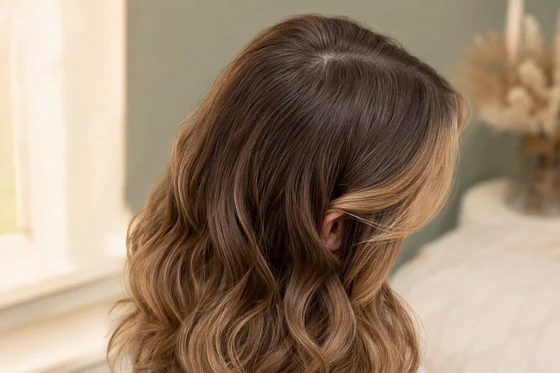
The panel is saturated to the root at your part line, the most-inspected strip of hair on your head. Hair grows about half an inch per month, so by week 4 to 6 a high-contrast money piece shows a visible band of natural color at its base [4]. This is the structural trade of the technique: the root-level placement that makes it work is the same placement that makes regrowth impossible to hide. Three tools manage it.
Root smudge or shadow. A demi-permanent color melted over the top half inch at the appointment, blurring the future line before it exists. It costs $20 to 50 as an add-on and is the best value in the entire service; the difference at week six is dramatic.
Mid-cycle gloss. The toner, not the lift, is what visibly expires first, drifting brassy over 4 to 8 weeks. A $40 to 90 toner-only appointment at the midpoint refreshes the shade without touching lightener to the hair, and doubles as your damage checkpoint.
Strategic surrender. A grown-out money piece is not ruined color; it is face-framing balayage that used to start higher. Plenty of clients ride the panel down deliberately, letting it become mid-length brightness, and re-lift the root only every second or third visit, halving annual lightener exposure. If you stay within about two levels of your base, this looks intentional the whole way down; at four levels of contrast it looks like a decision by week ten, so the bolder your panel, the less this option is available to you convention.
Styling interacts with grow-out more than people expect. A deep side part hides the band longest, because the panel drapes over its own root line. Curtain bangs and the money piece are natural partners for the same reason: the bang’s curve carries the lightness away from the scalp before the eye reaches the regrowth.
When does a money piece flatter, and when does it work against you?
The money piece is not universally kind, and the failure cases are predictable enough to check before you book.
Where it earns its keep. Because the panel is a vertical stripe of brightness falling beside the face, it adds vertical emphasis: on round and square faces, the falling bright line reads as length and draws the eye down rather than across. On oval faces nearly any width works, which is the boring, accurate answer. The technique also flatters anyone whose base color has gone flat and single-note, because two sections of contrast re-introduce dimension for the lowest possible price, and anyone who wants to audition lightness near their face before committing a whole head to it.
The fine hair caveat, stated plainly. A money piece borrows against density, and fine hair has less to lend. Two mechanisms. Optically, a saturated panel needs enough hair mass to read as a solid ribbon; on fine or sparse front sections the same application reads stripy, and high contrast is a spotlight, so it points directly at the sparseness it sits in. Structurally, fine strands have less cortex per fiber, so the same bleach exposure removes a larger fraction of the strand’s strength, and the front hairline hair is already the finest, most weathered hair on your head [2]. If your front sections are thin, the better buy is almost always fine babylights woven through the frame: same neighborhood of brightness, no solid panel to fail, less bleach per strand. The broader playbook for maximizing visual density is in hairstyles for thin hair.
Other cases where it drags. Very short crops give the panel no length to read as a ribbon, so it becomes a spot rather than a stripe; at pixie length, ask about an all-over face-frame tint instead. Extremely tight, high-contrast panels against very dark bases can read costume-adjacent under office lighting, which is fine if chosen and startling if not; the fix is a root smudge and a warmer toner, not abandoning the idea. And if you never wear your hair down or forward, you are paying for contrast that spends most of its life pinned back.
How do you ask your colorist for a money piece?
The term is now on every salon menu, but it spans everything from two subtle ribbons to a full 90s stripe, so constraints beat vocabulary. Bring a photo of the goal on a base color near yours, shot in daylight, and use scripts like these.
“I want a money piece about an inch wide on each side, two to three levels lighter than my base, toned neutral. Nothing platinum on the first pass.”
“Please build in a root smudge so there is no hard line at the part when it grows out.”
“This hairline hair is my finest hair. What developer volume are you planning for it, and can we go gentler here than you would on my lengths?”
“When I come back for touch-ups, how will you avoid overlapping the hair you already lightened?”
“My budget is a touch-up every 8 weeks and one gloss in between. Design the width and contrast around that schedule, not around day one.”
“I have gray coming in right at my part. Can we place the money piece over it so it grows out inside the panel?”
The overlap question is the one that protects your hair, and the schedule question is the one that protects your wallet; a good colorist will respond to both with specifics rather than reassurance.
The bottom line
A money piece is a saturated face-framing panel, lightened from the root at the hairline, and its persistence since 2020 comes down to physics rather than fashion: it spends all of its contrast in the few square inches next to your face, where attention actually lands. It is the cheapest high-impact service on the color menu at roughly $75 to 175 per visit, but its root-level placement puts it on a 6-to-10-week cadence, so treat it as low-commitment rather than low-maintenance. Match the toner to your undertone, favor copper and caramel targets on dark bases, and insist on a root smudge and an overlap plan at every touch-up. If your front hairline is fine or sparse, take the babylights version of the same idea instead. Used with those constraints, it is the best value experiment in hair color: one hundred dollars to find out what brightness near your face does for you.
Frequently asked questions
How much does a money piece cost?
In most US salons a standalone money piece runs $75 to $175, or $50 to $100 as an add-on to an existing color appointment, with big-city and high-demand colorists above that. Toner or gloss is often billed separately at $35 to 80, so ask whether it is included. It is the cheapest way to buy a visible color change, because the colorist is lightening two small sections instead of a whole head.
How long does a money piece last?
The lightened hair is permanent on the strand; what expires is the toner, which drifts brassy or dull over 4 to 8 weeks, and the root line, which shows within 4 to 6 weeks on high-contrast versions. Most people book a refresh every 6 to 10 weeks. A subtler, lower-contrast money piece can stretch to 12 weeks or convert into face-framing balayage as it grows.
What is the difference between a money piece and face-framing highlights?
Width and saturation. Face-framing highlights are fine woven pieces threaded through the front sections, a subtle brightening. A money piece is a solid, saturated panel, usually the front half inch to two inches on each side of the part, lightened from the root so the color reads as a deliberate bold stripe rather than scattered brightness.
Can you do a money piece on dark or black hair?
Yes, and dark bases are where the technique is most visible, because contrast is the whole point. The honest constraint is lift: taking a dark base to caramel or copper is one comfortable session, while a pale blonde money piece on near-black hair usually needs strong lightener or two sessions and will show regrowth fastest. Copper and caramel versions on brown and black hair are among the most requested variants.
Does a money piece damage your hair?
The chemistry is the same oxidative lightener used in any highlight, and bleaching measurably degrades the hair fiber. The saving grace is surface area: a money piece bleaches a small fraction of your hair, so the damage is confined to two sections you can condition aggressively or trim away. The risk concentrates at touch-ups, where overlapping previously lightened hair re-bleaches the same strands every cycle.
Is a money piece high maintenance?
Per visit it is the least demanding lightening service, 60 to 90 minutes. Per calendar it is more demanding than balayage, because the panel starts at the root along your part line, exactly where regrowth is most visible, so it asks for attention every 6 to 10 weeks. A root smudge at the appointment and a mid-cycle gloss stretch the interval.
What is a copper money piece?
A money piece toned into the copper family, from strawberry copper to cinnamon to burnished auburn, instead of blonde. On brown and dark bases it delivers warmth and contrast without committing the whole head to red, and it needs less lift than a blonde version, which makes it gentler and quicker. Trend roundups for 2026 put copper shades and softer blended money pieces at the top of colorist request lists.
Should you get a money piece if you have fine or thin hair?
Cautiously. A saturated bleached panel on fine hair can read stripy, and lightened fine strands are more fragile because there is less cortex per strand to absorb the chemical hit. If your front hairline is sparse, high contrast draws the eye to exactly that spot. Fine woven babylights through the front sections usually deliver the brightness with less visual and structural cost.
- Porcheron A, Mauger E, Russell R. Aspects of Facial Contrast Decrease with Age and Are Cues for Age Perception. PLOS ONE. 2013;8(3):e57985.
- Grosvenor AJ, et al. The physical and chemical disruption of human hair after bleaching: studies by transmission electron microscopy and redox proteomics. Int J Cosmet Sci. 2018;40(6):536-548.
- L'Oreal Paris. Why the Money Piece Hair Trend Is a Must-Try This Year. lorealparisusa.com.
- Prinzivalli L. Money Piece Highlights Are 2022's Biggest Hair Trend. The Zoe Report. 2020, updated 2022.
- E! News. Top Spring 2026 Hair Color Trends, According to a Celeb Colorist. 2026.
- Fash. Hair Highlights Cost: Average Salon Color and Dye Prices. Fash.com cost guide. 2026.