Hair after 50
Medium-Length Hairstyles for Women Over 50: Lob, Layers, or Modern Shag?
Medium length, roughly collarbone to shoulder, is the widest sweet spot after 50: it keeps ponytails, waves and updos on the table while shedding the weight that flattens fine hair. Three families cover most heads: the lob, the layered mid-length and the modern shag. Choose by density and texture, not by birth year.
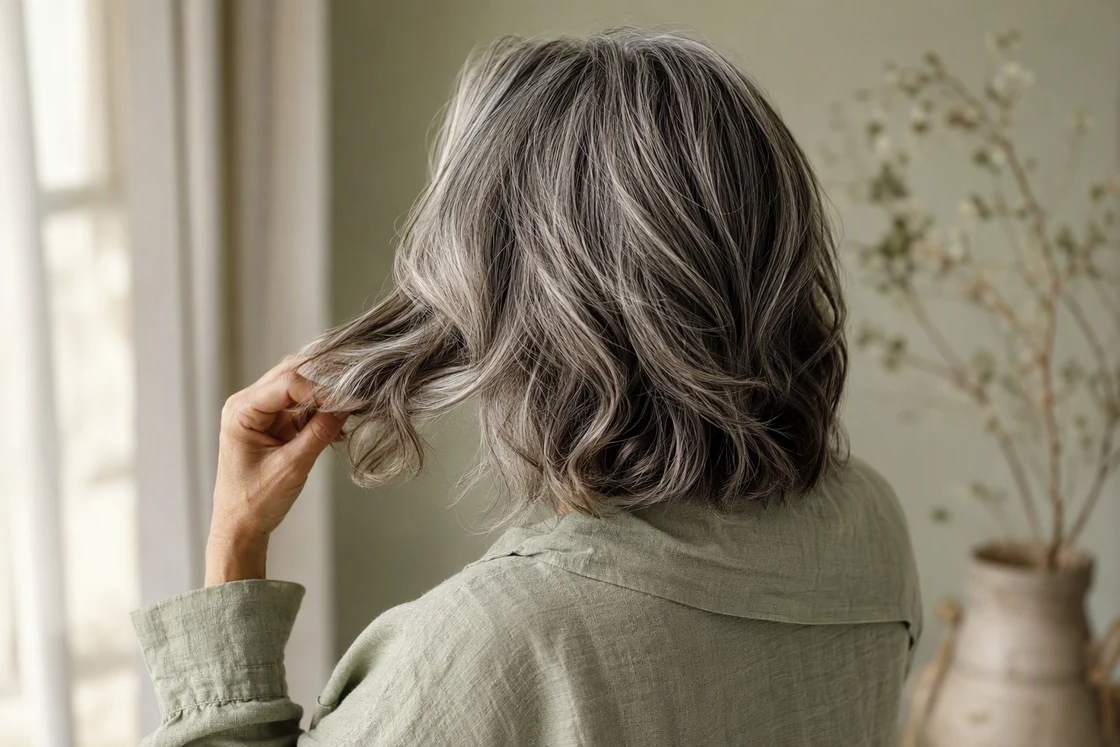
Ask ten stylists where most of their over-50 clients end up after a few years of experimenting and you will hear the same answer: somewhere between the collarbone and the shoulder. Not because medium length is a compromise, but because it is the range where the physics of finer hair and the practicalities of real weeks overlap best. This guide covers the three cut families that dominate that range, who each one serves, and exactly what to ask for. It is part of our full guide to hairstyles for women over 50, which maps the whole length spectrum.
Why is medium length the sweet spot after 50?
Because it is the only range that keeps both options open: enough length for movement, waves, ponytails and half-up styles, and little enough weight that finer hair can still hold a shape.
The mechanics matter here. Research measuring thousands of scalp fibers found that perceived hair amount in Caucasian women drops noticeably from the mid-40s onward, driven by a combination of falling fiber diameter and falling density, not either factor alone research-backed [1]. Hair fiber changes are gradual and individual, but the practical consequence is consistent: the same head of hair supports less hanging weight than it did at 35 [2].
Long hair concentrates that weight. Every inch past the shoulder pulls the root flatter, and fine hair past the shoulder blade tends to collapse into a thin curtain: length without volume. Very short hair solves the weight problem completely but closes doors: no ponytail on a skipped-wash day, no waves, no updo for a wedding.
Medium length splits the difference on purpose. At collarbone-to-shoulder, a cut can carry face-framing pieces, hold a bend or a wave for two days, tie back cleanly for the gym, and still lift at the crown because there is not enough hanging mass to defeat the root. That versatility, more than any trend, is why roughly 40 percent of over-50 searches around length land on this range.
There are three families to choose from. The right one depends on your density and texture, not your age.
What does a lob actually do?
A lob, the long bob, is a bob dropped to the collarbone: one strong perimeter line, minimal interior layering. What it does is concentrate every hair you have at the ends, which is exactly where finer hair looks sparsest. The result is a baseline that reads dense and deliberate.
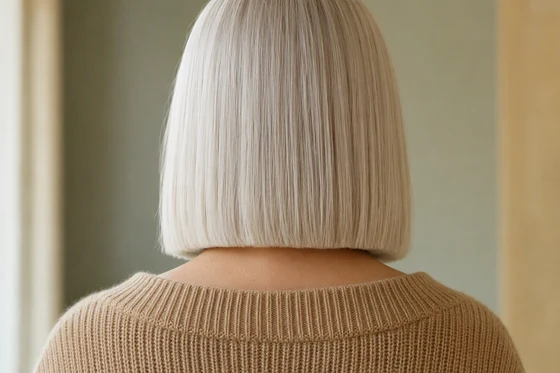
The main decision inside the lob family is the finish of the ends:
Blunt ends are cut straight across with scissors. They maximize the appearance of thickness at the hemline and photograph crisp. The cost: a blunt lob is a styled cut. Air-dried, the hard line shows every kink and flip, so it wants a quick round-brush pass or a flat-iron bend most days.
Soft or point-cut ends are the same silhouette with the last half inch texturized. You give up a little of the density effect and gain forgiveness: the perimeter tolerates air-drying and second-day sleep marks.
Who the lob serves best: fine-to-medium hair that is straight or barely wavy, and anyone whose main complaint is “my ends look thin.” Who should skip it: thick or coarse hair, which turns a one-length lob into a heavy triangle, and strong curl, which will not hold the flat perimeter at all. If your hair is dense, you want the next family.
A note on gray: the lob’s clean line pairs unusually well with a defined gray grow-out or a full silver, because the simplicity of the shape lets the color read as the design choice it is.
Where should layers start in a layered mid-length cut?
Answer first: the finer your hair, the lower and fewer the layers. For fine hair, the shortest interior layer should start below the occipital bone (the bump at the back of your skull), leaving the top layer long enough to cover and support the ends. For medium density, layers can start around jaw level. Only thick hair earns crown-high layering, because only thick hair has density to spare.
The reason is arithmetic. Every layer removes hair from the perimeter and relocates the ends higher up. On thick hair this is the whole point: layers debulk the interior so the shape stops ballooning and starts moving. On fine hair, aggressive layering strips the hemline until it looks stringy, which is how “layers thin my hair out” became a common complaint. The layers were not wrong; the starting height was convention.
Face-framing is the second lever, and it is independent of interior layering. A face frame is the short-to-long angle cut around the front hairline, typically starting between the cheekbone and the jaw. It does three things: creates movement where people actually look, breaks up a heavy perimeter near the face, and gives half-up styles their loose front pieces. Cheekbone-length framing emphasizes the eyes and cheeks; jaw-length framing emphasizes the jawline and is more conservative. If you wear glasses, start the frame at or below the frame line of the glasses so the two do not fight.
Who this family serves: almost everyone, which is why it is the default. It is the most adjustable cut on this page: the same “layered mid-length” ticket can be tuned from nearly-blunt to nearly-shag by moving two numbers, layer height and amount of face frame.
Is the midi shag worth the styling cost?
If your hair has any natural wave, yes, and the styling cost is lower than its reputation. If your hair is pin-straight and fine, mostly no, because the shag’s shape depends on texture the cut cannot create alone.
The midi shag is heavy layering worn on purpose: short crown layers, visible steps, a bit of undone fringe or curtain bangs, ends left airy. Where the layered mid-length keeps its interior work discreet, the shag displays it. On wavy hair the short crown layers do the lifting for you, since less length at the crown means the wave springs up instead of pulling flat. This is why the shag is the strongest volume cut on this page for fine-but-wavy hair.
The honest cost accounting:
- Daily styling: low. A shag on wavy hair is the best air-dry cut in the medium range. Damp hair, a texture or curl cream, scrunch, leave it alone.
- Product: moderate. The cut assumes some product defining the texture; without it, layered fine hair can look flyaway.
- Maintenance: high. The shape lives in the layer proportions, so it needs trims every 6 to 10 weeks, more often than a lob.
- Commitment: real. A grown-out shag takes months to rejoin a one-length shape. Try heavy layers on a layered mid-length first if you are unsure.
On straight hair, a shag needs a curling wand or hot rollers to produce the bend the cut is designed around. That is a fine trade if you enjoy styling; it is the wrong cut if you do not.
How does medium length work with curls?
Well, provided the cut is designed for the dry curl, not the wet length. Curl pattern varies enormously between individuals, enough that researchers use an eight-type classification just to describe it [5], and the single biggest planning fact is shrinkage: curly hair dries 20 to 50 percent shorter than it hangs wet. A “collarbone” cut measured wet can sit at the chin dry.
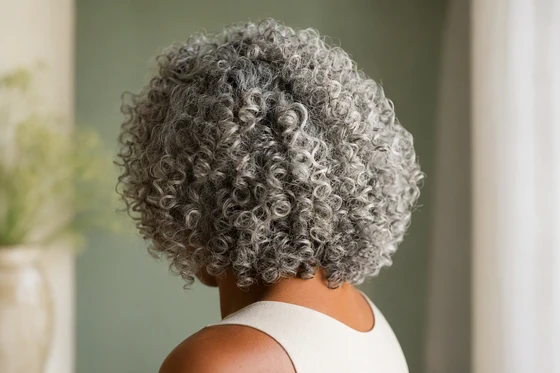
Practical rules for a curly medium:
- Ask for a dry cut, or a stylist who cuts curl-by-curl. Cutting curls wet and straight guarantees surprise length and uneven spring convention.
- Shape is rounded, not flat. A curly medium is layered into a soft rounded silhouette or a gentle triangle. Chasing a blunt lob line in curly hair means daily heat straightening, which is a different (and more expensive) style.
- Gray curls often behave differently. Many women find texture changes alongside pigment loss as fibers age [2]; if your curl has loosened or coarsened, bring that up in the consultation rather than asking for your 40-year-old cut back.
- Length buys definition. Very short curls can go fluffy; at collarbone length there is enough weight for curls to clump and spiral, while still short enough to lift at the root.
Styling is the wash-day model: cleanse, condition heavily, apply leave-in and gel or cream to soaking-wet hair, scrunch, then air-dry or diffuse. Between washes, refresh with water and a little product rather than restyling from scratch.
Which medium cut fits your hair?
One table, five common situations. Density and texture drive the choice; the last column is the sentence to open your consultation with.
| Your hair | Best family | First thing to tell your stylist |
|---|---|---|
| Fine and straight | Lob, blunt or softly point-cut | “Collarbone lob, keep the perimeter strong, no layers above my jaw.” |
| Fine and wavy | Midi shag or low-layered mid-length | “I want my wave doing the work: crown layers, airy ends, air-dry friendly.” |
| Thick or coarse | Layered mid-length | “Debulk the interior so it moves, but keep the perimeter looking full.” |
| Curly | Curly medium, rounded layers | “Cut it dry, plan for shrinkage, I want it at my collarbone when dry.” |
| Lowest maintenance | Soft-ended lob or soft shag | “It has to work air-dried with five minutes and one product.” |
If you sit between rows, start from the lower-maintenance option; it is easier to add layers at the next appointment than to wait out layers you regret.
How do you style a medium cut without a daily blowout?
Build the week around air-drying and spend heat deliberately. The lab data backs the instinct: dryer damage to the hair surface increases with temperature, and researchers found the least damaging machine-dry was a dryer kept moving about 15 cm from the hair at moderate heat, around 47°C, rather than close-up high heat research-backed [3]. Fine or gray fiber has less cuticle to lose, so a heat budget matters more now, not less.
A workable split:
Air-dry days (most days). Rough-towel gently, apply one styler (cream for smoothing, mousse for lift, curl cream for texture), part it where it lives, and leave it alone until fully dry. Touching hair mid-dry creates frizz. Shags and soft-ended cuts excel here; blunt lobs tolerate it if you accept a relaxed finish.
Round-brush reality. A full salon blowout at home is a skill most people never need. The achievable version takes eight minutes: air-dry to 80 percent, then round-brush only the top layer and the face frame, with the dryer on medium pointing down the shaft. The underneath does not show; stop styling it.
Heat-tool days (one or two a week). A 32 mm to 38 mm wand or iron puts a bend in a lob or refreshes a shag in five minutes. Always on dry hair, always with heat protectant, and at the lowest temperature that holds, not the maximum the tool offers.
Second-day rescue. Dry shampoo at the root, one face-framing piece re-bent, done. Medium length also unlocks the honest backup plan short hair lacks: a low ponytail or the half-claw-clip.
What if you are between lengths?
Medium is also the range everyone passes through, in both directions, so it pays to treat it as a real destination rather than a corridor.
Growing up from short: hair gains roughly half an inch a month, with wide individual variation [4], so the trip from a pixie to a collarbone lob takes a year or more. The way to keep that year deliberate is scheduled small trims that shape each stage: crop to layered bob to lob. If you are still deciding whether to grow at all, our guide to short hairstyles for women over 50 makes the case for staying short.
Coming down from long: cut in stages only if you are genuinely unsure. If you already know long lengths are pulling your hair flat, a single decisive cut to the collarbone gives you the full effect immediately, and the removed weight often reveals wave you forgot you had.
What should you say in the consultation?
Bring function words, not decade words. “Something appropriate for my age” hands the stylist a guess; these hand them a spec:
- “My priority is volume at the crown; my ends can be soft, but nothing above the jaw gets layered.”
- “I air-dry five days a week. Show me what this cut looks like with zero heat.”
- “I’m growing my gray out and I want the cut to make the line look intentional.”
- “My hair is finer than it was five years ago. What would you change from a standard lob for that?”
- “I need it to go into a ponytail. Do not cut the front shorter than my chin.”
A stylist who responds to those sentences with follow-up questions is the one you want. For the full pre-appointment script, photos to bring, and the questions worth asking back, use our salon consultation checklist, and browse the rest of the series in the over-50 hub.
The summary is short. Medium length after 50 is not the safe middle; it is the range with the most working options. Pick the lob for a strong perimeter on finer straight hair, the layered mid-length as the adjustable default, the midi shag to let wave do the lifting, and a dry-cut rounded shape for curls. Then spend your effort where it shows: the top layer, the face frame, and a stylist who talks in specifics.
Frequently asked questions
What counts as medium-length hair?
Anything from the collarbone to an inch or two past the shoulder. Chin-length and above reads as short; past the shoulder blade reads as long. The useful landmark is the collarbone: at or just below it, hair is long enough to tie back but short enough to hold shape without heavy styling.
Is shoulder-length hair aging?
The length does nothing on its own; the shape does everything. Hair fiber gets finer through the 50s, so a cut that carries too much unbroken weight pulls flat at the crown and drags the whole silhouette down. Remove that weight with a lob, layers or a shag and the same length reads current on anyone. Judge the cut by what it does for your density, not by a number.
What is the difference between a lob and a bob?
Length. A bob sits between the jaw and the chin; a lob (long bob) sits at or just below the collarbone. The lob keeps the bob's clean perimeter but leaves enough length for a low ponytail, waves and half-up styles, which a true bob cannot do.
Are layers or one length better for thinning hair?
It depends where the thinning is. If the ends look sparse, a blunter one-length perimeter makes the baseline look denser. If the crown is flat but the ends are fine anyway, a few internal layers restore lift. Many stylists split the difference: blunt perimeter, two or three invisible layers through the crown only.
Does medium length work with curly hair?
Yes, but cut for the curl, not the wet length. Curls shrink 20 to 50 percent as they dry, so a cut that hits mid-back wet can sit at the shoulder dry. Ask for a dry cut or a stylist who compensates for shrinkage, and expect the shape to be a soft triangle or rounded layers rather than a flat lob line.
Which medium cuts can air-dry well?
The midi shag and any layered cut with soft, point-cut ends. Blunt lobs are the worst air-dry candidates because the straight perimeter shows every kink. If you want a wash-and-wear week, tell your stylist the cut must work with your natural texture and no more than five minutes of styling.
What half-up styles work at medium length?
The half-claw-clip (top third twisted back into a small claw), a half-up with a soft tuck at the crown for lift, and face-framing pieces left loose around a low half-knot. Medium length is the minimum for all three, which is one of its main advantages over short cuts.
How often does a medium-length cut need a trim?
Every 8 to 12 weeks for lobs and layered cuts, every 6 to 10 for a shag, because the shape depends on the interior layers staying proportioned. Hair grows about half an inch a month, so a 12-week gap moves a collarbone lob to the shoulder: still medium, but a different cut.
Can I grow a pixie or short crop into a medium cut without an awkward stage?
Not entirely, but you can shorten it. The route is: keep the nape and sides trimmed while the top grows, transition through a layered bob, then let the perimeter drop to the collarbone. Regular small trims during the grow-out sound counterproductive but keep the shape deliberate at every stage.
- Robbins C, Mirmirani P, Messenger AG, et al. What women want: quantifying the perception of hair amount, an analysis of hair diameter and density changes with age in Caucasian women. Br J Dermatol. 2012;167(2):324-332.
- Trüeb RM. Aging of hair. J Cosmet Dermatol. 2005;4(2):60-72.
- Lee Y, Kim YD, Hyun HJ, et al. Hair shaft damage from heat and drying time of hair dryer. Ann Dermatol. 2011;23(4):455-462.
- Loussouarn G, El Rawadi C, Genain G. Diversity of hair growth profiles. Int J Dermatol. 2005;44 Suppl 1:6-9.
- Loussouarn G, Garcel AL, Lozano I, et al. Worldwide diversity of hair curliness: a new method of assessment. Int J Dermatol. 2007;46 Suppl 1:2-6.