Cuts by face shape
The Bixie: The Bob-Pixie Hybrid, and Whether You Should Get One
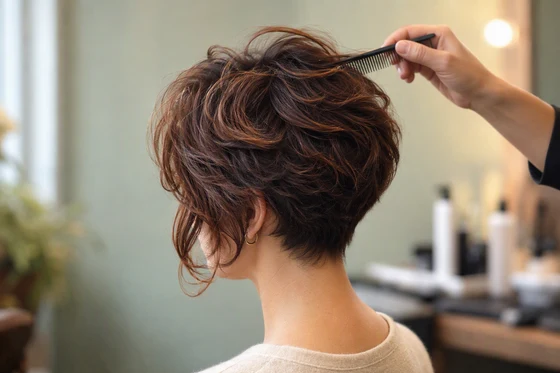
A bixie is a hybrid haircut that pairs pixie-short back and sides with bob-length hair, roughly three to five inches, through the top and crown, so it reads shorter than a bob but fuller and softer than a pixie. It suits fine and medium hair especially well because the crown layers create lift that longer cuts pull flat, and it is the standard vehicle for growing a pixie out into a bob. Expect 5 to 10 styling minutes a day and a trim every 5 to 7 weeks, because the shape depends on a short-to-long gradient that grows out fast.

Somewhere between the pixie you are not quite brave enough for and the bob you are slightly bored of sits a cut with a silly name and a serious design. The bixie, pixie-short in the back, bob-length on top, is the fastest-growing haircut search in the United States right now, and unusually for a trending cut, the demand is coming from two opposite directions at once: people easing into short hair, and people growing short hair out. This guide defines the cut precisely, puts it side by side with the pixie, bob, and shag, and prices its upkeep honestly, in minutes, weeks, and dollars.
What exactly is a bixie?
Most trend coverage defines the bixie by vibe: a bob-pixie hybrid, edgy but soft, short but not too short [3][4]. That is true and useless in a salon chair. Here is the specification.
A bixie has three zones cut to different jobs:
The nape and sides are pixie territory. The back is cropped short, usually 1 to 2 inches at the nape, tapering or softly stacked so the neck is visible. The sides are short enough to expose or half-expose the ear. This zone is what makes the cut read as short from behind.
The top and crown are bob territory. Through the crown and top, lengths run roughly 3 to 5 inches, cut in choppy, disconnected-looking layers that stack on top of each other. This is where the cut’s volume lives, and it is the single biggest difference from a pixie, which crops this zone to an inch or two.
The face frame splits the difference. Front pieces are left longest, anywhere from cheekbone to jaw, sometimes with a curtain fringe [3]. They tuck behind the ear, move when you turn your head, and are the reason a bixie photographs like a bob from the front and a pixie from the back.
Put differently: a bob concentrates its weight in one perimeter line at or below the jaw, a pixie removes weight almost everywhere, and a bixie redistributes the weight to the crown. There is no hard weight line, which is why the cut reads soft, and the silhouette is a gradient from cropped nape to full crown, which, as we will get to, is also why it grows out fast.
If you are comparing this against the bob family proper, the weight-line logic is unpacked in our bob comparison guide; the bixie is essentially what happens when you take a bob’s top and a pixie’s bottom and cut the transition between them.
Why is the bixie suddenly everywhere?
The numbers first, because they are unusual. Search interest in the bixie is up roughly 122% year over year, at around 110,000 US searches a month, with six-month growth over 300%, which makes it the fastest-rising named haircut in current trend data [1]. Editorial coverage has followed the same curve: fashion press has called it the short cut positioned to dominate 2026, with Gracie Abrams, Jessie Buckley, Zendaya, Kristen Stewart, and Florence Pugh among the names attached to versions of it [2][3].
Celebrity adoption explains the spike’s timing but not its size. The size comes from the cut’s position in the decision landscape. Short-hair conversions fail on commitment: the distance between a lob and a pixie is enormous, and cutting past the point of no return is the single most cited fear in the chair. The bixie is the missing rung on that ladder. It delivers most of a pixie’s payoff, the lightness, the exposed neck, the five-minute mornings, while keeping enough length on top to part, tuck, wave, and, crucially, retreat from. If you hate it, you are four months from a bob, not a year.
The same geometry works in reverse, which is the half of the demand most coverage misses: the bixie is the standard vehicle for growing a pixie out, and every pixie eventually gets grown out. A cut that serves both directions of traffic between the two most popular short-hair categories was always going to have a large addressable market. The name is new; the position was waiting.
The cut also has history, which is worth knowing so you can calibrate the references: the shape is a direct descendant of the choppy 1990s crops worn by Meg Ryan and Gwyneth Paltrow, revived in sharper form through the 2020s and renamed [3]. When your stylist says ”90s layered crop,” you are talking about the same cut.
Bixie vs pixie vs bob vs shag: what actually differs?
These four get tangled together in coverage because they share DNA: layers, texture, movement. The differences are structural, and they determine everything downstream: styling time, trim cadence, and what your hair needs to be for the cut to work.
| Pixie | Bixie | Bob | Shag | |
|---|---|---|---|---|
| Overall length | 0.5 to 3 in | Nape 1 to 2 in, crown 3 to 5 in | Jaw to collarbone | Chin to past shoulder |
| Weight placement | Almost none, minimal crown weight | Redistributed to crown and top | One perimeter line at the ends | Broken up through heavy layering |
| Ears and neck | Fully exposed | Neck exposed, ears tuckable | Covered | Covered |
| Can it tuck behind the ear? | No | Yes, front pieces | Yes | Yes |
| Ponytail possible? | No | No | Usually at lob length | Yes |
| Daily styling | 3 to 5 min | 5 to 10 min | 5 to 20 min depending on version | 5 to 10 min |
| Trim interval | 4 to 6 weeks | 5 to 7 weeks | 4 to 10 weeks by version | 8 to 10 weeks |
| Grow-out behavior | Awkward fast, mullet risk at the nape | Grows into a layered bob | Grows into a longer bob or lob | Most forgiving on this list |
| Best-case hair | Fine to medium, straight to wavy | Fine to medium, straight to curly with the right cutting | Varies by version | Wavy to curly, medium to thick |
Three readings of that table are worth making explicit.
The bixie is the only cut on the list that is short and reversible. The pixie is shorter but locks you in; the bob and shag preserve options but are not meaningfully short. If the question you are actually asking is “how short can I go and still change my mind by spring,” the bixie is the answer, and no other named cut currently occupies that slot.
The bixie trades the pixie’s crispness for insurance. A great pixie is architectural: it holds a sculpted shape with almost no styling. The bixie’s crown layers need a minute of deliberate lift and a texturizing product or they can read as simply unbrushed. You pay two to five extra minutes a morning for the extra length and the exit route.
The shag is the better cut if your real goal is texture with length. A bixie on someone who wants to keep shoulder-grazing hair is just a shag cut too short. The bixie’s argument only lands if you want the back of your neck bare.
Who does the bixie serve best?
Every cut has a constituency it flatters by convention and a constituency it serves by mechanics. The bixie’s mechanical case is strongest for two overlapping groups: fine hair, and hair past midlife, which is usually the same conversation.

The biology is measurable. Scalp hair density declines steadily from the twenties onward, and individual strand diameter rises to a peak around the mid-forties and then declines, so by the fifties most women are working with both fewer hairs and finer ones research-backed [5]. Clinically detectable female pattern hair loss follows the same slope: present in roughly 6% of women under 50 but approaching 40% of women over 70, concentrated at the crown and part line [6]. None of this is a problem to be hidden; it is a set of engineering constraints, and cuts either respect them or fight them.
The bixie respects them three ways.
It removes hanging weight. Fine strands bend under the weight of their own length: a fine-haired lob lies flat against the skull because the mass below the shoulders is pulling the roots down. Crop the lengths to bixie proportions and that load disappears, so whatever lift the roots can generate, they keep. This is the same physics that makes short cuts the standing recommendation for thin and fine hair generally; the bixie just executes it with more length on top than a pixie allows.
It stacks its volume exactly where density loss shows. The crown and part line are where thinning becomes visible first [6], and the crown is precisely where the bixie concentrates its layered mass. Layer stacked on layer at 3 to 4 inches creates occlusion: you see hair on top of hair rather than scalp through hair. A one-length bob does the opposite, pulling everything down and splitting flat at the part.
Its styling budget is honest. Five to ten minutes is a schedule most people actually keep, which matters because a cut that needs twenty minutes to look intentional gets worn unintentional most days.
This is why the bixie appears so consistently in over-50 short-hair editorial, and why stylist convention treats it as a first recommendation for that chair conversation. If you are weighing it against the crop, the stacked bob, and the other short options in that category, our short hairstyles for women over 50 guide puts them side by side, and the broader over-50 guide covers the length question from scratch.
Who does it serve least? Very thick, very straight hair, which can read as a helmet at these lengths unless the stylist debulks the interior aggressively, and anyone whose non-negotiables include a ponytail. And one honest note on face shape: convention favors the bixie for round and oval faces because the crown volume adds height, and cautions that fuller cheek-level face-framing can add width where a round face is already widest convention. Treat that as geometry to discuss in the chair, not a rule.
How does the bixie behave on your texture?
The bixie is unusually texture-tolerant for a short cut, but “tolerant” means the cutting has to change with the texture, not that one cut fits all [3][4].
Straight, fine to medium. The core constituency. The cut works, but the crown lift is manufactured, not natural: rough-dry, then a small round brush or a few fingers-and-dryer passes at the crown, then a light texture paste or powder. Eight to ten minutes. Skip the lift step and the cut still looks tidy, just flatter and more pixie-adjacent.
Wavy. The best-case texture. A 2A to 2C wave hits bixie lengths and bends exactly where the layers want movement, so styling collapses to rough-drying with a texturizing spray and scrunching. Five minutes, often less. If your wave has been fighting the weight of long hair for years, this cut is where it finally shows up to work.
Curly. Genuinely good, with one hard requirement: the cut must be done dry or curl by curl, because shrinkage of 30 to 50% means a crown cut to four inches wet can sit at two inches dry, which turns a planned bixie into an accidental pixie. Cut correctly, the curly bixie is self-styling: curl cream, air-dry or diffuse, done.
Coily. The bixie’s logic translates as a tapered shape: close-cut nape and sides, maximum length and shape retention at the crown. Ask for the cut on stretched or blown-out hair so the lengths are predictable, and expect the styling conversation to be about hydration and definition products rather than lift, which coily texture supplies on its own.
Thick hair of any pattern. Possible, but the interior must be debulked with point-cutting or careful thinning, or the crown layers stack into a mushroom silhouette by week three. This is the texture where stylist skill matters most; it is also the texture most likely to be happier in a shag or a longer layered bob instead.
What does a bixie honestly cost to live with?
The purchase price is ordinary: a bixie is a standard short haircut, $50 to $120 at a mid-range US salon, more in major metros, and the first cut is worth booking with someone experienced in short layering because the whole design is in the transitions.
The recurring costs are where you should look before committing.
Trims: every 5 to 7 weeks, non-negotiable if you want it to stay a bixie. Scalp hair grows about a centimeter a month, roughly half an inch research-backed [7], and the bixie’s silhouette is nothing but a calibrated gap between a 1-inch nape and a 4-inch crown. Six weeks of growth adds most of an inch everywhere, which shrinks that gap proportionally more than it would change any longer cut: the nape fuzzes over the neckline, the crown layers drop and separate, and the shape’s whole argument, short but full, goes quiet. Industry guidance clusters at 4 to 6 weeks [4]; 5 to 7 is realistic if you tolerate a soft week at the end. This is the cut’s real price. At 7 to 9 visits a year, annual upkeep runs roughly $350 to $1,100 before tips.
Mornings: 5 to 10 minutes, honestly. Detailed by texture above. The pixie beats it by a few minutes; everything longer loses to it.
Products: minimal but not zero. One texturizer (paste, powder, or spray) and a heat protectant if you use a dryer [4]. The cut does not need the arsenal a blowout-dependent bob needs.
The hidden cost is decision fatigue in reverse. Because the bixie loses definition fast, weeks 6 through 8 will repeatedly ask you a question: trim back to crisp, or let it run? Know your answer before you start, because drifting is how people end up with a shape nobody chose.
If you want to see the shape on your own head before spending any of the above, AI try-on tools handle short layered cuts like this reasonably well, and a preview is cheaper than a regret at these lengths.
Is the bixie the smartest way to grow out a pixie?
Yes, and this section is the most useful thing on this page if you currently have a pixie you are done with.
Growing out a pixie fails in a predictable place. All zones of a pixie grow at the same rate, about a centimeter a month [7], but they start from different lengths and have different jobs. The nape and sides hit “shaggy” within six weeks. The top takes months to reach a length that reads as intentional. Left unmanaged, the back wins the race and you spend half a year in an accidental mullet, which is precisely the stage that sends people back to the chair to crop it all off and start over. The grow-out does not fail from slowness; it fails from shapelessness.
The bixie solves this by inverting which zones you let run. The protocol:
Months 0 to 3: hold the back, release the top. Book trims every 5 to 6 weeks, but only the nape, the sides, and the perimeter get cut. The top and crown grow untouched. Around month three, the top hits 3 to 4 inches and you are wearing a deliberate bixie rather than a growing pixie. Total hair sacrificed: almost none that mattered.
Months 3 to 6: live in the bixie. This is the stage’s payoff: it is not an awkward phase, it is a destination cut that happens to be en route. Keep the same trim cadence, keep the crown layered so it stacks rather than flops, and start letting the sides catch up toward the ear.
Months 6 to 10: release the back. Once the top clears roughly 5 inches, stop cropping the nape and let the back grow into a stacked, then graduated, bob shape. The gradient that defined the bixie gradually flattens into a bob’s perimeter. Somewhere around month 9 or 10 you have a jaw-length layered bob by every definition, grown with zero months of shapelessness.
The arithmetic is worth internalizing: pixie to bob is 4 to 5 inches of growth at the front, which at half an inch a month is 8 to 10 months no matter what you do. The bixie does not shorten that timeline. What it does is make every week of it a haircut you chose. Evidence on growth rates is solid research-backed [7]; the staging protocol itself is stylist convention, refined by repetition rather than studied, but it is as close to consensus as the industry gets.
Two practical notes. First, tell your stylist on day one that the pixie is being grown out via a bixie; the cutting changes immediately, because a maintenance pixie trim and a grow-out trim remove hair from opposite places. Second, budget for the trims. “Growing it out” sounds free; done well, it costs the same 7 or 8 visits a year as keeping it short. The visits are buying shape, not length.
How do you ask for a bixie at the salon?
“Bixie” is now common salon vocabulary, but names drift, and a cut this dependent on proportions deserves numbers. Screenshot whichever script fits.
The standard bixie:
“I want a bixie: pixie-short at the back, bob energy on top. Nape and back cropped to about an inch and a half, sides short enough to tuck but covering the top of my ear, and three to four inches through the crown and top in choppy, stacked layers. Leave the face-framing pieces longest, around cheekbone length. I want the volume at the crown, not the ends.”
The fine-hair or over-50 version:
“Same shape, but protect my density: keep the perimeter ends blunt rather than heavily texturized, no razor on the ends, and build the layering at the crown where I want the fullness. I’d rather it read slightly fuller than slightly edgier.”
The pixie grow-out version:
“I’m growing my pixie out into a bob and I want to stage it through a bixie. Today, trim only the nape, sides, and perimeter; do not touch the top or crown. I’ll come back every five to six weeks and we’ll keep the back tight until the top reaches about five inches, then start letting the back grow.”
The curly version:
“Cut it dry, or curl by curl. I want a bixie silhouette after shrinkage: cropped nape, real length and shape at the crown. Cut the crown so it sits at three to four inches as it dries curly, not as it stretches wet.”
If the stylist’s response to any of these is to talk you into a shag or a full pixie instead, listen to the reasoning: on your texture or density they may be right, and the comparison table above is exactly the conversation you should have out loud. And if you are still deciding whether this cut is even the right family, our decision guide walks the whole tree from the top.
The bottom line
The bixie is a precisely engineered compromise: pixie-short where short hair pays off, at the nape and neckline, bob-length where insurance pays off, at the crown and face frame. Its strongest constituencies are fine hair and post-midlife hair, where the physics of removed weight and stacked crown volume do real, measurable work, and anyone traveling in either direction between a pixie and a bob. Its honest costs are a 5-to-7-week trim cadence that does not forgive procrastination, and a few more styling minutes than the pixie it resembles from behind. If you want the shortest cut you can still walk back from, this is currently the best answer the industry has.
Frequently asked questions
What is the difference between a bixie and a pixie?
Length on top and around the face. A pixie is short everywhere, usually half an inch to two inches, with the ears and neck fully exposed. A bixie keeps the pixie's cropped back and sides but leaves three to five inches through the top and crown, with face-framing pieces that can reach the cheekbone or jaw, so it moves, tucks, and parts like a very short bob rather than a crop.
Is a bixie a good haircut for women over 50?
It is one of the strongest candidates, for mechanical rather than fashion reasons. Hair strand diameter and density both decline measurably from midlife onward, and a bixie removes the hanging weight that pulls thinner hair flat while stacking its layers at the crown, where volume loss shows first. It also styles in 5 to 10 minutes, which is a realistic daily budget rather than an aspirational one.
Does a bixie work on fine or thinning hair?
Yes, and it is arguably the cut's best use case. Short lengths carry almost no weight, so fine hair holds root lift instead of collapsing, and the stacked crown layers create the appearance of density where it is most visible. The one caution: ask your stylist to keep the perimeter ends fairly blunt rather than heavily razored, because aggressive texturizing spends end density that fine hair cannot afford.
Is a bixie a good way to grow out a pixie?
It is the standard route, and most stylists will steer you onto it whether or not anyone says the word bixie. Growing out a pixie fails at the back, where the nape outpaces the top and drifts toward a mullet. The bixie inverts that: you keep the nape and sides trimmed while the top and crown grow, so every stage looks deliberate, then release the back in the final months as the top approaches bob length.
How often does a bixie need a trim?
Every 5 to 7 weeks. The cut's entire silhouette is a gradient from a cropped nape to a longer crown, and scalp hair grows about a centimeter a month, so the gradient flattens quickly: the nape fuzzes out and the crown layers drop and separate. Push past 8 weeks and it stops reading as a bixie and starts reading as a grow-out, which is fine only if a grow-out is what you want.
Can you get a bixie with curly hair?
Yes, but insist on a stylist who cuts curls dry or curl by curl. Curl shrinkage means a crown cut to four inches wet can spring up to two, so the shape has to be cut where the curl actually sits. Done well, a curly bixie is one of the lowest-effort versions, because the texture the cut wants is already growing out of your head.
How long does a bixie take to style in the morning?
Five to ten minutes for most straight and wavy hair: rough-dry, a little lift at the crown with fingers or a small round brush, a texturizing product worked through the layers. Very straight, very fine hair sits at the top of that range because the crown lift has to be built with a dryer. Curly versions can air-dry with a curl cream in under five minutes or diffuse in about fifteen.
Can you tuck a bixie behind your ears or tie it back?
Tuck yes, tie no. The face-framing pieces and the longer crown of most bixies reach the ear, so the front tucks cleanly, which is a genuine daily convenience a true pixie cannot offer. A full ponytail is out of reach until the cut has grown well into bob territory, so if tying your hair back is non-negotiable, a bixie is not your cut yet.
- Rising Trends. Top Haircare Trends in 2026 (Backed by Data). RisingTrends.co. 2026.
- Who What Wear beauty desk. The Bixie Is the A-List Haircut Set to Dominate 2026. WhoWhatWear.com. 2026.
- Bangstyle editorial. Why the Bixie Haircut Trend Should Be on Your Radar. Bangstyle. 2026.
- John Frieda editorial team. Guide to Bixie Cuts: The Best Bixie Trends. JohnFrieda.com. 2025.
- Robbins C, Mirmirani P, Messenger AG, Birch MP, et al. What women want: quantifying the perception of hair amount, an analysis of hair diameter and density changes with age in Caucasian women. British Journal of Dermatology. 2012;167(2):324-332.
- Birch MP, Messenger JF, Messenger AG. Hair density, hair diameter and the prevalence of female pattern hair loss. British Journal of Dermatology. 2001;144(2):297-304.
- LeBeau MA, Montgomery MA, Brewer JD. The role of variations in growth rate and sample collection on interpreting results of segmental analyses of hair. Forensic Science International. 2011;210(1-3):110-116.